










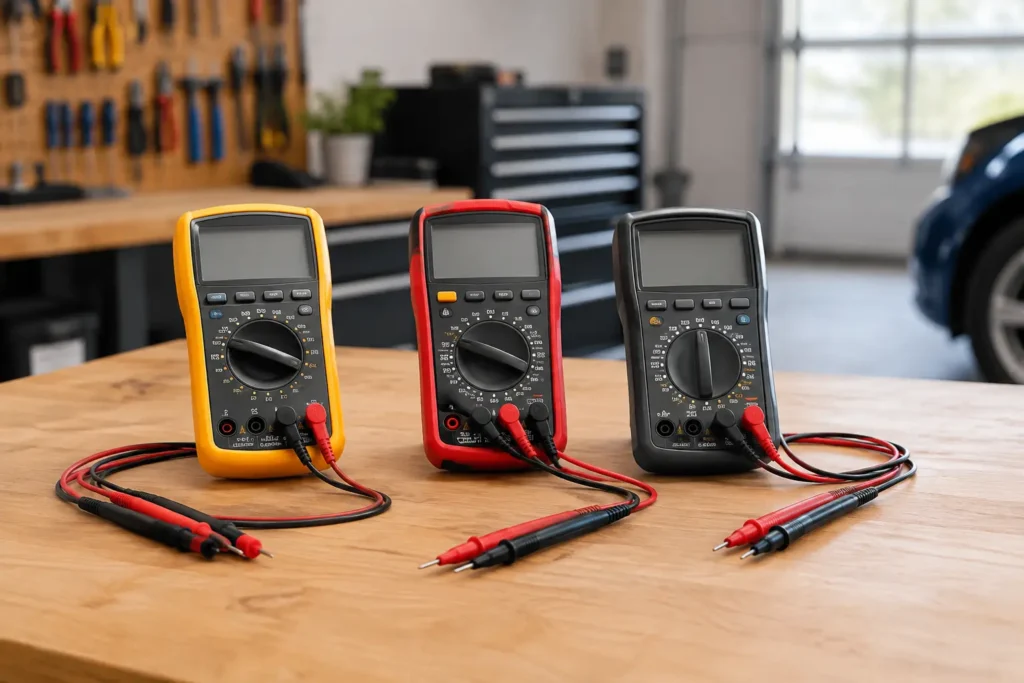
A digital multimeter comparison should start with the jobs on your bench, not the biggest number printed on the box. A mechanic tracing a parasitic battery drain needs a different meter from an electrician checking mains circuits, and a DIYer testing a trailer plug does not need to pay for functions they will never use. The right meter saves diagnostic time, protects the vehicle or installation, and earns its place in the toolbox.
For most garages, a dependable auto-ranging digital multimeter with proper fused current inputs, a backlit display and automotive-friendly functions is the sensible starting point. Buy for accuracy and safety first. Extra features only matter when they make a real fault easier to find.
Large Digital Universal Multimeter | LCD Display | ROHS Compliant
Digital Multimeter Comparison: What Actually Matters
Digital multimeters measure voltage, resistance and current. Most also check continuity and diode condition. That basic set covers a large share of workshop electrical work: confirming battery voltage, checking charging systems, testing fuses, finding broken wires, proving earth connections and checking sensors.
The comparison becomes more useful when you look beyond the advertised number of functions. Build quality, input protection, display response and the condition of the supplied leads can have a bigger effect on day-to-day use than an extra measurement mode.
Voltage range and accuracy
A standard 12V vehicle battery should read roughly 12.6V when fully charged and rested. With the engine running, a conventional charging system will commonly sit around 13.8V to 14.7V, depending on vehicle design and conditions. A meter that is accurate in low-voltage DC ranges helps you see meaningful differences rather than just confirming that some voltage exists.
For garage use, choose a meter that reads DC and AC voltage clearly and has a useful low-voltage resolution. A display resolving to 0.01V on a suitable DC range is practical for battery and charging checks. Do not confuse resolution with accuracy, however. Resolution is how many digits the screen shows; accuracy is how close the reading is to the true value.
Auto-ranging meters select the correct range themselves. They are quicker for general work and reduce the chance of selecting an unsuitable setting. Manual-ranging meters can still be accurate and affordable, but they take longer when you are moving between circuits. For a busy workshop, auto-ranging is usually worth having.
Current measurement and fuse protection
Current testing is where many multimeters are damaged. Voltage is measured across a circuit. Current is measured in series with it. Put the leads in the current sockets and touch them across a battery or powered supply, and you can blow the meter fuse, damage the meter or create a dangerous spark.
A useful automotive meter should have separate, clearly marked current terminals and proper internal fuses. Look for a milliamp input for low-current work such as parasitic drain testing, plus a higher-amperage input for short-duration checks. Read the maximum current rating and duty limit before use. Many handheld meters can only measure high current for a few seconds before overheating becomes a risk.
For starter motors, glow plugs, alternator output and other high-current circuits, use a DC clamp meter rather than routing heavy current through a standard multimeter. A clamp meter measures current around a cable without disconnecting it. It is faster, safer and better suited to high-load automotive diagnostics.
Continuity, resistance and diode test
Continuity testing is one of the most-used functions in a garage. A good meter gives a quick, audible beep when resistance is low, allowing you to check wiring while keeping your eyes on the vehicle. Slow continuity response is frustrating when tracing harness faults, testing switches or checking earth straps.
Resistance mode is useful for checking components and circuits with the power isolated. It can help identify open circuits, poor connections and resistive faults. The important rule is simple: never measure resistance on a live circuit. Disconnect the power source where possible and allow capacitors to discharge before testing.
Diode mode is valuable for checking conventional diodes and can assist with basic alternator rectifier checks. It is not a substitute for full charging-system diagnosis, but it can quickly point to a component that needs closer inspection.
Automotive functions worth paying for
Not every feature belongs on every meter. For automotive technicians and serious DIY users, the functions below can justify a modest step up in price:
- Temperature measurement helps with coolant, air-conditioning, heating and general workshop checks when a compatible probe is included.
- Frequency and duty cycle are useful for sensors, injectors, solenoids and pulse-width-modulated circuits.
- Capacitance can assist with checking certain electrical components, although results in-circuit can be misleading.
- Min/max capture records changing readings, useful when an intermittent voltage drop occurs during cranking or when a sensor signal fluctuates.
- True RMS AC measurement provides better readings on non-sinusoidal AC waveforms. It is more relevant for mains, inverters and variable-speed equipment than for routine 12V checks.
A non-contact voltage detector can be handy around mains wiring, but treat it as an initial indication only. It should never be the sole method used to prove a circuit is dead.
Match the Meter to the Job
Everyday DIY and vehicle maintenance
For battery checks, fuse testing, trailer wiring, bulbs, basic continuity and 12V accessory fitting, an entry-level auto-ranging meter is normally enough. Prioritise a clear display, a protective rubber holster, reliable test leads and a sensible warranty over a long list of obscure modes.
A cheap meter can be false economy if its leads are thin, its rotary switch is loose or its continuity function is slow. A basic meter that survives being carried around the garage is better value than a feature-heavy unit that cannot stand regular use.
Independent garages and mobile mechanics
Daily diagnostic work calls for a tougher unit with better leads, backlighting, fast continuity and dependable low-voltage accuracy. Min/max capture and duty-cycle measurement make sense here, as does a stand or magnetic hanger for hands-free testing.
Consider buying a separate clamp meter for higher-current work rather than expecting one handheld meter to cover every task. This two-tool setup is often more practical and more affordable than chasing one expensive all-in-one model.
Mains, workshop equipment and mixed trade work
If you test mains-fed compressors, chargers, welders, lighting circuits or power tools, safety ratings need more attention. Look for a meter with an appropriate CAT rating for the circuits you work on. CAT ratings relate to the level of transient overvoltage a meter is designed to withstand, not simply its maximum voltage reading.
For general work on equipment supplied from building wiring, a properly rated CAT III meter is a sensible benchmark. The meter, leads and probes should all be appropriately rated. Never assume a high stated voltage range means the product is suitable for distribution boards or industrial equipment.
Do Not Ignore Leads, Probes and Build Quality
The test leads are the part you handle most, yet they are often overlooked in a digital multimeter comparison. Flexible silicone leads remain easier to use in cold workshops and tight engine bays. Shrouded plugs, insulated probe tips and strain relief at both ends improve safety and lifespan.
Fine probe tips are useful for back-probing automotive connectors, while crocodile clips make battery, earth and long-duration checks easier. Use proper back-probe pins where needed rather than forcing oversized probes into terminals and spreading the contacts. A damaged connector can create an intermittent fault that was not there before.
A protective holster, firm rotary selector and stable kickstand may sound minor, but they matter when the meter is used every day. A backlit screen is particularly useful under dashboards, in footwells and during winter call-outs. If the display is difficult to read at an angle, it will slow you down.
Safe Testing Habits That Protect the Meter
Before testing, inspect the leads for cuts, loose probe tips or damaged insulation. Confirm the leads are in the correct sockets and select the correct function before touching the circuit. When measuring voltage, start on a range higher than expected if you are using a manual-ranging meter.
For current testing, switch the vehicle off before breaking the circuit where possible, and understand the expected draw. On modern vehicles, do not disturb modules or open doors repeatedly during a parasitic drain test, as this can wake control units and produce misleading readings. Allow the vehicle to enter sleep mode before judging the result.
When working around ignition systems, hybrid systems or electric vehicles, follow the manufacturer procedure and use equipment rated for the task. High-voltage vehicle work is not an area for guesswork or a low-cost meter of unknown protection standard.
Getting Better Value From Your Purchase
The best buy is rarely the lowest-priced meter or the most expensive one. It is the meter that covers your regular jobs safely, has leads you can trust and will still work after months of workshop use. For most vehicle work, that means an auto-ranging unit with DC and AC voltage, resistance, continuity, diode test, fused current ranges and a backlit display. Add temperature, duty cycle and min/max capture if diagnostics are part of your weekly workload.
Irish Tools Shop customers building a practical garage toolkit should treat a multimeter as essential equipment, alongside a battery tester, quality sockets and safe lifting gear. Choose the functions you will use, keep spare fuses available, and spend a few minutes learning the current terminals before the first live test. A reliable reading at the right moment is worth far more than a crowded specification list.
