






8 Drawer Tool Box / Chest With Tools & Stainless Steel Work Top
A cheap 200-piece case can look like a bargain until the first seized bolt rounds off a socket or the ratchet slips under load. The best mechanic tool set for beginners is not the one with the biggest piece count. It is the one that covers routine vehicle work with dependable, correctly sized tools you will still use years from now.
For a first garage setup, buy coverage before novelty. Good sockets, ratchets, combination spanners and a few essential service tools will do far more work than a suitcase filled with thin screwdrivers, duplicate bits and fittings you will never touch. Start with tools built to work, then add specialist equipment when a job genuinely requires it.
4 Ton Low Profile Floor Trolley Jack with Quick Dual Pump & 3 Years Warranty
What a beginner mechanic tool set should include
For modern cars across Ireland and the UK, a metric-focused set is the sensible starting point. Most routine work involves common fasteners from 8 mm to 19 mm, with 10 mm, 13 mm, 15 mm, 16 mm, 17 mm and 18 mm appearing regularly. Imperial sizes are useful for older British vehicles, American imports, trailers and certain equipment, but they should not take priority in a first automotive kit.
A worthwhile starter set needs three drive sizes. A 1/4-inch drive ratchet handles trim fixings, small brackets, hose clips and confined engine-bay work. A 3/8-inch drive is the all-rounder for service jobs, while 1/2-inch drive provides the strength needed for wheel bolts, suspension fasteners and heavier repairs. If the kit only includes 1/4-inch drive and a small 3/8-inch selection, it will quickly feel limiting.
The core contents should cover the following:
- Metric six-point sockets in shallow and deep patterns, ideally from 4 mm or 5 mm through to at least 19 mm.
- 1/4-inch, 3/8-inch and 1/2-inch ratchets with useful extensions, universal joints and adaptor pieces.
- Combination spanners from roughly 8 mm to 19 mm.
- Hex keys, Torx bits and bit sockets for the fasteners used on current vehicles.
- A solid screwdriver set, pliers, cutters, a hammer and a tape measure.
A few extras make an immediate difference. A spark-plug socket, oil-filter removal tool, breaker bar and torque wrench are not glamour purchases, but they turn common servicing into a safer, less frustrating job. You can usually buy these separately rather than paying for an oversized kit that includes inferior versions.
35 Piece 1/2″ Square Drive Deep Impact Hex Socket Set | 78mm Long | 6 Point | Colour Coded
Choose quality where force is applied
Not every tool in a set sees the same punishment. Ratchets, sockets, spanners and breaker bars take the load, so this is where quality matters most. Look for chrome vanadium steel, a clean finish, clearly marked sizes and ratchets with a positive, fine-tooth mechanism. A decent ratchet should engage confidently rather than needing a big swing in a tight engine bay.
Six-point sockets are a better choice for beginners than relying on twelve-point sockets. They grip the flats of a bolt head more securely and are less likely to round a corroded fastener. Twelve-point designs can be useful where access is restricted, but they are not the best first choice for stubborn suspension or exhaust bolts.
Do not judge a set by polished metal alone. A well-presented case is useful for storage, yet it does not prove the tools are fit for workshop use. Check that sockets lock firmly onto the ratchet, extensions fit without excessive movement and the moulded case actually holds each piece in place. Tools loose in a case go missing quickly.
Big piece counts can be poor value
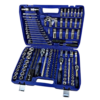
A 216-piece mechanic set and a 94-piece set may have similar real-world usefulness. The larger number can include every screwdriver bit, multiple adaptors, tiny sockets, duplicate sizes and accessories that inflate the total without helping you change brakes, service an engine or remove a wheel.
For a beginner, a properly specified 100 to 150-piece kit is often the stronger purchase. It should contain the common metric sizes in more than one drive, deep sockets for nuts on studs, extensions for awkward access and enough spanners to stop a simple job becoming a search for one missing size.
There is one exception: a larger kit is good value when the extra pieces are genuinely useful. Extra deep sockets, impact sockets, Torx bit sockets and wider spanner coverage all earn their place. The specification matters more than the number printed on the case.
Best mechanic tool set for beginners: the right drive mix
If you can only afford one serious socket set at first, choose a 3/8-inch drive metric set with deep and shallow sockets, extensions and a good ratchet. It is compact enough for engine work yet capable enough for many under-bonnet and interior jobs.
However, a complete beginner setup should move beyond one drive size as budget allows. A 1/2-inch breaker bar and wheel socket are essential for wheel removal. A normal hand ratchet is not designed to crack off tight wheel bolts, and forcing it can damage the mechanism or injure your hand when it lets go.
A 1/4-inch set is equally valuable when working on battery terminals, dashboard trim, airbox fittings and smaller engine components. Its lower profile prevents the common mistake of using too much force on a small fastener. Use the smallest drive that can safely do the job, then step up when torque is needed.
Manarola 4 Ton 2 Post Car Lift With 12 Months Warranty | Single Phase
Add the tools a socket case cannot replace
A mechanic tool set gets you started, but it does not make a vehicle safe to work underneath. For basic servicing and repair, plan for a trolley jack with a suitable lifting capacity, a rated pair of axle stands, wheel chocks and proper lighting. Never work under a car supported only by a jack.
A torque wrench is another purchase beginners should make early. Wheel bolts, spark plugs, brake components and many engine fasteners have manufacturer torque settings. Guessing by feel is unreliable, especially when you are still learning how much force different threads can take. Choose a wrench that covers the torque range of the jobs you expect to do, and return it to its lowest setting after use if the manufacturer instructs it.
For brake work, a piston wind-back kit can be required on rear calipers with integrated handbrake mechanisms. For oil changes, a drain pan, funnel, filter tool and nitrile gloves save mess and wasted time. These are specialist additions, not reasons to overload your first purchase.
Manarola 3 Ton Mid Rise Scissor Lift – Electric Release | Single Phase
When to buy impact sockets and air tools
Standard chrome sockets are made for hand tools. They should not be used with an impact wrench unless they are explicitly rated for impact use. Impact sockets are normally heavier, often finished in black phosphate, and designed to handle repeated hammering loads without shattering.
If you expect to remove wheels regularly, work on seized suspension bolts or maintain more than one vehicle, a 1/2-inch impact socket set is a sensible early upgrade. Pair it with a correctly sized impact wrench, whether cordless or air-powered. Air tools can offer excellent value in a working garage, but only where the compressor delivers enough air volume for the tool. A low-capacity compressor will leave an impact wrench weak and frustrating.
For occasional DIY work, a breaker bar, quality wheel socket and manual torque wrench may be the better value route. Buy power tools to solve a regular workload, not because they look professional on a shelf.
4 Ton Low Profile Floor Trolley Jack with Quick Dual Pump & 3 Years Warranty
Build a set around the cars you work on
The best buy changes with the vehicle. German cars often use a lot of Torx and external Torx fittings. Many French vehicles have awkward trim clips and compact engine bays. Older cars may need more imperial spanners, while commercial vehicles and 4x4s call for stronger 1/2-inch drive tools, longer bars and larger sockets.
Before ordering, inspect the jobs you intend to tackle over the next six months. A basic service, brake-pad change, wheel removal and battery replacement are good examples. Check the socket sizes and special fittings involved. This prevents buying a general set, then discovering you still need a 16 mm deep socket, a T30 bit or a brake wind-back tool before you can start.
Irish Tools Shop is a practical place to build this up in stages: begin with a dependable mechanic set, then add workshop essentials, impact sockets and lifting equipment as the jobs become bigger. Buying the right tool once is usually cheaper than replacing a weak one after a difficult repair.
Avoid these beginner buying mistakes
The first mistake is buying a kit with no deep sockets. Deep sockets are vital for nuts on studs, battery clamp bolts and many engine-bay fixings. The second is missing a breaker bar, then abusing a ratchet to remove tight bolts. The third is buying a torque wrench that does not cover wheel-bolt settings or is too large for smaller fasteners.
Also avoid mixing poor-quality loose tools with no storage plan. A tool chest or roller cabinet is not essential on day one, but labelled drawers or a strong case keep your kit complete and make future jobs faster. Missing a 13 mm socket halfway through a brake service is not a minor inconvenience.
Start with a metric set that has proper drive coverage, deep sockets and reliable hand tools. Keep it organised, use the correct tool for the load and add specialist items only when the work calls for them. That is how a beginner tool kit becomes a garage setup you can depend on.
8 Drawer Tool Box / Chest With Tools & Stainless Steel Work Top
