







A cheap jack that will not reach the correct lifting point is no bargain. Nor is a heavy-duty jack that is too bulky to move around a home garage. The best jacks for home car maintenance lift your vehicle safely, fit the work you actually do and give you enough clearance to use axle stands underneath.
For most owners, a trolley jack is the right starting point. It is stable, quick to position and far more practical for regular servicing than the emergency scissor jack supplied with many cars. However, vehicle weight, ground clearance, driveway surface and required lifting height all affect which model offers the best value.
The best jack type for your vehicle
There is no single best jack for every garage. A low-slung performance car, a family saloon and a 4×4 each present different lifting requirements. Buy the jack that suits the vehicle’s official jacking points and the jobs on your list, not just the largest capacity on the label.
Trolley jacks for regular servicing
A trolley jack is the best all-round choice for home maintenance. Its long chassis and wheels allow it to roll under the car, while the lifting arm raises smoothly with a handle pump. This makes it ideal for oil changes, brake work, wheel removal, suspension jobs and general inspections.
A 2-tonne trolley jack suits many cars, hatchbacks and medium saloons. A 2.5-tonne or 3-tonne model is a smarter purchase if you maintain SUVs, vans or more than one vehicle. The extra capacity usually brings a wider base, stronger steel construction and a more reassuring margin for everyday work.
Look closely at the minimum saddle height. Low-profile trolley jacks are made for cars with limited clearance, including lowered vehicles. A standard trolley jack may be strong enough but still fail to fit underneath the front crossmember or designated jacking point. At the other end of the scale, check maximum lift height. Higher lift gives better access for axle stand placement and work beneath the vehicle.
Bottle jacks for heavy lifting and tight storage
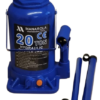
Bottle jacks are compact hydraulic units with a vertical ram. They offer high lifting capacity for the money and take up very little space, making them useful for heavier vehicles, trailers and occasional roadside or workshop use.
Their limitation is height. Even a short bottle jack can be too tall to slide beneath an ordinary car, and its narrow footprint is less forgiving on uneven surfaces. They work best where there is generous ground clearance and a solid, level base. For a 4×4, pickup or van, a bottle jack can be an affordable and capable option. For frequent work on a low car, a trolley jack is usually the better tool.
Scissor jacks are for emergencies, not workshop jobs
The scissor jack stored in a vehicle is designed for changing a wheel at the roadside. It is light, compact and inexpensive, but slow to operate and generally less stable than a proper trolley jack. Keep it in the boot for its intended purpose, but do not rely on it for repeated servicing or work beneath the car.
High-lift jacks have a specialist role
High-lift farm-style jacks provide exceptional range for lifted 4x4s and off-road vehicles with suitable recovery points. They are not a general home-maintenance jack. Their height, exposed mechanism and operating force demand care, and they are unsuitable for lifting most standard cars from factory sill points.
What capacity should a home garage jack have?
Jack capacity is often misunderstood. A 2-tonne rating does not mean it is only suitable for a 2-tonne car. When lifting one end or one corner, the jack carries only part of the vehicle’s weight. Even so, capacity should never be treated as a reason to cut corners.
Check the vehicle’s gross weight and choose a jack with a sensible margin. A 2-tonne trolley jack is commonly adequate for passenger cars, while a 3-tonne model provides greater flexibility for heavier SUVs, vans and future vehicle changes. A higher rating is useful, but it does not replace proper setup. A 3-tonne jack on loose gravel is not safer than a correctly positioned 2-tonne jack on level concrete.
Consider the construction as well as the headline number. A heavy steel trolley jack is durable and stable, though it is harder to carry and store. Aluminium models are easier to move and popular for mobile use, but compare the saddle quality, wheel design, handle strength and hydraulic warranty before buying on weight alone.
Best jacks for home car maintenance: features worth paying for
The specification sheet tells you whether a jack will be a useful workshop tool or a frustrating compromise. Focus on the details that affect every lift.
A low minimum height is essential for modern cars with deep bumpers, side skirts or lowered suspension. A high maximum lift lets you raise the car far enough to place axle stands at their correct support points. A long handle gives better pumping leverage, while a two-piece handle can make storage easier in a crowded shed or garage.
A rubber saddle pad helps protect painted pinch welds and lifting points. It is a worthwhile feature, but do not assume it suits every vehicle. Some cars need a shaped jack pad or an adapter designed for the factory lifting point. Check the handbook before lifting, particularly on electric and hybrid vehicles where underbody damage can be costly.
For frequent use, look for a foot pedal or rapid-lift system. This takes the saddle quickly up to the vehicle before the hydraulic lift begins, saving time when tyres, brakes and suspension work are routine jobs. It is a convenience feature rather than a safety feature, but it makes a noticeable difference in a busy garage.
A jack is not a support stand
Never work under a vehicle supported only by a jack. Hydraulic seals can fail, a release valve can be knocked, or the vehicle can shift if it is lifted from the wrong point. The jack raises the vehicle. Rated axle stands hold it securely.
For safe home maintenance, use this basic setup:
- Park on firm, level ground, with the gearbox in gear or Park and the handbrake applied.
- Chock the wheels that remain on the ground before lifting either end of the vehicle.
- Lift only from approved jacking or central lifting points stated in the vehicle handbook.
- Lower the car gently onto a matched pair of rated axle stands, then check stability before starting work.
- Keep the jack in contact as secondary support where practical, without relying on it as the primary support.
Avoid paving slabs, soft tarmac, gravel and sloped driveways. A jack or axle stand can sink, roll or tilt under load. If you have no flat concrete surface, postpone under-car work until you have a safe place to do it. This is not an area where improvised timber stacks or blocks are acceptable.
Choosing value without buying twice
The cheapest trolley jack can be tempting when the job is only an oil change or a set of brake pads. Yet poor wheels, a rough release valve and limited lift height soon turn a low-price purchase into an annoyance. Buy a jack with enough capacity, the correct height range and axle stands to match, then it will serve across many routine jobs.
For occasional maintenance on a standard car, a 2-tonne low-profile trolley jack and a pair of correctly rated axle stands is a strong, cost-effective setup. For an SUV, van or mixed household fleet, step up to a 2.5-tonne or 3-tonne trolley jack with higher lift. Add wheel chocks, a rubber pad and a creeper or kneeling mat if you want the garage to work more efficiently.
Irish Tools Shop stocks workshop lifting equipment alongside the everyday tools needed to put it to work, from trolley jacks and axle stands to brake kits and impact sockets. Choosing compatible equipment in one order saves time and helps ensure the lifting setup is ready before the vehicle is off the ground.
Before ordering, measure the clearance beneath your car, check its weight and identify its approved lifting points. Those three checks will tell you more about the right jack than any oversized capacity claim ever will.
