













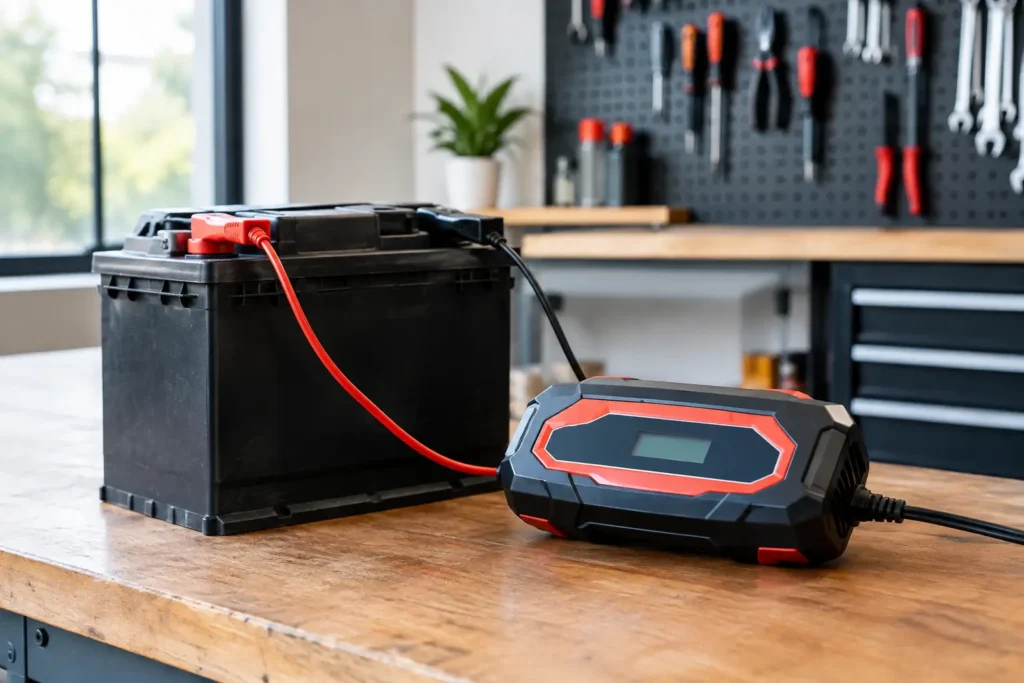
A flat battery is not a minor inconvenience when a vehicle is blocking a ramp, booked in for collection or needed for the morning run. The right battery chargers keep cars, vans, motorcycles and workshop equipment ready to move, without relying on a jump start that only masks the real problem. For a home mechanic, that means less time waiting. For a busy garage, it means fewer lost hours and a more professional handover.
Choosing one is not simply a matter of buying the highest amp rating at the lowest price. Battery type, vehicle use, charging speed and the features that protect modern vehicle electronics all matter. Buy to suit the batteries you actually see in the workshop, and a charger becomes one of the most useful pieces of equipment on the bench.
What Battery Chargers Need to Do
A proper charger should replenish a battery safely, monitor its condition and reduce the risk of overcharging. Older basic chargers can still have a place for straightforward lead-acid batteries, but they need more attention from the user. Modern smart chargers are usually the better option for regular garage and trade use because they automatically adjust the charge cycle as battery voltage rises.
Most vehicle batteries need more than a quick boost. A deeply discharged battery may need several hours of controlled charging before it can hold enough power to start reliably. A quality smart charger moves through stages such as diagnosis, bulk charging, absorption and maintenance. Once the battery is full, it switches to a safe holding mode rather than continuously forcing current into it.
That maintenance function matters for vehicles that spend long periods parked. Classic cars, motorcycles, seasonal machinery and customer vehicles awaiting parts can all suffer from gradual battery drain. A compatible maintenance charger can keep the battery topped up without the repeated overcharging that shortens battery life.
Choose the Right Charger Output
The amp rating affects charging time, but bigger is not automatically better. Small batteries found in motorcycles, ride-on equipment and compact cars are best matched with lower-output chargers. A high-output unit may charge quickly, yet it can be unsuitable if it lacks a controlled low-amp setting.
For many cars, a smart charger in the mid-range is a sensible all-round choice. It has enough output to recover a standard car battery in a reasonable time while remaining practical for maintenance charging. Larger batteries in vans, 4x4s, agricultural equipment and workshop fleets benefit from higher output, particularly where turnaround time matters.
As a guide, compare charger output with battery capacity, measured in amp-hours (Ah). A battery around 60Ah can be maintained by a lower-amp smart charger, but a higher-output model will restore it faster. Allow for losses and charging stages rather than expecting a simple one-hour-per-amp calculation. A battery that is old, sulphated or seriously depleted will take longer and may not recover at all.
For garages, it is often worth having two units: a compact smart charger for everyday cars and maintenance work, plus a heavier-duty model for commercial batteries and faster recovery. This costs less in the long run than tying up one undersized charger on a large van battery for an entire day.
12/24V DC Dual Battery Mobile Jump Starter / Power Supply 120V & 230V AC 2000mA
Battery Type Comes First
Check the battery label before connecting anything. Conventional flooded lead-acid batteries remain common, but modern stop-start vehicles often use AGM or EFB batteries. These types need suitable charging profiles. Using a charger with an AGM mode is the safe choice for AGM batteries, as it applies the correct charging voltage and cycle.
Lithium vehicle batteries need even more care. Do not assume a standard lead-acid charger is compatible. Use a charger specifically designed for the lithium chemistry fitted, and follow the battery maker’s instructions. The wrong charging programme can damage the battery or create a safety risk.
If the label is unclear, identify the battery before charging. Guesswork is not good workshop practice, particularly on newer vehicles with battery monitoring systems.
Smart Features Worth Paying For
The best battery chargers earn their place through protection and convenience, not clever marketing. Automatic charging and maintenance mode are the starting point. Beyond that, look for reverse-polarity protection, short-circuit protection and spark protection. These features help prevent expensive mistakes when working quickly between jobs.
Temperature compensation is useful in unheated garages and outdoor work areas. Cold batteries charge differently from warm ones, and a charger that adjusts its output can provide a more accurate, safer charge. An IP-rated casing is also worthwhile where dust, damp and workshop spills are unavoidable.
A reconditioning or repair mode can sometimes help recover a lightly sulphated lead-acid battery. It is not a miracle cure for a failed battery, cracked case or damaged cell. If a battery repeatedly loses charge after a full cycle, test it properly and replace it where necessary. Continually charging a failing battery wastes time and can leave a customer stranded.
Some chargers include a supply or power mode for supporting vehicle voltage during diagnostics, software work or battery replacement. This can be useful, but check the stated output carefully. A charger designed only for maintenance may not provide stable enough power for demanding electronic work. For garages carrying out regular coding or diagnostic jobs, a dedicated battery support unit may be the better investment.
US PRO 15 Meter Wall Mounted Retractable Cable Reel 230V 3200W
Safe Charging in the Garage
Even smart equipment needs correct handling. Charge batteries in a well-ventilated space, away from flames, grinding sparks and welding work. Lead-acid batteries can release gas during charging, especially if damaged or overcharged. Inspect the case for swelling, cracks, leaks and loose terminals before connecting the clamps.
Switch off the charger before fitting or removing leads. Connect the positive clamp to the positive terminal first, then connect the negative clamp as instructed by the vehicle or charger manufacturer. On many vehicles, using the designated earth point rather than the battery’s negative terminal is preferred. This is especially relevant on modern vehicles with battery sensors.
Keep the charger leads tidy and away from moving parts. Do not leave a charger balanced on a battery or hanging by its cables. In a working garage, small habits like these prevent damaged leads, broken clamps and avoidable accidents.
If a battery is completely flat, some smart chargers may not detect it because the voltage is below the unit’s activation threshold. Certain models include a recovery mode for this situation. Do not bypass safety systems or try improvised charging methods. If the battery will not accept a controlled charge, it needs testing, not forcing.
When a Charger Is Not the Answer
A charger restores energy. It does not fix the fault that drained the battery. If a vehicle starts after charging but goes flat again, investigate the cause. It could be an ageing battery, poor alternator output, a loose earth connection or an excessive parasitic drain from an accessory or control module.
Battery testers and multimeters are valuable partners to charging equipment. Check resting voltage after the battery has stood, observe voltage drop under load and confirm alternator charging voltage with the engine running. For trade users, documenting these checks supports a clearer repair recommendation and avoids replacing parts on assumption.
Likewise, do not confuse a battery charger with a jump starter. A jump starter is designed to provide a short burst of high current to crank an engine. A charger replenishes the battery gradually and safely. Both are useful tools, but they solve different problems. A well-equipped workshop benefits from having both available.
Buy for Daily Use, Not Just the Price Tag
The cheapest charger may be enough for occasional use on a small car, but frequent workshop charging demands stronger clamps, durable cables, clear controls and proven protection features. Consider where it will live, how often it will be moved and whether it needs to cover cars, vans or motorcycle batteries.
Irish Tools Shop focuses on affordable, reliable workshop equipment because downtime costs more than a few pounds saved on a weak tool. A charger with the right battery modes, useful output and safe automatic control is a practical purchase that pays back through faster turnaround and fewer avoidable battery replacements.
Choose the charger that matches the batteries on your floor, keep it ready on the bench, and treat repeated flat batteries as a fault to diagnose rather than a job to recharge again tomorrow.
