










A multimeter earns its place in a tool chest the first time it finds a bad earth, a weak battery connection or a failed sensor without stripping half the vehicle apart. This automotive multimeter buying guide is for mechanics and serious DIY users who want dependable readings, safe operation and sensible value – not a cheap meter that causes more doubt than it removes.
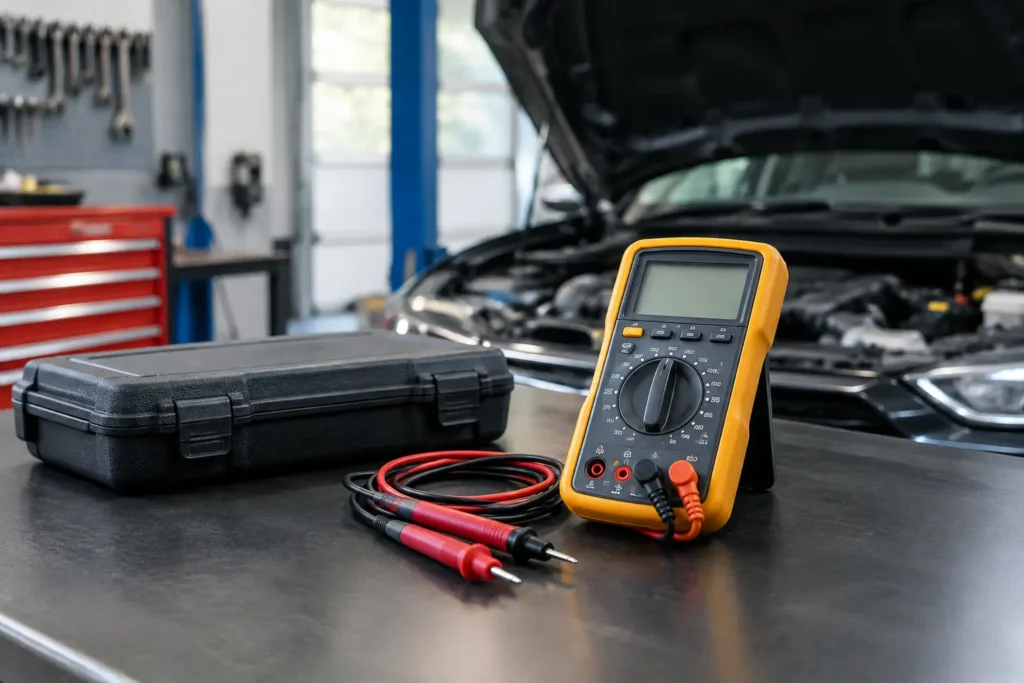
Large Digital Universal Multimeter | LCD Display | ROHS Compliant
What an Automotive Multimeter Must Do
Most cars and vans run on 12V systems, while lorries, plant and some commercial equipment use 24V. That does not mean any basic voltage tester is enough. Vehicle electrical work involves low-voltage circuits, but modern charging systems, ignition components, electric fans, injectors and control modules can produce conditions that expose the limits of poor-quality meters.
For routine garage fault-finding, your meter should accurately measure DC voltage, resistance and continuity. These are the core functions for checking batteries, alternators, fuses, wiring, bulbs, relays, switches and earth points. A clear audible continuity tone is particularly useful when tracing a wire or checking a fuse in an awkward position.
It should also measure DC current, although this function needs care. Measuring current means placing the meter in series with the circuit, and connecting it incorrectly can blow the meter fuse or damage the meter. For parasitic battery-drain tests, a current range is useful. For higher-current starter, charging and accessory circuits, a DC clamp meter is generally the better and safer choice.
Automotive Multimeter Buying Guide: The Key Specifications
Ignore inflated function lists until you have checked the basics. A workshop meter needs to be accurate, protected and easy to use with gloves on. The specifications below make the biggest difference in day-to-day work.
Voltage range and accuracy
Choose a meter that covers at least 0-60V DC comfortably, with a 600V or 1,000V maximum range for general workshop flexibility. The maximum range is not a sign that you will test 1,000V vehicle circuits. It gives the meter wider use around mains-powered workshop equipment and provides a sensible safety margin when used correctly.
Accuracy matters most around battery and charging diagnostics. A decent meter should reliably show the difference between a resting battery at roughly 12.6V, a partially discharged battery and an alternator charging at around 13.8V to 14.7V. Exact figures vary by vehicle, temperature and smart charging strategy, but a vague or drifting display is no use when making a diagnosis.
Auto-ranging or manual-ranging
Auto-ranging meters select the correct measurement range themselves. They are fast to use, reduce setup errors and suit busy workshops. The small trade-off is that some inexpensive auto-ranging models take a moment to settle on a reading.
Manual-ranging meters can be quicker once you know the circuit you are testing and are often more affordable. They are perfectly workable for regular mechanical tasks, but you need to select the right range before testing. For most buyers, auto-ranging is worth paying for if the budget allows.
CAT safety rating and internal protection
The CAT rating tells you how well a meter is designed to withstand electrical transients in different environments. For vehicle diagnosis, a meter rated CAT III 600V offers useful protection for general workshop and mains-adjacent tasks. CAT II equipment may suit basic low-energy work, but it is not the same level of protection.
The rating only has value when the whole setup matches it. Look for properly insulated test leads, shrouded plugs, finger guards and fused current inputs. A meter with a replaceable high-energy ceramic fuse is a better choice than one relying on a basic glass fuse. Never assume a low price tool has the stated protection without checking the product specification and build quality.
Display, backlight and response speed
A large backlit display saves time under dashboards, in engine bays and during winter call-outs. You should be able to read the screen without moving the probes or changing position. A hold function is useful where the display cannot be seen while testing.
Response speed matters when checking intermittent faults. A slow meter can miss a voltage drop or an unstable sensor supply. A min/max recording function is valuable for catching a brief low-voltage event when cranking the engine, checking charging stability or investigating a circuit that cuts out over bumps.
Functions Worth Paying For
A good automotive meter does not need every measurement mode available. Buy functions you will use, and put the budget into better leads, protection and reliability.
Frequency and duty-cycle measurement are worthwhile for technicians working on pulse-width-modulated circuits, injector signals, wheel-speed sensors and control outputs. They help confirm that a signal exists, though they do not replace an oscilloscope when waveform quality is the real question.
Temperature measurement is useful for checking cooling systems, intake temperatures and heater performance if the meter includes a compatible probe. Capacitance can help test some electronic components, but it is less central to normal vehicle servicing. A transistor test socket is rarely a deciding feature for garage work.
True RMS measurement is beneficial if you test variable-speed drives, inverter equipment, mains-powered tools or non-standard AC waveforms. On a typical 12V vehicle, it is not the first feature to prioritise. It is still a sensible extra for a workshop tool that will be used beyond basic automotive work.
Do Not Overlook the Test Leads
The probes are the part that touch the vehicle, so poor leads can undermine a good meter. Flexible silicone leads remain manageable in cold conditions and resist workshop wear better than stiff, thin cables. Choose leads with secure probe tips, intact insulation and properly moulded connections.
Probe accessories make diagnosis quicker. Back-probe pins allow testing at connectors without forcing terminals apart. Crocodile clips free both hands when monitoring voltage during a cranking test. Fine needle probes help reach small terminals, but use them carefully to avoid spreading or damaging connector contacts.
For frequent electrical work, keep spare leads and fuses available. A blown fuse should not stop a workshop job, and damaged leads should be replaced immediately. Taping over split insulation is not a professional repair.
Choosing the Right Level of Meter
A budget digital multimeter is enough for occasional jobs such as battery checks, fuse testing, continuity checks and simple accessory wiring. It can offer excellent value for a home garage, provided it has protected inputs, clear instructions and dependable leads.
For daily garage use, step up to an auto-ranging meter with a backlit display, continuity buzzer, min/max function and stronger case protection. This is the sensible middle ground for technicians servicing several vehicles a week. It saves time without paying for specialist features that may sit unused.
For diagnostic work on modern vehicles, look for a higher-quality automotive meter with duty cycle, frequency, temperature capability and better input protection. Pair it with a DC clamp meter if you regularly test starter draw, alternator output or battery drains. One tool does not have to do every job badly when two purpose-suited tools can do it safely.
Common Buying Mistakes
The cheapest meter is often a false economy if it has weak probes, an unclear display and no meaningful protection. Equally, paying for a premium brand name alone does not guarantee the functions required for your work. Compare the actual ranges, accuracy, safety category, supplied accessories and warranty.
Do not buy purely on the maximum voltage printed on the front. A 1,000V label says little about measurement accuracy at 12V, input fuse quality or lead construction. Also check whether the meter has a separate, clearly marked current socket. Connecting a probe to the current input and then testing voltage across a battery is one of the quickest ways to damage a meter.
Finally, avoid diagnosing a vehicle on voltage alone. A circuit can show 12V with no load and still fail when asked to power a motor, lamp or module. Learn to carry out voltage-drop tests across power and earth connections. That simple habit finds corrosion, loose terminals and high-resistance cables that a continuity test can miss.
A dependable multimeter is not a luxury item in a working garage. Choose one that suits the vehicles you service, protect it with good leads and use it methodically. The right meter turns electrical faults from expensive guesswork into a measured repair.
