






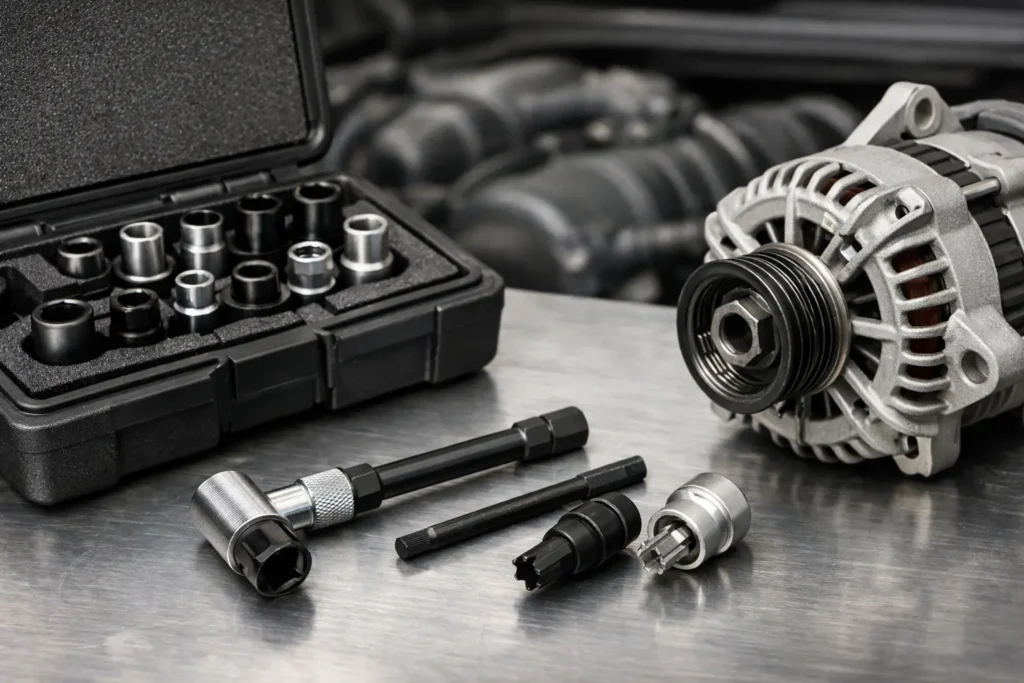
A slipping auxiliary belt, rattling tensioner or noisy alternator does not always mean the alternator itself has failed. On many modern vehicles, the problem sits in the overrunning alternator pulley. Replacing it properly requires a 13 Piece Alternator Freewheel Pulley Removal Tool – not a hammer, grips or an improvised socket arrangement that can damage the shaft, pulley or new part.
For working garages and serious home mechanics, this compact kit earns its place quickly. It gives you the specialist spline and multi-point adaptors needed to hold the alternator shaft still while removing or tightening the freewheel pulley. That means a cleaner repair, less wasted time and no need to replace a serviceable alternator simply because its pulley has seized.
What an alternator freewheel pulley does
An alternator freewheel pulley, also called an overrunning alternator pulley or decoupler pulley, lets the alternator rotate independently for a moment when engine speed drops. It reduces belt vibration and helps the auxiliary drive run more smoothly, particularly on diesel engines and vehicles with high electrical demand.
When the pulley locks solid, the belt system can become noisy and the automatic tensioner may flick or bounce excessively at idle. When it freewheels in both directions, the alternator may not be driven correctly. Either fault can lead to premature belt, tensioner and idler wear.
The pulley is threaded directly onto the alternator shaft and often tightened firmly from the factory. Its outer body must turn while the internal shaft is held still. Standard sockets cannot do both jobs at once, which is exactly why a dedicated removal kit is the right tool for the repair.
Why a 13 Piece Alternator Freewheel Pulley Removal Tool matters
A 13-piece set is designed to cover the range of alternator shaft profiles found across common European and Asian vehicles. Although the exact contents vary by manufacturer, kits commonly include a selection of spline, Torx-style, hex and multi-spline holding bits, together with matching outer pulley sockets or adaptors.
The benefit is coverage without buying several single-purpose tools. A garage handling different makes can select the correct inner bit and outer adaptor at the bench, rather than stopping a job to source another fitting. For DIY users, it provides a far better chance of matching the pulley on the first attempt.
It also protects expensive components. Trying to remove a freewheel pulley with a strap wrench, locking pliers or an impact gun alone can crush the pulley housing, round the shaft fitting or overload the alternator internals. A correct tool engages the component as intended and applies force where it belongs.
That said, 13 pieces does not automatically mean universal fitment. Alternator pulley designs vary. Before ordering, check the vehicle application, alternator manufacturer and the profile visible in the centre of the pulley. Bosch, Valeo, Denso and other units can use different shaft drives even on similar vehicles.
Check compatibility before starting the job
The first check is whether the alternator has a conventional solid pulley or a freewheel type. A freewheel pulley usually has a protective plastic cap over its centre. Remove the cap carefully and inspect the internal drive shape. Do not use the old pulley as the only reference if it is badly corroded or damaged – confirm the correct replacement pulley by alternator number where possible.
Next, look at the kit specifications. The important details are the outer socket sizes, the internal bit profiles and the drive size required for the ratchet or breaker bar. Many kits use a hollow outer socket so the holding bit can pass through its centre. This is essential: the outer tool turns the pulley while the inner tool prevents the alternator shaft from rotating.
Access matters too. Some vehicles allow the pulley to be changed with the alternator in place after removing the wheel arch liner or undertray. Others need the alternator removed from the engine. Tight access can change the job from a quick service item into a longer repair, so inspect the vehicle before quoting time or stripping parts off.
How to remove an alternator freewheel pulley correctly
Work only with the engine off, keys removed and the battery disconnected. If the alternator is coming off the vehicle, disconnect the battery negative terminal first and secure the vehicle safely on axle stands where underneath access is required.
The basic method is straightforward, but stubborn pulleys demand patience rather than brute force.
- Remove the auxiliary belt and inspect it for cracking, glazing, frayed edges and oil contamination. Check the tensioner and idler pulleys at the same time. Replacing only the freewheel pulley while leaving a failing tensioner behind can bring the noise straight back.
- Remove the protective cap from the pulley centre. Clean loose corrosion from the exposed fitting so the holding bit seats fully. A bit that is only half engaged is likely to round the shaft profile under load.
- Select the inner holding bit that fits the alternator shaft with no looseness. Slide the matching hollow outer socket over the pulley, then pass the holding bit through it into the shaft.
- Hold the shaft stationary with the correct ratchet, breaker bar or spanner arrangement. Turn the outer pulley socket in the required direction. Most pulley assemblies use a conventional right-hand thread, but never assume this – verify the fitting instructions for the replacement pulley or vehicle.
- Once removed, inspect the alternator shaft threads and mounting area. Clean them carefully. Do not apply random thread-locking compound or grease unless the pulley manufacturer specifies it, as both can affect tightening accuracy or contaminate the mechanism.
- Fit the new pulley by hand first to avoid cross-threading. Use the holding bit and outer socket to tighten it to the torque specified by the pulley or vehicle manufacturer. Refit the cap, belt and any removed covers, then check that the belt sits correctly in every pulley groove.
A compact impact wrench can help where access allows and the tool instructions permit it, but it is not a cure for a poor-fitting adaptor. The shaft must still be restrained correctly. If the internal fitting is rounded, seized beyond reasonable force or the alternator bearings feel rough, replacing or professionally rebuilding the alternator may be the more economical repair.
Signs the pulley should be replaced
Noise alone is not a full diagnosis, but several symptoms point towards a faulty alternator freewheel pulley. A rattling or chirping belt drive at idle, a tensioner arm that visibly jumps, belt squeal during gear changes and repeated auxiliary belt failures all deserve investigation.
With the belt removed, the pulley can often be checked by hand. Depending on its design, it should lock in one direction and rotate smoothly in the other. A decoupler pulley may have a slightly different feel because it contains an internal spring mechanism. Compare its movement with the replacement part instructions rather than forcing it.
Do not overlook related faults. A worn crankshaft pulley, seized idler, weak tensioner, misaligned alternator bracket or contaminated belt can create very similar symptoms. Good workshop practice is to inspect the whole auxiliary drive system before fitting parts.
Getting better value from a specialist tool kit
A freewheel pulley kit is a small investment compared with the cost of a complete alternator or the downtime caused by a belt failure. For garages, it prevents a regular service job becoming a parts-changing exercise. For serious DIY mechanics, it keeps the repair controlled and avoids paying for a specialist tool that may only be needed once.
Choose a set made from hardened steel with clearly identified adaptors and a solid storage case. Clear markings save time at the bench, while a case prevents the small inner bits from disappearing into a crowded tool chest. Check that the kit is suitable for the alternator types you see most often, rather than buying solely on piece count.
Irish Tools Shop focuses on affordable, reliable workshop equipment for the jobs that cannot wait. A properly matched alternator pulley removal kit belongs alongside your impact socket set, belt tools and electrical test equipment – ready when a noisy auxiliary drive turns up on the ramp.
