






A press that is too small wastes time. A press that is far larger than the work demands can waste valuable floor space and budget. This workshop press capacity guide cuts through the headline tonnage figures, so you can buy a hydraulic press that suits the jobs coming through your garage.
For bearing removal, bushes, suspension components, hubs and general fabrication, capacity matters – but it is not the only specification that decides whether a press will earn its place in the workshop. Frame strength, working width, bed adjustment and control all affect what you can safely get done.
Workshop press capacity guide: start with the job
A workshop press is rated by the maximum force it can apply. A 20-tonne press can exert up to 20 tonnes of pressing force at the ram. That does not mean every component needs 20 tonnes, nor does it mean it is sensible to run the press at its limit day after day.
Most serious DIY users and light automotive workshops find a 10-tonne or 12-tonne press capable of handling straightforward bushes, small bearings, U-joints and light pressing jobs. It is a sensible entry point where occasional use, compact size and price are the priorities. The limitation becomes clear when corrosion, larger hubs or tightly seized components enter the picture.
For regular garage work, 20 tonnes is often the practical sweet spot. It gives useful headroom for wheel bearings, suspension bushes, axle components and many passenger vehicle hub jobs without moving into the size and cost of a heavy industrial unit. If you run a busy repair bay, a 20-tonne hydraulic press is usually a more productive choice than repeatedly fighting a smaller press at its upper limit.
A 30-tonne, 50-tonne or higher-capacity press makes sense for tougher commercial work, larger components, agricultural machinery, fabrication and badly seized parts. The extra force is useful, but it must come with a suitably heavy frame, stable base and controlled operation. More tonnage is not a licence to force a part that is incorrectly supported or fitted at an angle.
Match press tonnage to common workshop tasks
The condition of the vehicle and component matters as much as its size. A clean, correctly supported bearing may release easily. The same bearing on an older vehicle exposed to road salt can require considerably more force. For garages working across Ireland and the UK, corrosion is a real reason to allow sensible capacity headroom.
A 10-tonne press is suitable for lighter work such as small bearings, pins, bushes and basic straightening. It is a good fit for a home garage where space is tight and the press will not be used all day. Do not expect it to comfortably cover every wheel hub or seized suspension component that arrives at the door.
A 20-tonne press covers a broader range of automotive repairs. It is the reliable all-rounder for mechanics replacing press-fit wheel bearings, bushes, ball joints, pulleys and many driveline parts. With the right bearing separator, press plates and support blocks, it can remove and install components accurately rather than relying on heat, hammers or improvised methods.
Higher-capacity presses are for work where the parts are bigger, thicker or routinely more stubborn. Commercial van components, agricultural equipment, heavy chassis work and production-level pressing may justify 30 tonnes or more. A 50-tonne model is a serious investment, so check that the workshop has the room, the work volume and the trained operator needed to use it properly.
Do not choose by a single difficult job alone. If one seized bearing each year needs more force than your normal work, outsourcing that task can be more economical than buying a large press. If those difficult jobs are appearing every week, capacity quickly pays for itself in saved labour and fewer damaged parts.
Capacity is only useful with the right working space
Tonnage figures look impressive, but a press is no use if the component will not fit between the bed and ram. Before buying, measure the largest assemblies you expect to work on. Consider the maximum opening height, the width between uprights and the travel of the ram, not simply the overall dimensions shown on a product listing.
Bed adjustment is particularly useful. A multi-position bed lets you bring the work close to the ram for short components, while still providing enough clearance for taller hub assemblies or fabricated parts. A winch-assisted bed is worth considering on heavier presses, as moving a substantial bed by hand is slow and can be unsafe.
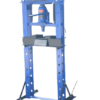
Also check the throat width. Wider is useful for large components, but a wide frame does not automatically mean better. The frame must remain rigid under load. A well-built, heavy-duty 20-tonne press with a stable H-frame is a better working tool than a lightly constructed unit carrying an ambitious rating.
Press plates, V-blocks and bearing tools should be part of the buying decision. They centre the work, spread loads correctly and prevent a component from slipping. A hydraulic press is only as controlled as the support beneath the job.
Manual, pneumatic or electric operation
A manual bottle-jack press is affordable, simple and dependable. It suits lower-volume work and gives the operator time to feel what is happening as pressure builds. For many workshops, this is the best value option, especially where the press is used for a few jobs each week rather than all day.
Pneumatic-hydraulic operation is a strong upgrade for regular use. It reduces pumping effort and speeds up repetitive jobs, making it easier to keep the operator focused on alignment and component movement. You will need an adequate compressor and air supply, so factor that into the real cost.
Electric or powered presses are aimed at higher-throughput environments. They can offer quicker operation and more consistent control, but they take up more budget and usually demand more dedicated workshop space. Choose them when the workload supports the investment, not simply because powered equipment looks more professional.
Safe working limits are not optional
Never treat maximum press capacity as a target. The rated tonnage is the upper limit of the equipment, not the force to apply to every job. Increase pressure steadily and stop if the component starts to twist, the support shifts or the part is not moving as expected.
Before each use, inspect the frame, ram, hose connections, pins, bed supports and press plates. Keep the work centred beneath the ram wherever possible. Off-centre loading can bend components, damage the press and create a dangerous release of stored energy.
Use suitable guards, eye protection and properly rated accessories. Never stack random sockets, timber offcuts or unstable objects under a component to make up height. A press can produce force quickly enough to turn poor support into a serious injury.
Signs that you may be asking too much from the press include:
- The ram or frame visibly flexes under load.
- The part begins to move sideways instead of pressing straight.
- The pump reaches high pressure but the component remains fixed.
- Support blocks or press plates start to shift.
- You need to improvise extensions or supports to fit the work.
Stopping to reassess is faster and cheaper than replacing a damaged hub, bearing housing or press frame.
Buy for regular work, not the occasional easy job
The best capacity choice is the one that handles your normal jobs with a safety margin and without slowing the workshop down. For general repair work, a quality 20-tonne H-frame press is often the most cost-effective starting point. It has the force for a wide range of vehicle repairs while remaining practical for a working garage.
If you only tackle lighter repairs at home, a 10-tonne or 12-tonne model can offer affordable, reliable service. If commercial, agricultural or heavy fabrication work is central to your business, move up in capacity and prioritise frame construction, bed clearance and controlled operation over a low headline price.
Irish Tools Shop stocks workshop equipment built for hard-working garages, where dependable specifications and keen pricing both matter. Check the full dimensions, included accessories and rated capacity before ordering, then choose the press that will keep earning its space long after the first seized bearing is out.
A good press should make difficult jobs controlled, repeatable and safe. Buy enough tonnage for the work you actually see, leave room for the jobs that fight back, and never compromise on support or setup.
