






A vehicle in the air can turn a difficult brake, exhaust, suspension or transmission job into straightforward workshop work. The wrong setup can waste floor space, slow every job down and create a serious safety risk. That is why choosing workshop lifting equipment starts with the work you actually carry out, the vehicles you see and the room you have available – not simply the lowest price or highest stated capacity.
For busy garages, dependable lifting gear pays for itself through better access and faster turnaround. For home mechanics, it brings safer working conditions and the confidence to take on jobs that are awkward on the ground. The key is buying equipment that suits your workshop now and still makes sense when the workload grows.
Choose Workshop Lifting Equipment for the Job
There is no single lifting solution for every garage. A trolley jack and axle stands are ideal for wheel, brake and suspension work, especially where the vehicle only needs to be raised at one end. They are affordable, mobile and easy to store, but they do not give the underbody access or working height of a vehicle lift.
A two-post lift is often the practical choice for workshops carrying out regular servicing, repairs and inspections. With the wheels free and the full underside exposed, technicians can move quickly around the vehicle. It is a strong all-round option, but it needs suitable concrete, sufficient ceiling height and enough clearance around the lifting arms. Measure before ordering. A lift that physically fits inside the building may still be too tight to use safely and efficiently.
Four-post lifts suit garages that want stable drive-on access, wheel alignment capability or vehicle storage. They can be easier for some customers to drive onto than positioning arms under lifting points. The trade-off is that the runways obstruct certain jobs underneath, and wheel-off work may require an additional jacking beam.
Scissor lifts are worth considering where space is limited or where a low-profile installation is preferred. They offer excellent access for tyres, brakes and fast service work, depending on the design. However, the centre structure can restrict access to parts of the underbody, so check exactly where the lift sits relative to the vehicle.
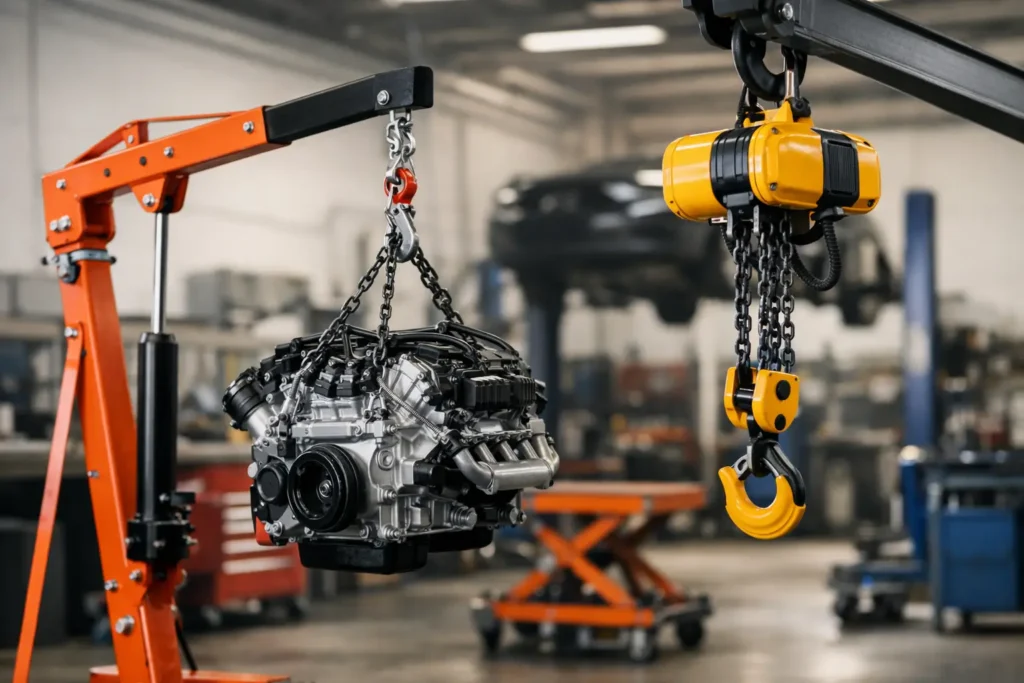
Engine cranes, transmission jacks and support equipment also belong in a properly equipped lifting plan. A car lift raises the vehicle, but an engine crane handles major removal work and a transmission jack supports heavy components safely at height. Buying the right combination avoids improvising with equipment that was never designed for the load.
Capacity Is More Than a Number
Load capacity is the first specification most buyers check, and it should be. But selecting a lift only on its maximum rating is a mistake. Your equipment must comfortably handle the heaviest vehicles you routinely work on, including modern SUVs, electric vehicles and vans where applicable.
Look at vehicle weight, wheelbase, width and lifting-point positions. A lift may have the capacity for a vehicle but lack the arm reach or runway length needed to position it correctly. Low-slung cars, long-wheelbase vans and vehicles with battery packs all create different clearance and support requirements.
Give yourself a sensible capacity margin rather than working at the limit every day. This is not about overbuying for the sake of it. It is about allowing for real workshop conditions: added accessories, uneven load distribution and the changing mix of vehicles coming through the door. A garage that mainly handles cars may find a 3-tonne unit adequate, while a workshop servicing larger commercial vehicles needs a different category of equipment altogether.
The same principle applies to jacks and stands. Never assume the capacity of a trolley jack means the vehicle can remain supported by it while you work. A jack is for lifting. Properly rated axle stands or a suitable vehicle lift are for supporting the load. Check the ratings on every item in the system, not just the largest one.
Installation Decides How Well a Lift Performs
A vehicle lift is only as good as its installation. Before committing to a two-post, four-post or scissor lift, assess the floor, height and electrical supply. Concrete condition and thickness matter, particularly for anchored equipment. Cracked, uneven or unsuitable floors require attention before installation – not after the lift arrives.
Ceiling height needs more thought than the overall height of the lift. Consider the vehicle at full rise, roof-mounted accessories, raised doors, lighting, ducting and overhead beams. Also allow enough room for technicians to move around the vehicle without working in a cramped position.
Plan the bay around the lift rather than treating it as an isolated purchase. You need clear access for vehicles entering and leaving, space to open doors, room for tool trolleys and a safe route around the working area. If the bay is too narrow, a good lift can become a daily frustration.
Portable equipment has its own requirements. A trolley jack should roll smoothly on a clean, level floor. Axle stands must sit on firm, stable ground and meet the vehicle at approved support points. Engine cranes need clear floor space and enough clearance to manoeuvre around the front of the vehicle. Keep these areas free of loose tools, hoses and discarded parts.
Safety Features Are Working Features
Workshop lifting equipment should help your team work confidently, not give them another risk to manage. Mechanical safety locks, secure arm restraints, controlled lowering systems and clearly marked lifting points are practical features that protect people and vehicles during every lift cycle.
For vehicle lifts, check how the locking system works and whether it engages across the full lifting range. Understand the controls before the equipment is used. A smooth hydraulic raise is only part of the job; the load must be held securely when a technician is working underneath it.
Routine checks should be part of the workshop schedule. Inspect lifting pads, arms, chains, cables, hydraulic hoses, fixings and safety catches for wear or damage. Keep moving parts maintained according to the manufacturer’s guidance, and remove equipment from service if there is any doubt about its condition. A worn pad or damaged hose is cheaper to replace than the consequences of ignoring it.
Training matters just as much. Technicians should know how to identify vehicle lifting points, balance the load, raise the vehicle carefully and confirm it is secure before working beneath it. This is especially relevant with electric and hybrid vehicles, where battery locations and designated jacking points may differ from familiar petrol or diesel models.
Build a Setup That Speeds Up Real Work
The best workshop setup is not necessarily the one with the biggest lift. It is the one that removes delays from the jobs you do most often. A tyre and brake-focused garage may get immediate value from a heavy-duty trolley jack, dependable axle stands and a mid-rise scissor lift. A general repair business handling clutches, exhausts and servicing may benefit more from a two-post lift with clear underbody access.
Think about the equipment around the lift as well. An organised tool chest reduces time spent walking back and forth. Impact socket sets, air tools, brake service kits and transmission equipment should be close enough to use without cluttering the bay. Efficient workshops keep essential gear within reach while leaving the floor clear for safe movement.
It also pays to consider serviceability and availability. Workshop equipment is not a decorative purchase. When a jack, crane or lift is out of action, jobs stop. Choose equipment with clear specifications, dependable construction and warranty support, then maintain it properly from day one.
Buy for Daily Use, Not Just Delivery Day
Price matters, particularly when fitting out a new garage or replacing several essential items at once. Cheap equipment that does not match your work soon becomes an expensive compromise. Equally, the most costly model is not automatically the best fit for a smaller workshop with a focused workload.
Buy the capacity, access and safety features you genuinely need. Compare dimensions carefully, confirm what is included and budget for installation where required. Irish Tools Shop offers affordable, reliable workshop equipment alongside the everyday tools that keep a bay productive, helping garages and serious DIY users build a setup without premium distributor pricing.
Make the next lifting purchase earn its floor space. Choose equipment that supports the vehicles you service, gives technicians safe access and keeps jobs moving when the workshop is at its busiest.
