






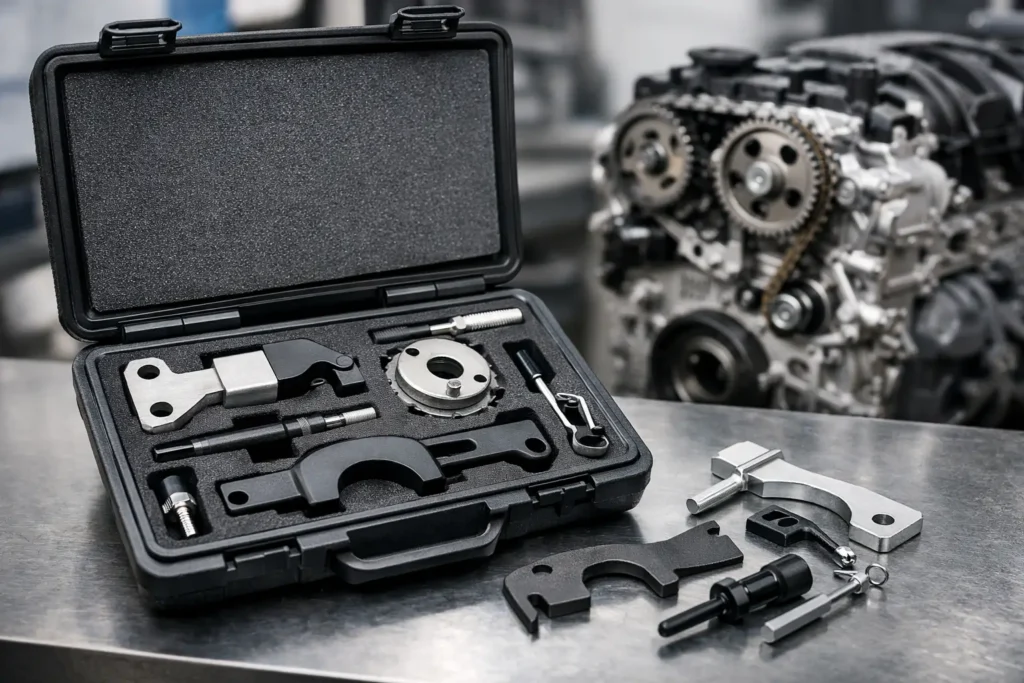
A timing belt or chain job can turn expensive very quickly when the crankshaft, camshaft or high-pressure pump moves even one tooth out of position. A proper vw timing tool kit is not a convenience item for the toolbox. It is the equipment that holds critical engine components at their factory timing positions while the belt, chain, tensioner or related parts are replaced.
For Volkswagen Group vehicles, guessing by paint marks or relying on one universal locking pin is a false economy. VW, Audi, SEAT and Škoda engines share many designs, but the correct timing procedure still depends on the exact engine code, fuel system and production generation. Buy the kit that matches the engine in front of you, and the job is quicker, safer and far less likely to return with a warning light or worse.
Why a VW timing tool kit matters
Modern VAG engines are tightly timed interference engines in many cases. If valve timing is incorrect, pistons and valves can make contact. The result may be bent valves, damaged rocker arms, marked pistons and a cylinder-head repair that costs far more than the original belt replacement.
The tools do more than stop parts turning. They establish top dead centre correctly, lock the camshaft or camshafts at the specified point and, where required, secure the injection pump, balance shaft or crankshaft. On certain engines, the kit also provides a counterhold adaptor so pulley bolts can be loosened and tightened without loading the timing system.
This is especially relevant when servicing vehicles that have already been worked on. Old paint marks may be inaccurate, pulleys may have been changed and a previous repair may not have followed the correct locking procedure. Factory timing positions and correctly fitted tools give you a known starting point.
Match the kit to the engine code, not just the badge
“VW timing kit” is too broad a description to buy from. A Golf can be fitted with very different petrol and diesel engines across its generations, and an engine used in a Volkswagen may also appear in an Audi, SEAT or Škoda. The model badge alone does not identify the locking tools required.
Check the vehicle registration, VIN data and, most importantly, the engine code before ordering. The engine code is commonly found on the vehicle data sticker in the service record or spare-wheel area, although location varies by model. Workshop data should then be used to confirm the engine family, timing-drive type and required procedure.
For example, older 1.9 TDI and 2.0 TDI PD engines often use a familiar combination of camshaft locking plate, crankshaft locking pin and injection-pump pin where applicable. Later common-rail diesel engines can require a different set of crankshaft and camshaft tools. Petrol TSI and FSI engines may use timing chains, camshaft alignment bridges or specialist counterhold tools rather than the hardware used on belt-driven diesels.
A broad VAG engine timing set can be good value for a busy independent garage working across several makes. For a one-off repair or a specialist workshop, an engine-specific kit is usually the better buy. It contains fewer unused pieces, takes less time to identify and reduces the chance of fitting the wrong adaptor.
What should a proper VW timing kit include?
The contents vary by engine, but a useful professional kit is clearly labelled and supplied in a fitted case. Loose, unmarked pins soon become a problem in a busy workshop. At minimum, check that the listing identifies compatible engine codes and names the key locking components.
A complete set may include:
- A crankshaft locking pin, plate or TDC locating tool
- A camshaft locking bar, plate, bridge or alignment fixture
- Injection-pump locking pins for relevant diesel engines
- A tensioner setting or retaining tool where the procedure requires one
- Counterhold tools and pulley adaptors for safe removal and torqueing
- Setting pins, bolts and brackets for particular VAG engine families
Do not assume every item is needed on every job. A large kit often covers multiple engines, so it is normal to have tools left in the case. The point is that the correct parts are present for the engine code you are servicing.
Material quality matters too. Locking pins need accurate diameters and clean machining so they locate positively without forcing. Cam locking plates and bridges should sit squarely and resist flexing. A cheap kit with poor tolerances can create the same risk as having no kit at all: it may appear to fit while holding the engine slightly out of position.
Timing belt and timing chain jobs need different tools
A timing belt replacement generally involves locking the crankshaft and camshaft before removing belt tension. Depending on the engine, the cam pulley may need to be released from its taper or moved within slotted holes while belt tension is set. This is why a counterhold tool and correct tensioner setting method are often as important as the locking pin itself.
Timing chain work can be more involved. Chain-driven petrol engines may need covers removed, engine mounts supported and camshaft alignment tools fitted while the chain, guides and tensioner are renewed. Some engines require the crankshaft to be held at a specific position rather than simply pinned at top dead centre. Variable valve timing components can add another layer of precision.
Never use a timing locking tool as a substitute for a crankshaft holding tool unless the repair data explicitly permits it. Locking pins are designed to locate timing position, not necessarily to withstand the torque of a stubborn crank pulley bolt. Use the specified counterhold equipment, correct socket and torque procedure. It protects both the engine and the tool.
Before fitting the tools: workshop checks that prevent trouble
Timing tools only work properly when the preparation is right. Turn the engine by hand in its normal direction of rotation until it reaches the specified timing position. Remove only the covers and components necessary to access the locking points, and keep the area clear enough to see whether every tool has seated fully.
If a locking pin will not enter smoothly, stop. Do not lever the crankshaft against a valve train, force a pin into a misaligned hole or rotate the engine with a cam tool fitted. Recheck the position, engine code and procedure. A pin that needs force is often telling you that the engine is not where it should be.
It is also worth inspecting the wider timing-drive system before reassembly. On a belt-driven engine, assess the tensioner, idlers, water pump and auxiliary belt components. Replacing only the belt may reduce the invoice today, but a seized idler or leaking water pump can destroy that new belt later. On chain-driven engines, inspect guides, tensioners and sprockets in line with the repair procedure.
Once the new parts are fitted and tensioned, remove the locking tools, rotate the engine manually through the specified number of revolutions, then return to the timing position and confirm that the tools re-enter correctly. This verification step takes minutes and can save hours of diagnosis after the engine is rebuilt.
Common buying mistakes with VW timing tools
The biggest mistake is buying a kit because it says “VW/Audi” without checking the engine codes listed. The second is treating the kit as a complete timing-belt service package. Locking tools set the timing, but you may still need a torque wrench, breaker bar, suitable sockets, engine support bar, pulley holding tool and diagnostic equipment for fault-code checks or service reset work.
Another common issue is choosing solely on the number of pieces. More pieces do not automatically mean better coverage. A compact kit that explicitly covers your regular engines is more useful than a large case full of vague, poorly identified adaptors.
For professional use, choose a kit with a durable blow-moulded case and clear tool references. The case is not cosmetic. It makes stock checks faster, prevents small pins disappearing into a tool chest and helps the next technician select the right component.
Build a timing-service setup that earns its place
A VW timing tool kit is one part of a dependable timing-service setup. Pair it with calibrated torque equipment, quality impact sockets for appropriate fasteners, strong axle stands and safe engine support equipment. If access is tight, good lighting and organised tool storage also make a noticeable difference to job time.
For garages handling regular VAG work, buying the right locking kit before the vehicle is stripped is the sensible approach. Irish Tools Shop focuses on affordable, reliable workshop equipment for mechanics and serious DIY users who need tools that work hard without premium distributor pricing.
The right kit should fit the engine code, lock positively, survive repeated use and arrive ready for the next repair. That is better value than saving a few pounds on a universal set that leaves timing to chance.
