






A missing 13 mm spanner can stop a straightforward repair, while a cheap one that rounds off after a few tight bolts is false economy. The right spanner set keeps essential sizes to hand, grips fasteners properly and stands up to the daily knocks of a working garage. Whether you service cars for a living, maintain plant equipment or work on your own vehicles at weekends, buying the set that matches the jobs matters more than simply buying the biggest bundle.
Start with the jobs you actually do
A spanner set should earn its place in the tool chest. For general automotive work in Ireland and the UK, metric sizes are the priority. Most modern cars, vans, motorcycles and workshop machinery use metric fixings, so a good metric combination set covers the work you are most likely to see.
Commonly used sizes include 8 mm, 10 mm, 11 mm, 12 mm, 13 mm, 14 mm, 15 mm, 16 mm, 17 mm, 18 mm and 19 mm. Smaller sizes are useful for trim, battery terminals and light-duty fittings. Larger sizes become more important for suspension, older vehicles, agricultural machinery and heavier garage work. A set that runs from 6 mm to 22 mm is a capable starting point for many mechanics. A broader 6 mm to 32 mm set offers better cover where space in the toolbox allows.
Imperial or AF spanners still have a place. They are useful for classic British vehicles, older machinery, imported equipment and certain plumbing or trade applications. If you routinely work on older Land Rovers, classic motorcycles or plant with mixed fasteners, keeping a separate AF set avoids forcing a near-match metric spanner onto a nut.
The key rule is simple: use the exact size. A slightly loose jaw can slip under load, damage the flats of the fastener and put your knuckles into the nearest sharp edge.
Combination spanners are the workshop standard
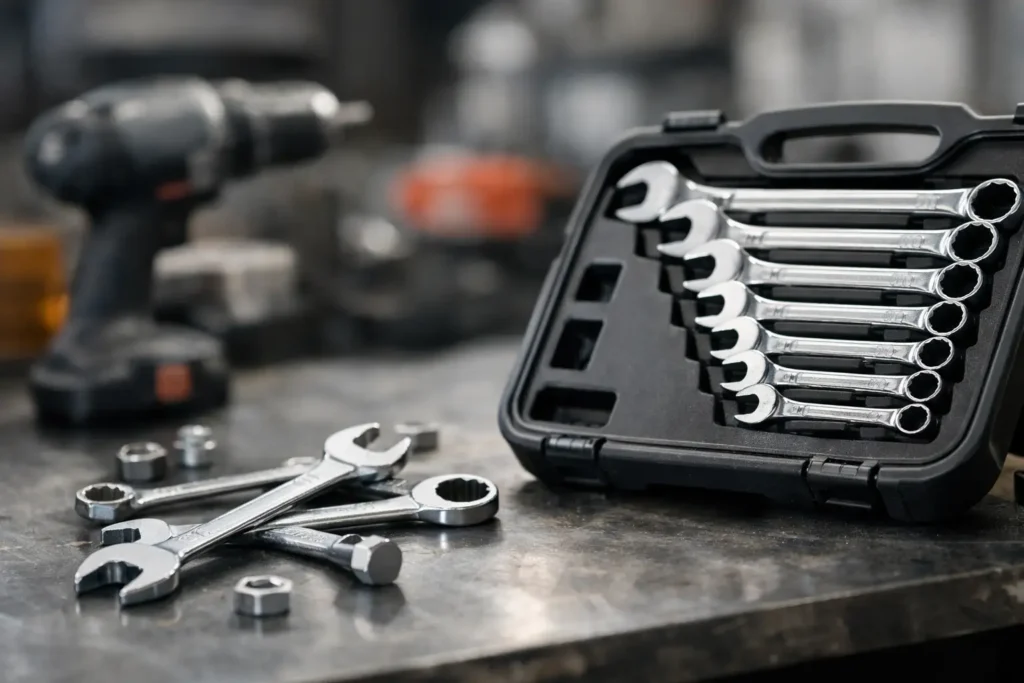
For most buyers, a combination spanner set is the best all-round purchase. Each tool has an open-ended jaw at one end and a ring at the other. The open end is fast to position on a nut or bolt where access is clear. The ring end offers more contact around the fastener, making it the safer choice for tight, stubborn or higher-torque fittings.
A quality ring profile normally has 12 points. This allows the spanner to engage the fastener at smaller turning increments, which helps in cramped engine bays and around suspension components. Six-point ring profiles offer more surface contact and can be preferable for heavily corroded fasteners, but they are less common in standard combination sets.
For routine servicing, a combination set is hard to beat. It handles brackets, alternators, hose clamps, battery fittings, engine mounts and countless other jobs without forcing you to reach for a socket every time. Add an impact socket set for higher-torque work and you have a practical foundation for a serious garage.
Offset rings and slim patterns
Look at the angle of the ring end before buying. A slight offset lifts your hand away from the work surface and gives the ring room to sit over recessed nuts. This is particularly useful on exhaust fittings, engine components and chassis hardware.
Slim-pattern spanners are valuable in confined areas, but there is a trade-off. A thinner body can improve access, yet a heavier, thicker spanner generally feels more secure when working on seized fixings. For everyday garage use, a balanced mid-weight pattern is often the sensible choice. Keep specialist thin spanners for jobs where clearance is the main problem.
What makes a spanner set reliable?
Material and manufacture decide whether a set lasts. Chrome vanadium steel is a common choice for dependable workshop hand tools because it combines strength with sensible weight and cost. The steel alone is not the whole story, though. Accurate jaw sizing, clean machining and a proper heat treatment have a major effect on how the spanner grips and performs.
A well-made open end should sit snugly over the flats of a nut rather than rocking from side to side. The jaw faces need to be crisp, not rounded. On the ring end, inspect the internal profile for consistent machining. Poorly finished spanners are more likely to slip, especially after repeated use on tight or rusted fasteners.
Chrome plating is popular because it resists corrosion and wipes clean easily. It suits clean workshops and general mechanical work. Satin or matt finishes can offer better grip with oily hands and do not show fingerprints as readily. Neither finish makes a poor tool good, so prioritise fit, steel quality and a clear warranty over appearance.
Avoid using a standard spanner as a striking tool or extending it with a pipe unless the tool is specifically designed for that load. Extra leverage can damage the spanner, round the fixing or cause an injury when the tool releases suddenly. For seriously tight bolts, use the correct breaker bar, impact socket or purpose-built torque tool.
Choose the right size range and number of pieces
More pieces do not always mean better value. A 25-piece set that includes every useful size is usually more productive than a large set filled with awkward gaps or sizes you will never use. Check the actual range, not just the number printed on the packaging.
For vehicle servicing, a practical metric set should include the frequently used sizes without skipping 13 mm, 15 mm, 16 mm or 18 mm. These gaps are frustrating because they are exactly the sizes that appear on automotive brackets, brake components and suspension work.
Consider buying two sets if you work professionally. One full set can stay in the main tool chest, while a second, more compact selection goes in the service trolley or mobile kit. That costs more initially, but it saves time walking back and forth across the workshop and reduces the chance of leaving essential tools behind on a call-out.
Double-ended open spanners provide a lower-cost way to carry a broad size range. They are useful as a backup or for site work, but they do not replace a proper combination set where access, torque and speed matter. Adjustable spanners are useful for certain fittings, yet they should not be the default choice for vehicle fixings because their moving jaw has more potential to slip.
Storage affects speed, loss and tool life
Loose spanners at the bottom of a drawer waste time. They also make it easier to lose the size you need halfway through a job. A set supplied in a roll, rack, tray or fitted case keeps sizes ordered and makes missing tools obvious.
A tool roll is a practical option for mobile mechanics and tradespeople. It is compact, easy to carry and can be laid out beside the vehicle. A plastic or metal rack works well in a toolbox drawer, while a fitted foam tray gives a more organised professional finish in a larger chest. The right choice depends on how you work, but the result should be the same: every size visible, protected and ready to grab.
Do not overlook storage when comparing sale prices. A slightly higher-priced set with durable organisation can offer better long-term value than loose spanners that disappear into a crowded toolbox.
When a ratchet spanner set is worth the extra cost
Ratchet spanners speed up repetitive work where there is not enough room to remove and reposition a conventional spanner. They are particularly useful around engine bays, dashboards, fuel systems and brackets with long threaded bolts. A fine-tooth mechanism needs less swing to turn the fastener, which is a real advantage in tight spaces.
They are not the answer to every job. A ratchet mechanism adds complexity and is generally not the first tool to use on seized bolts or for final high-torque tightening. Break a stubborn fastener free with a conventional ring spanner or socket first, then use the ratchet spanner to save time. For a busy garage, owning both types is the practical approach.
Flex-head ratchet spanners add another level of access, but the pivot can feel less solid under heavy load. They are excellent specialist tools, not a replacement for fixed-head combination spanners.
Buy for value, not just the lowest price
Affordable professional-grade tools should do the job repeatedly without making simple repairs harder. When comparing a spanner set, look beyond the headline price. Check the size range, steel type, finish, case or rack, ring profile and warranty support. These details determine whether the set remains useful after months of real work.
A good set does not need to be the most expensive badge in the toolbox. It needs to fit accurately, cover the sizes you use, resist corrosion and feel dependable when a fitting fights back. Irish Tools Shop focuses on practical workshop equipment that gives mechanics, tradespeople and serious DIY users reliable everyday value without premium distributor pricing.
Choose the set that suits your current work, leave room for specialist additions as your jobs expand, and keep it organised. When the right spanner is always within reach, the next repair moves faster.
