








A tyre that is only a few PSI out can wear badly, affect braking feel and cost fuel. For a busy garage, a reliable inflator gauge is not a nice extra – it is the tool that turns compressed air into a controlled, repeatable job. The best tyre inflator gauges give you a clear reading, a secure valve connection and enough hose length to work quickly around cars, vans and light commercial vehicles.
What Makes the Best Tyre Inflator Gauges?
A good inflator gauge combines three jobs: it reads tyre pressure, adds air and allows excess pressure to be released. That sounds simple, but cheap units often lose air at the valve, read poorly at common road pressures or use fittings that do not suit the airline already installed in the workshop.
For most cars and vans, accuracy matters more than an extreme pressure range. A gauge that reads clearly between 20 and 50 PSI is generally more useful than a wide-range unit with a tiny, crowded scale. Look for a gauge with a stated accuracy rating where possible. Even a quality mechanical gauge should be checked periodically against a known accurate reference, especially when it is used every day.
The connection at the tyre valve also matters. A clip-on chuck is quick for repeated work and keeps your hands free while inflating. A screw-on chuck gives a more secure seal, but it is slower when checking several wheels. For mobile work, a swivel connector can make awkward wheel positions less frustrating and reduce strain on the hose.
Choose the Right Gauge Type for the Job
There is no single inflator gauge that suits every garage. The right choice depends on the vehicles you service, how often the tool is used and whether it stays beside a fixed compressor or travels in a van.
Analogue dial inflator gauges
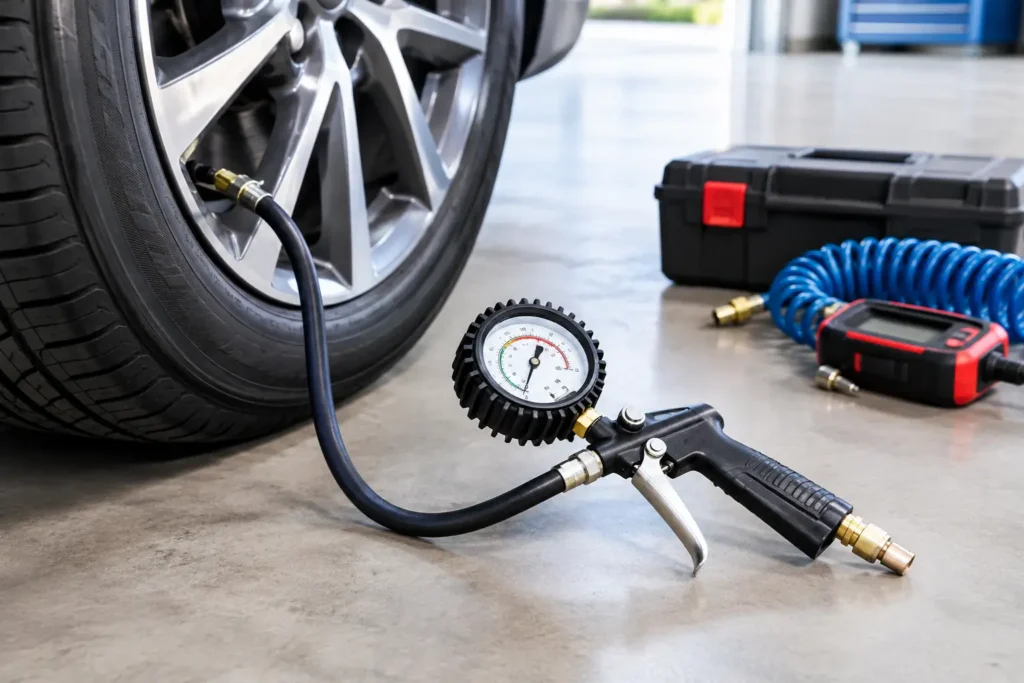
Dial gauges remain a strong choice for workshop use. They are straightforward, do not rely on batteries and are easy to read at a glance. A rubber protective surround is worthwhile because gauges get knocked off benches, caught on wheels and dropped on concrete.
Choose a dial with large markings and a sensible range. A 0-60 PSI gauge is ideal for most passenger vehicles, while a 0-100 PSI version gives more headroom for many vans. A 0-160 PSI gauge may be needed for higher-pressure commercial applications, but its lower-range resolution can be less precise.
The trade-off is that analogue gauges can lose calibration after hard knocks. They also need enough light to read properly. For fixed workshop bays, however, they remain dependable, affordable and easy to maintain.
Digital tyre inflator gauges
Digital models provide a clear numerical reading, often to 0.1 PSI. That is useful when matching pressures precisely across performance tyres, low-profile tyres or vehicles with sensitive tyre-pressure monitoring systems. Backlit displays are also practical in poorly lit garages and during roadside call-outs.
A digital gauge should have a durable casing, protected buttons and an automatic shut-off function to preserve battery life. Check the battery type before buying. Standard, readily available batteries are a better choice than a specialist cell that leaves the tool unusable when it runs flat.
Digital does not automatically mean more accurate. A well-made analogue gauge can be highly dependable, while a low-cost digital unit can drift or react badly to damp, cold and workshop abuse. Buy on build quality and stated accuracy, not the display alone.
Pencil gauges and standalone pressure gauges
Pencil gauges are compact, cheap and useful as a spare, but they are not the best option for fast tyre inflation. They measure pressure only and can be harder to read accurately. Keep one in a tool chest, glovebox or mobile kit for basic checks, but use a proper inflator gauge where tyre work is part of the job.
A standalone dial gauge is also useful for verification. Checking an inflator gauge against a separate, trusted gauge can help identify a problem before it affects every vehicle leaving the workshop.
Key Specifications to Check Before Buying
The gauge is only one part of the setup. Before ordering, check that the complete tool suits your compressor, airline and normal workload.
First, inspect the air inlet fitting. Many workshops use Euro quick-release couplers, while other systems may use PCL-style fittings or BSP threaded connections. A quality inflator gauge can still be inconvenient if it arrives with the wrong connector. Adaptors are inexpensive, but matching the existing airline standard saves time.
Hose length is another practical detail. A short hose keeps the tool compact, yet it can force you to crouch close to dirty wheels and makes some valve positions awkward. A flexible hose around 300 mm to 600 mm is a sensible middle ground for most garage work. It should be flexible enough in cold conditions, with protected crimped ends rather than flimsy fittings.
Also consider these working details when comparing models:
- A bleed button lets you reduce pressure without removing the chuck, making final adjustment quicker.
- A protected gauge face resists damage from falls, trolley wheels and general workshop knocks.
- A locking or clip-on chuck speeds up repeated tyre work and reduces air loss at the valve.
- A clear PSI scale is essential, while bar readings are useful when working across mixed vehicle specifications.
- A comfortable trigger gives better control when topping up tyres gradually rather than blasting in air.
For professional use, avoid treating the cheapest gauge as a false economy. If the chuck leaks or the reading cannot be trusted, every tyre check takes longer and tyre pressures become guesswork. A solid mid-range tool normally offers the best balance of price, durability and everyday accuracy.
Air Tyre 1/4″ Inflator with Analogue Gauge 220PSI | Hose Length 11″
Matching Gauge Range to Cars, Vans and Workshop Equipment
Passenger cars commonly run around 30-36 PSI, although the correct figure always comes from the vehicle manufacturer’s tyre-pressure label or handbook. A gauge centred around this range gives the clearest reading and the most useful control.
Vans, pickups and loaded commercial vehicles can require substantially higher pressures, particularly on rear axles. If your work includes regular van servicing, choose an inflator gauge rated to at least 100 PSI. Do not assume an unloaded van should be set to its fully loaded pressure – manufacturers often specify different values for normal and maximum-load use.
For lorries, agricultural equipment or high-pressure specialist applications, a standard car tyre inflator may not be suitable. Higher-pressure gauges, longer hoses and different valve arrangements may be required. This is where checking the pressure range, chuck type and compressor output before purchase prevents an expensive mismatch.
Your compressor also needs enough usable air delivery. Topping up one car tyre does not demand much airflow, but continuous tyre work in a busy bay can expose the limits of a small compressor. If pressure falls sharply while inflating, wait for the receiver to recover rather than relying on a reading taken while the system is struggling.
How to Get Accurate Pressure Readings
Even the best tool can give misleading results if it is used carelessly. Check tyres when they are cold wherever possible. Driving heats the air inside the tyre, raising pressure temporarily. For a workshop inspection after a vehicle has arrived, follow the manufacturer’s guidance rather than blindly setting a cold-pressure figure on hot tyres.
Push or screw the chuck on squarely. A brief hiss as it connects is normal, but continued leaking means the seal is poor and the displayed pressure may not be reliable. Keep the valve clean, inspect the valve core if leaks persist and replace cracked valve caps.
Inflate in short bursts, then release the trigger and allow the gauge to settle. If the tyre is slightly over, use the bleed valve in small steps. This is faster and more accurate than repeatedly removing and reconnecting the chuck.
For fleet work or customer handovers, record the pressure used and check all four tyres, plus the spare where fitted. Correct pressure is about more than tyre life. It supports predictable handling, braking performance and load carrying.
Care That Keeps an Inflator Gauge Working
Keep the gauge dry and do not leave it hanging where it can be run over or pulled from the airline. Drain compressor moisture traps regularly, because water in an air system damages tools and can affect internal components over time.
If the needle does not return to zero, the display flickers or the chuck starts leaking, deal with it before the next tyre job. Replace worn chucks and hoses where practical, but retire a gauge that cannot be verified. Pressure equipment is too routine and too safety-critical to work around unreliable readings.
For a practical workshop setup, choose a clear, protected gauge with the right PSI range, a dependable chuck and fittings that match your airline. Irish Tools Shop stocks the garage essentials that keep tyre checks quick, accurate and affordable – because a small tool that works properly saves time on every vehicle through the door.
