






A filter that has been tightened by heat cycles, fitted dry at the seal, or left untouched through several services can turn a quick oil change into a frustrating job. Which tools remove oil filters effectively depends less on brute force and more on the filter’s position, diameter and casing style. The right remover grips firmly without crushing the canister, damaging nearby parts or coating the workshop floor in old oil.
For most garages and serious DIY users, one universal tool is rarely enough. A cap wrench is often the cleanest option on a conventional spin-on filter, while pliers, a strap wrench or a chain wrench can save the day when access is restricted or the filter is seized. Choosing the correct tool before draining the sump keeps servicing faster, cleaner and more profitable.
19 Piece Cup Type Oil Filter Wrench Set For Cartridge Type Filters
Which tools remove oil filters best?
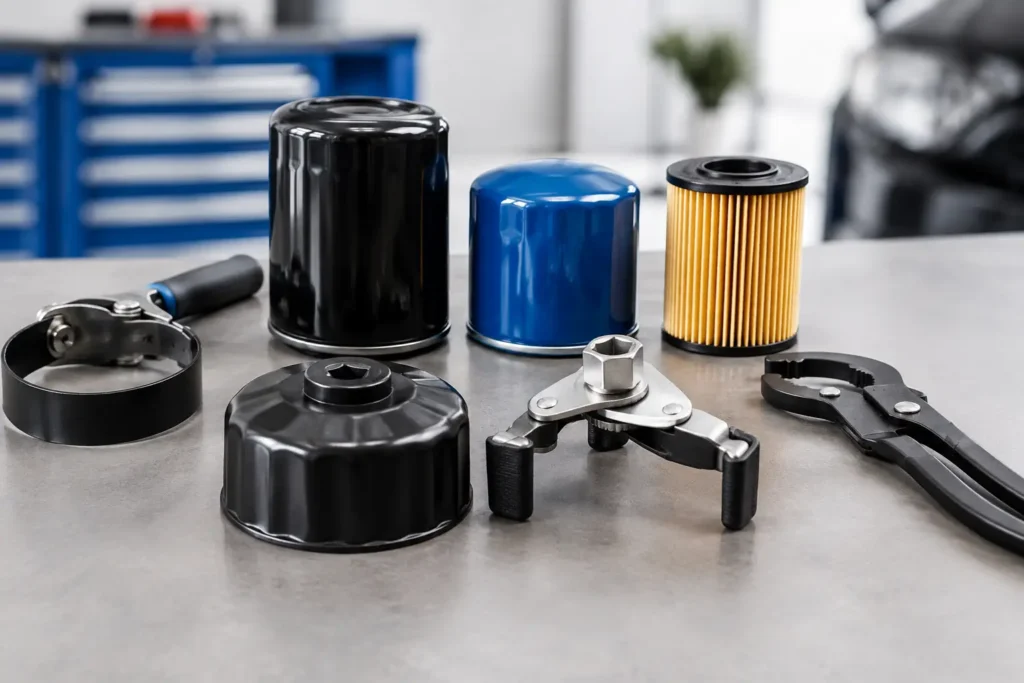
Oil filters broadly fall into two groups. Spin-on filters are self-contained metal canisters that screw directly onto the engine. Cartridge filters sit inside a reusable housing and are removed by taking off a plastic or aluminium cap. Each design calls for a different approach.
For spin-on filters, cup-style cap wrenches, adjustable claw removers, filter pliers, strap wrenches and chain wrenches are the main choices. For cartridge housings, a correctly sized oil filter socket or cap socket is usually the proper tool. Avoid trying to force a cartridge housing off with pliers or a chain wrench. Plastic caps can crack, and a replacement housing can cost far more than the correct socket.
The best buying decision is based on the jobs coming through the workshop. If you service a regular mix of cars and vans, a cap wrench set plus an adjustable remover covers a wide range. If you work on older vehicles, commercial vehicles or neglected service items, add a heavy-duty strap or chain wrench for extra grip.
Cap-style oil filter wrenches
A cap-style wrench fits over the end of a spin-on filter like a socket. It is driven with a ratchet, extension bar or breaker bar, depending on space and how tight the filter is. For cartridge systems, a similar-looking cap socket engages the moulded flats on the filter housing.
This is usually the first-choice tool where there is enough room around the filter. It applies turning force evenly around the filter body, so there is less risk of crushing a thin canister. It is also ideal when the filter sits low down or behind a splash guard and needs to be reached with an extension.
The limitation is fitment. A cap wrench must match the filter’s diameter and flute count, so a single cap does not suit every vehicle. A workshop set with common sizes is the practical answer for regular servicing. Check whether the tool is designed for a metal spin-on filter or a cartridge housing cap, as the two are not interchangeable.
Best for regular service work
Cap wrench sets are a strong value purchase for garages handling modern cars. They are quick to use, easy to store and less likely to damage components than aggressive gripping tools. Use a six-point socket or appropriate drive tool on the cap where possible, and keep the ratchet square to avoid slipping.
Adjustable claw and three-leg removers
Adjustable claw removers use two or three serrated arms that tighten their grip as torque is applied. Most are driven from the centre with a 3/8-inch or 1/2-inch ratchet. They suit a broad range of spin-on filter diameters, making them useful when the correct cap wrench is not available.
A three-leg type centres itself well and can grip firmly on stubborn filters. It works particularly well from underneath when there is clear access to the bottom of the filter. The harder the filter resists, the more the jaws bite.
That strength is also the trade-off. On a thin or rusty canister, the claws can dent the filter. This is not a concern if the filter is being replaced, but a crushed filter can become harder to remove if the tool loses purchase. Start with controlled pressure and ensure the arms are seated evenly. Do not use an impact wrench on an oil filter remover – it can tear the canister or damage the filter mounting thread.
2 Pce Self Adjusting Oil Filter Wrench (63-120mm) With 1/2″ and 3/8″ Adaptor
Oil filter pliers
Oil filter pliers have long, shaped jaws that wrap around the canister. They are simple, fast and highly useful where there is side access. A mechanic can grip, turn and remove many filters without setting up a ratchet or matching a cap size.
They are a sensible all-rounder for home servicing and mobile work because they cover several filter sizes. The extended handles give good leverage, while the serrated jaws bite into the casing when the filter is oily. They are particularly useful in an engine bay where a socket-style tool cannot be placed over the filter end.
Pliers are not the neatest method on tightly packed engines. They need room to open and swing, and their jaws can crush a filter if used with excessive force. Use them for removal only, never for fitting a new filter. A new spin-on filter should normally be tightened by hand according to the vehicle manufacturer’s instructions.
Strap wrenches for awkward access
A strap wrench uses a flexible band, usually rubber, nylon or reinforced webbing, wrapped around the filter. Turning the handle tightens the strap around the canister. Because the strap spreads force over a larger area, it can offer a secure grip without biting deeply into the metal.
This makes it a good option for filters in awkward locations and for larger-diameter filters. Rubber straps can be especially useful on smooth filters where metal jaws struggle to hold. They are also less likely to mark painted surfaces if working close to other components.
The drawback is that a strap can slip when the filter is heavily contaminated with oil or is extremely tight. Wipe the filter body first, position the strap close to the mounting end and pull steadily. Cheap, thin straps can stretch or twist under load, so choose a heavy-duty workshop-grade model if it will see frequent use.
Chain wrenches for seized filters
A chain wrench is the hard-working option for filters that refuse to move. Its metal chain loops around the canister and locks against a handle as it is turned. It produces serious grip and suits large filters, including those found on vans, 4x4s, agricultural equipment and plant machinery.
For stubborn filters, few hand tools match the holding power of a chain wrench. It is a valuable addition to a workshop tool kit where vehicles may arrive with overdue servicing or filters fitted too tightly by a previous operator.
Use it with care. A chain wrench can quickly crush a standard spin-on filter, especially if the chain is positioned too far from the mounting plate. That does not always stop removal, but it can make a messy job messier. Keep a drain tray directly underneath and wear gloves, as the chain and casing edges can be sharp.
What about screwdrivers and improvised methods?
Driving a screwdriver through an oil filter is a last-resort tactic, not a proper removal method. It creates a guaranteed oil spill, weakens the casing and can leave the mounting plate stuck to the engine if the filter tears apart. There is also a real risk of striking wiring, hoses or the engine block in confined spaces.
If a filter is badly seized, work through the proper options first: confirm the direction of removal, use the correct cap or adjustable tool, improve access by removing the undertray if necessary, and apply steady force. A chain wrench or quality claw remover is cheaper than the time lost cleaning up a failed improvised attempt.
Match the tool to the vehicle and the job
Before ordering an oil filter removal tool, identify whether the engine uses a spin-on filter or cartridge housing. Check the available access from above and below, and consider the filter sizes you see most often. A technician servicing fleet vans may need stronger chain and strap tools than a DIY owner changing the filter on one family car.
A practical workshop setup includes a cap wrench set for common applications, an adjustable three-leg remover for mixed work, and either filter pliers or a strap wrench for difficult access. Add a chain wrench when dealing with larger or stubborn filters is part of the job. This combination avoids wasted time, damaged filter housings and unnecessary repeat work.
For affordable, reliable workshop equipment, buy for the jobs you actually carry out rather than the biggest-looking tool on the shelf. Irish Tools Shop supplies the hard-working garage essentials that help keep routine servicing moving and vehicles back on the road.
A clean oil change starts before the drain plug comes out: have the right filter tool, a suitable drain pan and the replacement filter ready. When the old filter finally breaks free without a fight, the rest of the service is exactly what it should be – quick, controlled and ready for the next job.
