







A Peugeot 1.2 timing job can become an expensive comeback if the crankshaft and camshafts are not held in their exact positions. Peugeot 1.2 timing tools are not an optional extra for proper belt, chain or cylinder-head work – they are the equipment that keeps valve timing controlled while the engine is stripped and rebuilt.
For busy garages, mobile mechanics and capable DIY users, the right kit saves time at the vehicle and removes guesswork. A universal pin set may look close enough, but close enough is not a specification. Peugeot 1.2 engines have changed across model years and power outputs, so tool selection starts with the engine code and timing-drive design, not the badge on the bonnet.
Why Peugeot 1.2 timing tools matter
The 1.2-litre petrol engine appears across a wide range of Peugeot, Citroën, DS, Vauxhall and other Stellantis vehicles. Many are known as PureTech units, but that label alone does not identify the correct tooling. There are naturally aspirated, turbocharged and later revised versions, with differences in timing arrangements, camshaft locking points and service procedures.
During timing-belt replacement, camshaft work or head removal, the crankshaft must be indexed precisely and the camshafts locked as the manufacturer procedure requires. If the engine turns independently while the belt or chain is off, piston-to-valve contact may be possible on an interference engine. Even where no immediate damage occurs, incorrect timing can lead to misfires, poor starting, fault codes and lost labour when the job has to be done again.
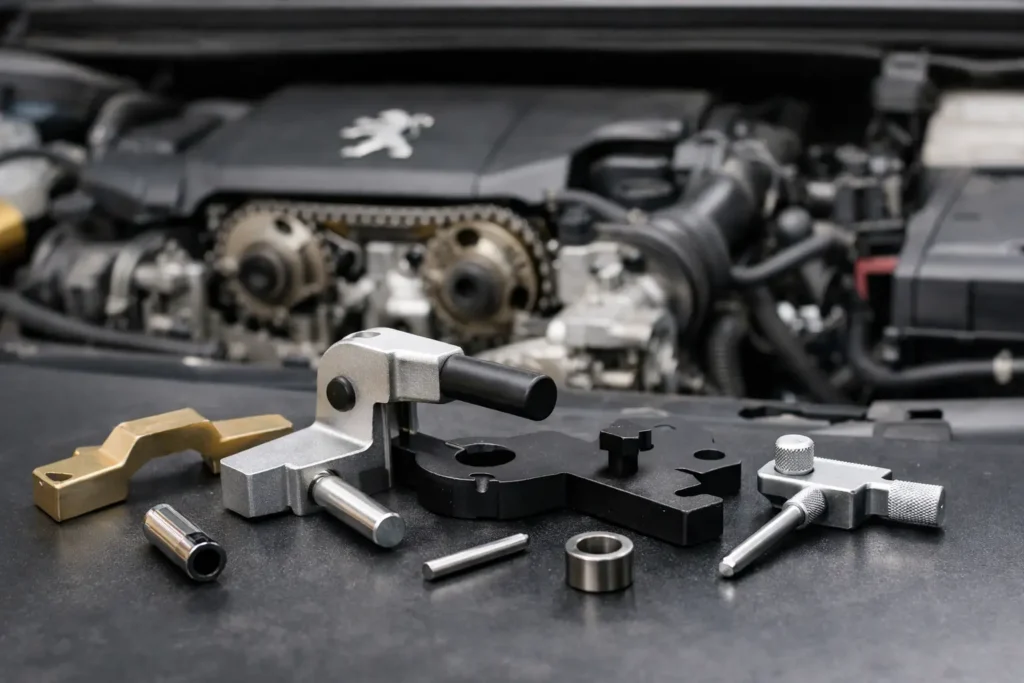
A vehicle-specific timing kit normally provides the correct diameter and length of locking pins, along with the setting or alignment plates needed to secure the engine at top dead centre. This gives the technician a repeatable reference point rather than relying on paint marks, marker pen or memory. Paint marks can assist during inspection, but they should never replace proper locking equipment on a critical engine repair.
Check the engine before buying a timing kit
The most common ordering mistake is buying a kit listed simply for a Peugeot 1.2 petrol. That description is too broad on its own. Confirm the vehicle registration details, build year, engine code and engine output before ordering. The engine code is usually available from vehicle data, technical information or the engine identification marking.
Also establish what work is being carried out. A kit suitable for a timing-belt service may not include every item required for cam carrier removal, crankshaft pulley work or a deeper cylinder-head repair. Some jobs need additional support equipment, such as an engine support beam, torque wrench, pulley holding tool, puller or suitable low-profile sockets. Timing tools position the engine correctly, but they do not replace the rest of the workshop equipment required to complete the procedure safely.
On early 1.2 PureTech applications, the belt-in-oil arrangement deserves particular care. Belt condition, debris in the lubrication system and the exact manufacturer service process should be assessed before parts are fitted. Later engine variants may use a different timing-drive arrangement, so do not assume a wet-belt kit covers every newer 1.2 model.
When comparing kits, look for clear fitment details rather than broad claims. Good listings identify the engine family or codes covered, the applications intended and the individual locking components included. If the listing does not give enough fitment information to match your engine, stop and verify before purchasing.
What a proper Peugeot 1.2 timing tool kit should include
A useful kit is built around accuracy, not the number of pieces in the case. The essential components depend on engine variant, but a correctly specified set commonly includes crankshaft locking pins, camshaft locking pins or plates, and an alignment gauge or setting tool where the engine procedure calls for one.
The locking pins should be hardened steel and machined cleanly. A rough, poorly finished pin can damage a locating hole or fail to seat fully, which defeats the point of using dedicated equipment. The case matters too. In a working garage, a marked blow-moulded case makes it quicker to check that every component is back in place before the next booking.
Do not be distracted by oversized multi-brand kits if only a small portion is relevant to the job. A broad kit can offer value for a workshop servicing several engine families, but a dedicated Peugeot and Citroën 1.2 kit is often faster to identify, easier to use and less likely to leave the technician sorting through unused adaptors. The best choice depends on the vehicles you see regularly.
Dedicated kit or universal timing tools?
Universal timing tools have a place in a general workshop, particularly for older engines and less specialised work. They are useful for holding sprockets or supporting a range of service tasks. However, they are not a replacement for manufacturer-style locking positions on a modern Peugeot 1.2 engine.
A dedicated kit costs a little more than an improvised arrangement, but it pays for itself quickly when it prevents an avoidable error. It also supports a more efficient workflow. The technician can lock the crank and cams, check the position, carry out the repair and verify timing without repeated measuring or uncertain reference marks.
For garages servicing Peugeot, Citroën and related Stellantis vehicles every week, dedicated timing equipment is a sensible stock item. For occasional users, it is still the right purchase where the engine application matches. Timing work is one area where hiring the cheapest tool or forcing a near-fit pin can turn a routine service into a major repair.
Using timing tools correctly in the workshop
Even the best kit will not compensate for an incorrect procedure. Start with the official repair data for the exact engine and vehicle. Remove covers and ancillary components carefully, rotate the engine only in the specified direction, and bring it to the stated timing position before inserting any locking pin.
A locking pin should slide into its correct location without force. If it will not enter, do not hammer it home. Recheck the crankshaft position, camshaft position and whether the tool actually suits the engine code. Forcing a pin may damage the engine, bend the tool or create a false impression that the timing is set.
Once the timing drive has been renewed or refitted, follow the required tensioning sequence and torque settings. Remove the locking tools before rotating the engine by hand through the required number of revolutions. Then return to the timing position and confirm that the pins and plates locate correctly again. This final check is quick, but it is one of the strongest safeguards against a costly mis-timed engine.
Never use timing pins as levers, pulley stops or holding tools while applying high torque. They are locating tools. Use the proper counterhold tool where the procedure requires one. This protects both the locking points and the kit itself.
Build the right kit around the timing job
Timing tools are only one part of a dependable engine-service setup. A calibrated torque wrench is essential for critical fasteners, while a breaker bar, quality socket set and suitable extractor tools make access work faster and safer. If engine mounting components must be removed, an engine support beam provides stable support from above. For lower access, a trolley jack and correctly rated axle stands remain workshop essentials.
For a garage, buying tools as a working system makes better commercial sense than replacing poor equipment job by job. Reliable, affordable professional-grade tools reduce delays, protect labour margins and give technicians confidence when dealing with high-risk work. Irish Tools Shop focuses on the everyday workshop equipment that earns its space on the bench, from specialist service kits through to lifting and storage equipment.
Buy on fitment, quality and availability
The lowest-priced timing kit is not always the best value. Check that it covers the exact engine, includes the locating tools required for the repair and is made for repeated workshop use. A missing plate or incorrect pin found halfway through a job is more expensive than spending a little extra on the right kit at the start.
Keep the kit clean after use, return each component to its marked position and inspect pins for wear, corrosion or bending before the next job. Dedicated timing tools are small items, but they protect one of the most precise operations in engine repair. Match the kit to the engine code, follow the repair data and you can complete Peugeot 1.2 timing work with the accuracy a professional workshop demands.
