






4 Ton Low Profile Floor Trolley Jack with Quick Dual Pump & 3 Years Warranty
A jack that looks fine on a product page can be the wrong tool the moment it rolls under the car. Too tall to reach the jacking point, too short to lift high enough, or simply not built for the weight – that is usually where buyers get caught out. If you are working out how to choose trolley jacks, the right starting point is not price alone. It is the vehicle, the working height, and how often the jack will actually be used.
For most buyers, a trolley jack is not a casual purchase. It is a workshop essential. Whether you are a home mechanic changing brakes at the weekend or a garage using lifting equipment every day, the wrong jack slows the job down and creates unnecessary risk. The right one gives you stable lifting, decent clearance, and the confidence that the tool will hold up under regular use.
0.5 Ton Vertical Hydraulic Telescopic Car Gearbox Transmission Jack
How to choose trolley jacks for the job
The first thing to get right is capacity. Many buyers assume a 2 tonne jack lifts a 2 tonne car with no issue, but that is too simplistic. A trolley jack normally lifts one end of the vehicle at a time, not the full vehicle weight, yet you still want a healthy safety margin. For small hatchbacks and saloons, a 2 tonne model often covers basic home use. For heavier estates, SUVs, vans, and regular trade work, a 2.5 tonne or 3 tonne jack is usually the safer buy.
Going bigger is not always better, though. Higher-capacity jacks are often heavier and bulkier. If you need to carry the jack in a van, move it around a tight garage, or store it on a shelf, size and weight matter. A serious DIY user may get more value from a well-made 2.5 tonne low-profile jack than from an oversized workshop model that is awkward to handle.
Lift range matters just as much as rated capacity. This is where many poor purchases happen. A low sports car, performance saloon, or modern car with minimal ground clearance may need a low-entry jack that gets under the sill without scraping. At the other end, if you are lifting a 4×4, van, or light commercial vehicle, a standard jack may fit underneath but fail to raise the vehicle high enough for axle stands or wheel removal. Always check both the minimum saddle height and the maximum lift height before you buy.
Low profile or standard height?
If you mainly work on everyday passenger cars, a standard trolley jack may be enough. It tends to be more affordable and perfectly suitable for routine servicing, tyre changes, and brake work. If your vehicle sits low or uses side skirts, splitters, or sport suspension, low-profile design becomes far more important.
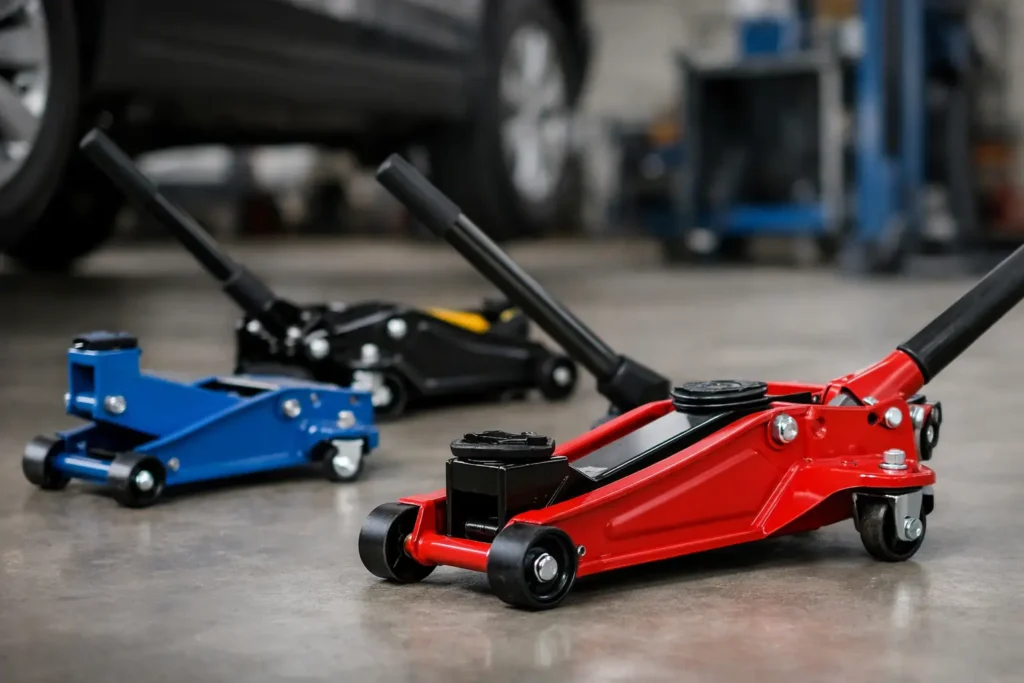
A low-profile trolley jack gives you access where a taller frame cannot. That sounds like a small detail until you are trying to slide the jack into place on a car with very little clearance. For garages dealing with mixed vehicle types, low-profile models usually make more sense because they cover a wider range of cars without needing workarounds like driving onto blocks first.
There is a trade-off. Some ultra-low jacks can be more specialised, and not every low-entry model gives you the lift height needed for taller vehicles. That is why the full lift range matters more than any single feature printed in large text on the box.
Steel, aluminium, and overall build quality
When comparing jacks, material choice tells you a lot about where the product fits. Steel trolley jacks are the standard choice for workshops and heavier use. They are usually tougher, more stable under load, and better suited to repeated use on garage floors. They also tend to offer stronger value for money if your priority is durability over portability.
Aluminium or hybrid aluminium-steel jacks are lighter and easier to carry. For mobile mechanics, track-day users, or anyone loading tools in and out of a vehicle, that lower weight can be a genuine advantage. The downside is that lightweight designs can cost more and may not feel as planted as a heavier steel jack under demanding use.
Build quality is not only about the main frame. Look at the wheels, saddle, handle fit, release action, and welds. A trolley jack should roll smoothly, position cleanly, and lift without feeling rough or vague. If the handle flexes too much or the release is abrupt, the tool can become frustrating very quickly. Professional users know this already – small design weaknesses become obvious after a week of real work.
3 Ton Trolley Jack Heavy Duty Hydraulic Floor Jack Fits Caravan Van 4×4 Garage
Single piston or quick lift?
If you use the jack regularly, lifting speed matters. A quick-lift or twin-piston system gets the saddle to the contact point faster, which saves effort and time. That is useful in a busy garage and still worthwhile in a home workshop if you are working on multiple vehicles.
A basic single-piston trolley jack can still be a sensible buy for occasional use, especially if price is a key factor. The main thing is to be realistic. If the jack only comes out a few times a year, you may not need workshop-spec speed. If it is part of your daily setup, a faster lifting design is money well spent.
Wheel size, manoeuvrability, and garage floor conditions
Many buyers focus on capacity and ignore how the jack moves. That is a mistake. A trolley jack that fights you on the floor is harder to position accurately and more annoying to use. In a proper workshop with smooth concrete, most decent models roll well enough. On rougher surfaces, expansion joints, or older floors, wheel quality becomes much more important.
Larger rear wheels and solid castors generally improve movement and positioning. Heavier-duty models tend to track better under load, which helps when you need a precise approach to a jacking point. If you are buying for a professional environment, stability and wheel quality are not optional extras. They are part of the tool doing its job properly.
Manarola 4 Ton 2 Post Car Lift With Electric Lock Release / Auto Lock | Single Phase
Safety is not a feature – it is the baseline
No matter how well-made the jack is, it is a lifting tool, not a support stand. That means using axle stands every time you work under a vehicle. A trolley jack should lift smoothly and hold load securely during the lift, but the vehicle must be supported correctly before any work begins underneath.
It is also worth checking for overload protection and a controlled lowering mechanism. These features help protect both the user and the jack itself. Cheap, poorly made jacks often cut corners here, and that usually shows up in inconsistent release, unstable lifting, or reduced service life.
If you are buying for a garage, reliability under repeated use should carry more weight than chasing the lowest ticket price. Downtime costs money. Replacing a failed jack in the middle of the week is rarely a saving.
Matching the jack to the vehicle type
For smaller cars and routine servicing, a compact 2 tonne or 2.5 tonne jack is often the practical choice. It stores easily, handles most domestic vehicles, and suits buyers who want affordable and reliable lifting equipment without paying for capacity they will never use.
For performance cars or low-clearance models, the focus should shift to low entry height first, then lift range and frame quality. A standard jack with a good capacity rating is still the wrong tool if it cannot get under the car safely.
For SUVs, pick-ups, vans, and mixed-use workshop environments, 3 tonne capacity and a higher maximum lift are generally better. These vehicles put more demand on the equipment, and buying too light usually leads to disappointment. If you run a trade workshop, it often makes sense to buy for the heaviest common job rather than the lightest vehicle in the building.
4 Ton Low Profile Floor Trolley Jack with Quick Dual Pump & 3 Years Warranty
Price, value, and what is actually worth paying for
A cheap trolley jack is only good value if it does the work safely and lasts. A more expensive model is only worth it if the added features match your use. That sounds obvious, but it is where many purchases go wrong. Buyers either overspend on features they do not need or underspend and end up replacing the jack early.
The best value usually sits in the middle – enough capacity, proper lift range, strong construction, and dependable operation without paying premium-brand money for no practical gain. That is why specification-led buying makes more sense than buying by badge alone.
If you are comparing options at Irish Tools Shop, look at the numbers first and the marketing second. Capacity, minimum height, maximum lift, chassis design, and build type tell you far more than broad claims about quality.
0.5 Ton Vertical Hydraulic Telescopic Car Gearbox Transmission Jack
How to choose trolley jacks without overbuying
The smartest way to buy is to match the jack to your most common work, then leave room for occasional heavier jobs. If you mostly service family cars, choose a model that fits those cars well and offers a sensible safety margin. If you handle trade work across different vehicle sizes, buy broader capability from the start.
A trolley jack should feel like a reliable part of the workshop, not a compromise you notice every time you use it. Get the height range right, buy enough capacity, and do not ignore build quality just to save a few pounds. The right jack earns its keep quickly, especially when the next job cannot wait.
