









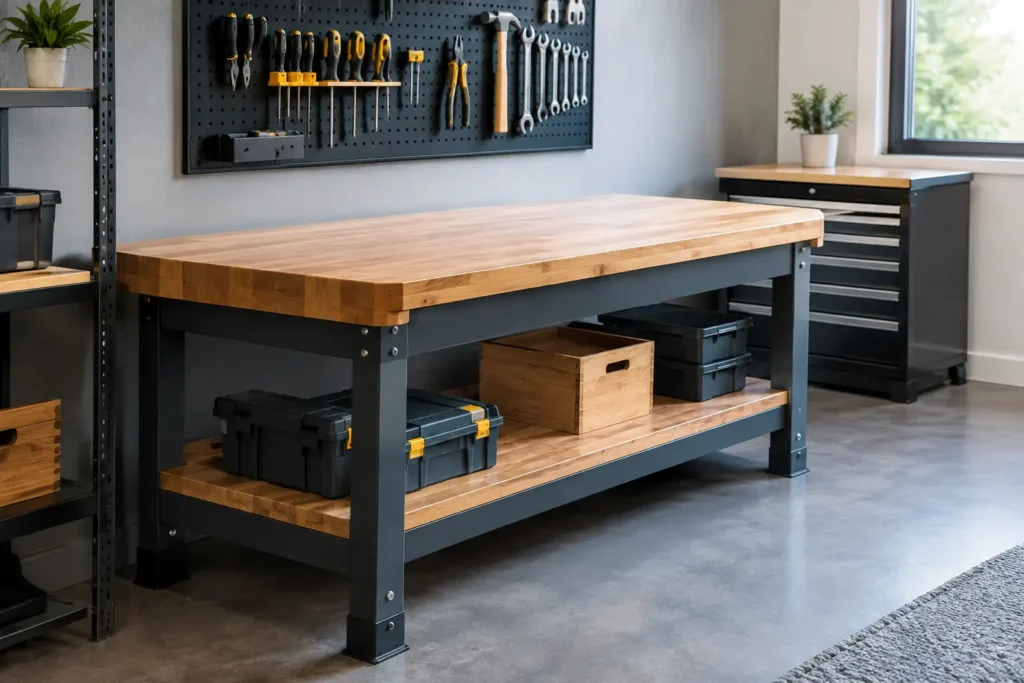
A workbench that flexes when you tighten a seized bolt, rocks while using a vice, or disappears under loose tools costs time every day. This garage workbench buying guide focuses on the specifications that matter in a working garage: usable space, load capacity, frame strength, storage and a top that can take proper abuse.
The cheapest bench is rarely the best value if it needs reinforcing after a few months. Equally, a huge industrial bench is wasted money if your workshop has limited floor space and most jobs are light repair work. Buy for the work you actually do, with enough capacity to handle the jobs you plan to take on next.
Start with the jobs your bench must handle
A bench used for servicing cars, assembling parts and organising hand tools needs a different setup from one used for rebuilding engines or fabricating brackets. Before comparing prices, think about what lands on the bench in a typical week. Brake calipers, impact tools, battery chargers and component trays need space and containment. A cylinder head, gearbox part or vice-mounted job needs a far stronger platform.
For general mechanical work, a solid steel-framed bench with a substantial timber or metal worktop is usually the sensible choice. If you regularly clamp parts, press bearings, cut steel or use a heavy bench vice, prioritise a heavy-duty frame and a thick top over extra drawers. Storage is useful, but it cannot compensate for a bench that moves under load.
Also consider whether the bench is a dedicated work surface or the centre of the whole garage. A dedicated fabrication bench can stay clear and bare. A main garage bench often needs built-in drawers, shelving and a backboard because it becomes the home for the tools used on every job.
Garage workbench buying guide: measure the real space
Measure the wall, then measure the working space in front of it. This is where many buyers get caught out. A 1.8-metre workbench may fit against the wall but still leave too little room to open a tool chest, manoeuvre an engine crane or walk around a vehicle safely.
Allow enough clearance to use the bench without blocking vehicle access, door openings or your route to the compressor and lifting equipment. In a single-car garage, a 1.2-metre to 1.5-metre bench often makes better practical sense than the longest option available. In a professional bay or larger home workshop, a 1.8-metre to 2-metre bench gives useful room for parts, tools and a permanent vice position.
Bench depth matters as much as width. A shallow top is fine for storing diagnostic equipment or hand tools, but it quickly becomes restrictive when working on larger assemblies. Around 600 mm deep is a good all-round starting point for garage work. More depth gives greater working room, though very deep benches can make wall-mounted storage hard to reach.
Height should suit the task. A worktop around waist height suits most standing mechanical jobs and reduces unnecessary bending. If several people use the garage, an adjustable-height bench can be worthwhile. For a fixed bench, check whether the height still works after fitting a vice, rubber mat or raised work surface.
Check the load rating, but read it properly
A quoted load capacity is one of the quickest ways to compare benches, but only if you understand what it represents. A high total capacity is useful, yet it may be based on an evenly distributed load across the complete worktop. A heavy engine component dropped into one area, or a vice pulling against the front edge, places a very different strain on the frame.
Look for a bench with steel legs, cross braces and a frame that supports the top along its length. Welded steel construction generally offers greater resistance to twisting than light bolt-together frames. Bolt-together benches can still be excellent value for maintenance and DIY work, provided the fixings are substantial and the legs can be secured properly.
For serious garage use, do not buy solely on the maximum kilogram figure. Examine how the weight is carried. Is there centre support on a long bench? Is the lower shelf braced? Are the feet wide enough to prevent movement? Can the unit be bolted to the floor or wall if required? These details decide whether the bench feels dependable when the job gets difficult.
Choose a worktop that matches the abuse
The worktop is the part you touch all day, and each material has a trade-off. Timber tops are popular because they are forgiving on components, easy to drill into and straightforward to repair. A thick hardwood or laminated timber top handles general workshop work well, although oil, brake fluid and aggressive chemicals should be cleaned quickly to avoid staining or damage.
Steel tops are tougher against impact, welding sparks and spills, making them useful in fabrication areas or commercial garages. They are less forgiving on painted parts and loose components, and a thin steel skin without proper support underneath can dent. A stainless steel top is easy to wipe down and resists corrosion, but it costs more and may be unnecessary for a standard mechanic’s bay.
For many garages, a thick timber top protected with a replaceable rubber mat gives the best balance. The mat prevents parts from rolling, protects the surface from scratches and provides a cleaner area for rebuilding smaller components. Keep a bare section available for clamping and vice work.
Do not treat vice fitting as an afterthought
A bench vice places huge leverage on the worktop and front rail. If you intend to fit one, choose the bench around the vice, not the other way round. The mounting area needs solid support directly below it, and the bench must be stable enough that hard tightening does not rack the frame.
A front corner is normally the most useful location because long materials can extend beyond the bench. Check that the vice handle can swing freely and that any drawers below will still open. On a timber top, use large washers or a backing plate beneath the mounting bolts to spread the load. On a metal-topped bench, ensure the frame rather than a thin sheet takes the strain.
If the bench will carry a grinder, drill stand or other fixed equipment, leave room around each machine for safe operation. A crowded bench encourages unsafe shortcuts, especially when you are trying to finish a job quickly.
Storage should save time, not steal work space
Drawers, cupboards and lower shelves make a garage more efficient when they are used for the right items. Deep drawers are ideal for impact sockets, brake service kits and larger hand tools. Shallow drawers suit pliers, measuring tools, drill bits and consumables. A lower shelf is useful for fluid containers, tool cases and equipment that is heavy but not needed every day.
Check drawer capacity, runner quality and whether drawers lock. Light-duty runners are acceptable for fasteners and gloves, but mechanic’s tools add weight quickly. A drawer that jams under a socket set is a daily frustration. If security matters, a lockable cabinet or lockable tool chest beside the bench may be better than relying on a few small locking drawers.
Avoid turning every square centimetre under the top into storage. Open leg room can be valuable when working close to a vice or sitting on a workshop stool. It also allows space for a trolley, parts bin or welding equipment when needed.
Fixed, mobile or modular: buy for the layout
A fixed workbench is the strongest choice for regular heavy work. Once levelled and anchored, it provides a stable base for clamping, pressing and vice use. It is the right option for most permanent garages, especially where the bench has a clear wall position.
A mobile bench on locking castors suits smaller workshops where vehicles and equipment must share the same floor. Choose large, heavy-duty castors with positive brakes, not small furniture wheels. Even then, mobile units are best for assembly, service work and tool preparation rather than heavy hammering or high-leverage vice work.
Modular benches can offer good value when you need to build a longer run over time. You can start with a strong base bench, then add cupboards, drawers or wall storage as the tool collection grows. Make sure added sections sit level and do not leave unsupported gaps in the worktop.
Spend where it makes the bench last
A good bench does not need decorative finishes or complicated accessories. Spend on frame steel, a properly supported top, stable feet and reliable drawer runners. These are the parts that keep working after years of dropped parts, oil spills and heavy tooling.
At Irish Tools Shop, the practical approach is simple: compare dimensions, construction and capacity before chasing the lowest headline price. A well-chosen garage workbench keeps essential tools within reach, gives you a stable place to work and makes every repair feel less like a fight with the workshop itself.
Before placing the order, mark out the bench footprint on the floor with tape and stand where you would use the vice. That five-minute check can prevent buying a bench that looks right online but does not work in your garage.
