






A gearbox job can stop dead when the engine has no safe support from above. The best engine support bars keep the engine correctly positioned while the gearbox mount, subframe or sump area is removed, giving mechanics with proper access without relying on a jack balanced underneath.
For a working garage, this is not a tool to buy on looks alone. Load rating, beam width, adjuster design and the condition of the vehicle’s lifting points all matter. A cheap bar that flexes, slips or does not span the inner wings correctly is no saving when the job involves a heavy engine and confined working space.
What an engine support bar does
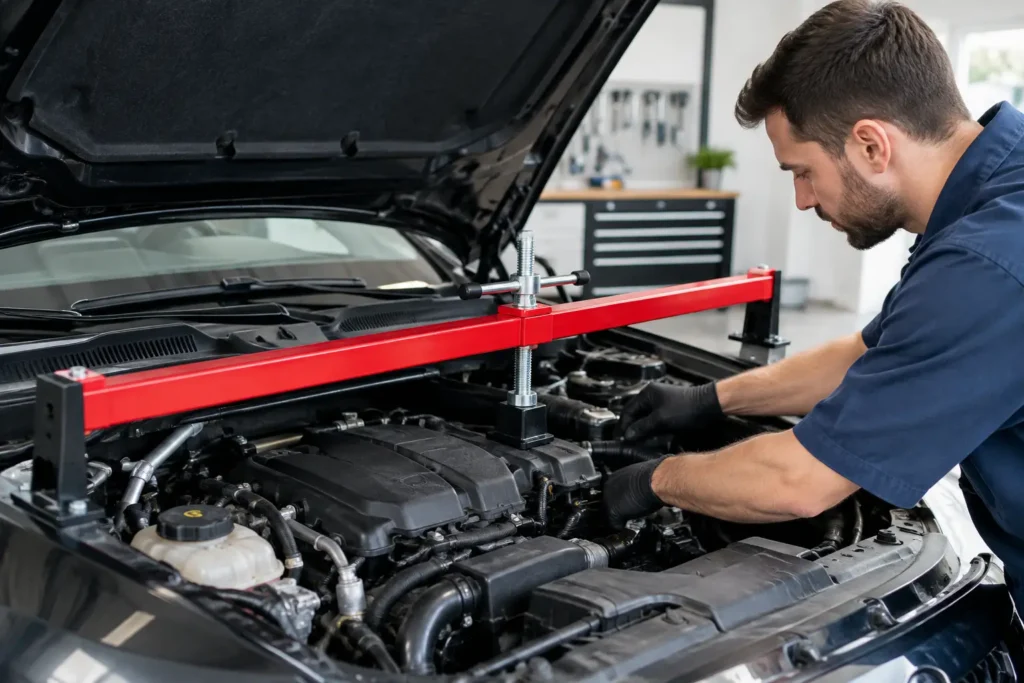
An engine support bar sits across the engine bay, normally resting on reinforced areas of the inner wings or suspension turret sections. A chain, hook or support bracket attaches to an approved engine lifting point, while threaded adjusters take the engine weight and allow small height changes.
This arrangement is particularly useful when removing a gearbox, replacing an engine mount, dropping a subframe, changing a clutch or carrying out timing work where an engine needs to be held in a controlled position. It frees space below the vehicle for a transmission jack, axle stands and normal workshop access.
An engine support bar is not an engine crane, and it is not a substitute for supporting the vehicle safely. The car must remain securely supported on correctly rated axle stands or a lift. The bar supports the engine only. Never use it on damaged inner wings, thin bonnet-rain channels or unapproved bodywork edges.
Best engine support bars: what to look for
The right choice depends on the vehicles coming through the workshop. A compact bar may be enough for occasional front-wheel-drive hatchback repairs. A busy garage handling larger saloons, vans and different engine layouts needs greater beam adjustment, stronger feet and a higher rated support system.
Load capacity with a sensible safety margin
Always start with the stated maximum load. Many common engine support bars are rated around 500 kg, which covers a wide range of engine-support work because the bar is often carrying the engine rather than the full powertrain. However, do not assume this rating suits every job.
Check the approximate engine weight, consider whether the gearbox or other components remain attached, and allow for the angle created as mounts are removed. A higher capacity does not excuse poor setup, but it gives a useful safety margin for professional work. The rating should be clearly marked and supported by a solid, heavy-duty frame rather than vague sales claims.
Adjustable beam width and stable feet
A support bar needs to span the vehicle securely. Measure between the intended support points before ordering, then compare that measurement with both the bar’s minimum and maximum width. A bar with generous adjustment is more useful across mixed fleets, but excessive extension can reduce stability if the design is light-duty.
Wide, padded or rubber-faced feet help spread the load and reduce the risk of marking painted surfaces. They also provide better grip than narrow bare-metal contact points. Even so, protect the bodywork where appropriate and inspect the contact area first. Paint protection is useful, but it cannot strengthen weak metal underneath.
Threaded adjusters that hold position
The adjusters are where control comes from. Look for substantial threaded posts, easy-to-grip handles and a design that lets the engine be raised or lowered gradually. Fine adjustment is valuable when lining up an engine mount or creating enough clearance to remove a gearbox.
Avoid forcing a stiff adjuster under load. If the thread is dirty, damaged or poorly lubricated, lower the load safely and address the issue. A clean, smooth-running thread makes the job quicker and reduces the temptation to use sudden force near a suspended engine.
Chains, hooks and attachment hardware
The supplied chains and hooks deserve the same scrutiny as the bar itself. They should be strong enough for the rated system and long enough to reach approved lifting eyes without awkward angles. For some engines, a levelling bracket or additional rated hardware may be needed to achieve the correct position.
Do not hook a chain around manifolds, pipework, wiring brackets or any convenient-looking casting. Use manufacturer-approved lifting eyes or a proven mounting point designed to carry the load. Keep the chain as vertical as practical and make sure it cannot foul belts, pulleys, hoses or the cooling fan.
Choosing a bar for your type of work
For serious DIY repairs, a straightforward adjustable steel bar with a clear 500 kg rating, two dependable threaded supports and protective feet is usually the sensible buy. It covers the jobs that make a trolley jack alone awkward or unsafe, without taking up the space or budget of an engine crane.
Garage owners should place more value on range and repeatability. If several technicians work on different makes every week, choose a wider, heavier unit with strong support pads and easily replaceable chains or hooks. The time saved setting it up correctly soon matters more than the small saving on a light-duty alternative.
For vans and heavier vehicles, verify the exact application before buying. A larger engine may require a dedicated support fixture, a higher-capacity beam or an engine crane used in accordance with the vehicle repair procedure. The best tool is the one rated and shaped for the job, not the one that is merely available on the shelf.
Safe setup before removing a mount or gearbox
Preparation prevents most support-bar problems. Park the vehicle on level ground, apply the handbrake and support it correctly before working underneath. If the gearbox is coming out, plan its support separately with a suitable transmission jack. Do not let the engine bar carry components it was never intended to hold.
With the bonnet open, identify the factory lifting points and inspect the inner wings or turret tops where the feet will sit. Remove loose trim only if needed for clean contact. Position the beam squarely across the bay, fit the chains or hooks, and take up the slack slowly.
Before removing any mount, apply only enough tension to support the engine. Watch for movement at the feet, chain and lifting point. Once the mount bolts are released, make small adjustments rather than winding the engine sharply in one direction. A second technician is useful on complex jobs, especially where engine position affects driveshafts, exhaust sections or hoses.
After the repair, refit and tighten all mounts to the correct specification before fully releasing the support bar. Lower the engine gradually, check that nothing is trapped or under tension, then remove the equipment. Rushing this final stage can damage a new mount or leave a hose pinched behind the engine.
Common buying mistakes that cost time
The first mistake is buying by price alone. Affordable equipment is good business, but a support bar needs a credible rating, decent welding, stable feet and hardware that inspires confidence. A low purchase price becomes expensive if the bar bends, the threads bind or it does not fit the vehicles you service.
The second is overlooking width. A bar may be rated for the load but still be useless if its feet do not reach safe bodywork support points. Check the fully closed and fully extended dimensions, not just a product photograph.
The third is treating an engine support bar as a universal lifting solution. It is designed for controlled support across an engine bay, not for lifting a vehicle, pulling an engine clear of the bay or holding a complete engine and gearbox assembly at an unsafe angle.
Finally, do not forget storage and maintenance. Wipe off oil and grime after use, inspect chains for wear, keep adjuster threads lightly lubricated and store the bar dry. Simple care keeps the mechanism accurate and ready when a clutch, mount or gearbox job arrives unexpectedly.
A properly rated engine support bar is one of those workshop tools that earns its place quickly. Choose one that fits your regular vehicles, set it up on verified support points and pair it with safe lifting equipment below. That gives you cleaner access, safer repairs and less wasted time on every job where the engine needs to stay exactly where it is.
