







Manarola 4 Ton 2 Post Car Lift With Electric Lock Release / Auto Lock | Single Phase
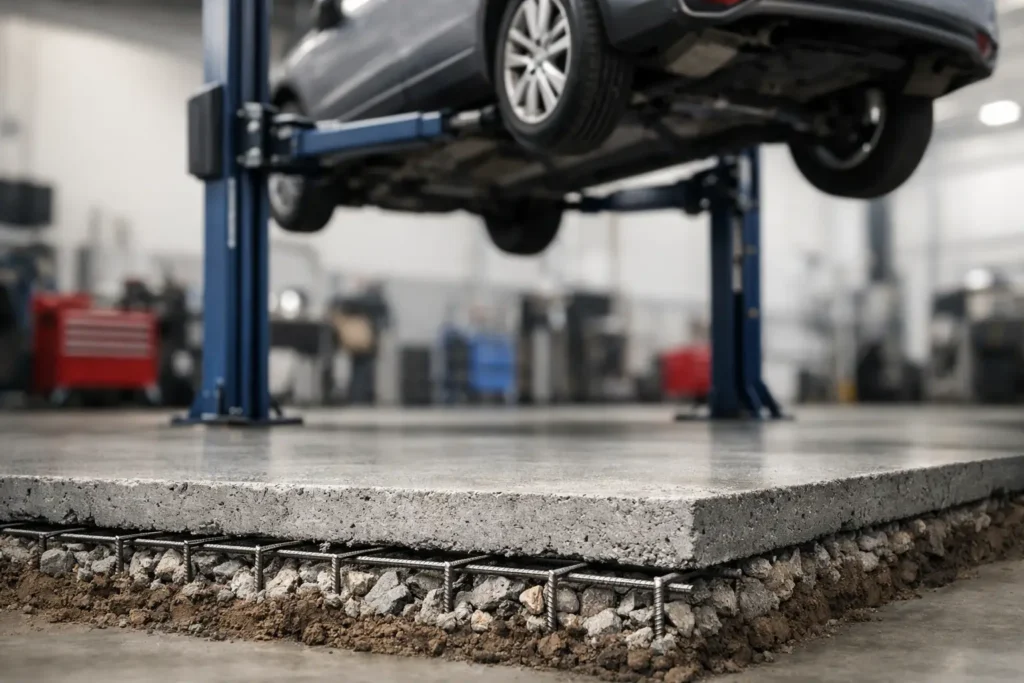
A two-post lift can turn a cramped workshop into a proper working space, but it puts serious forces into a small footprint. The question, “How thick does the concrete need for the two post lift?”, has no one-size-fits-all answer. In most cases, you need a sound, reinforced concrete slab at least 100-110 mm thick, but the lift manufacturer’s installation manual is the final word.
Getting this wrong is not a minor fitting issue. The columns, anchor bolts and lifting load all rely on the slab. A cheap shortcut beneath a heavy-duty lift can become an expensive and dangerous problem later.
How thick should concrete be for a two-post lift?
For many two-post vehicle lifts, the common minimum requirement is a concrete slab around 100 mm, or 4 inches, thick with a compressive strength of at least 20-25 MPa, often described as roughly 3,000-3,600 psi. However, plenty of lifts specify 110 mm, 125 mm or more. Larger-capacity lifts, asymmetric lifts, commercial units and certain baseplate designs may demand a thicker or stronger slab.
Do not treat 100 mm as automatic approval. It is a starting point, not a universal specification. A 3-tonne lift and a 5.5-tonne lift do not place the same demand on their anchor points, even if both appear similar from a distance.
The safe buying rule is simple: check the exact installation requirements for the lift model before pouring a new floor or drilling an existing one. If the manufacturer calls for 110 mm of C25 concrete, fitting it to an old 100 mm slab because it looks solid is not a sensible compromise.
Manarola 4 Ton 2 Post Car Lift With 12 Months Warranty | Single Phase
Slab depth is only half the job
Concrete thickness matters because the anchor bolts transfer the load from each lift post into the floor. Yet depth alone does not tell you whether that floor is suitable. The concrete must also be strong, properly cured and free from defects around the installation area.
For a working garage, aim for a properly specified reinforced slab rather than a thin domestic floor finish. Concrete needs time to reach its intended strength. New concrete is commonly allowed to cure for around 28 days before a lift is installed, unless the concrete supplier and lift manufacturer confirm another approved arrangement.
The quality of the ground underneath is just as relevant. A thick slab laid over poorly compacted fill can settle, crack or move. That is particularly worth checking in converted farm buildings, older units, detached garages and workshops where the floor’s construction is unknown.
Reinforcement helps control cracking and improve the slab’s overall performance, but it does not make an undersized slab acceptable. Nor does a smooth-looking surface prove that the concrete beneath is deep enough or strong enough for expansion anchors.
Manarola 3 Ton Low Profile Full Rise Scissor Lift – Pneumatic Release | Single Phase
Check the lift manual before ordering
Every reputable lift should come with clear foundation requirements. These usually state the minimum concrete thickness, compressive strength, anchor type, anchor embedment and required clearances. Follow those figures exactly, including any requirement for a single continuous slab beneath both columns.
Some lifts are designed for 100 mm concrete; others require 150 mm or a purpose-made pad. The difference may come down to lifting capacity, column design, arm geometry or the anchors supplied with the machine. Never swap anchors for a cheaper alternative unless the lift manufacturer has explicitly approved it.
Pay attention to the wording in the manual. Requirements such as “minimum 4.25 inches of 3,000 psi concrete” mean a genuine minimum depth of about 108 mm, not an estimate taken from the edge of a slab. If you cannot verify the depth, arrange a core sample or have a competent concrete contractor assess it before installation.
Can you install a two-post lift on an existing garage floor?
Sometimes, yes. Many mechanics install a two-post lift on an existing concrete floor successfully. The floor must meet the lift’s stated thickness and strength requirements and be in sound condition where both columns will sit.
Inspect the intended post locations closely. Avoid placing anchors through cracks, control joints, expansion joints, patched areas or the edge of a slab. A joint directly beneath a column is a red flag because it interrupts the concrete that should be resisting the load. Old repairs can be equally suspect if you do not know how deep they run or what material was used.
Floor coatings deserve attention too. Epoxy, tiles, levelling compound and thick paint may need to be removed beneath the baseplates so the posts sit flat on structural concrete. The baseplates need full, stable contact. Do not use random washers, timber packing or improvised shims to make up an uneven floor. Use only the shimming and installation method permitted by the lift supplier.
If the existing floor is questionable, cutting out and repouring purpose-built pads can be more economical than risking the lift, the vehicle and the people working underneath it. This is especially true if you are investing in a higher-capacity lift for daily workshop use.
Manarola 3 Ton Mid Rise Scissor Lift – Electric Release | Single Phase
Concrete strength, cracks and anchor holes
A suitable slab is generally dense, fully cured and free from major cracking around the anchor holes. Hairline surface cracking is not always an automatic failure, but it needs proper assessment when it is close to a baseplate. Wide cracks, loose concrete, spalling, crumbling edges and previous anchor holes can all reduce holding strength.
Anchor installation is not a job for guesswork. Hole diameter, drilling depth, cleaning method and tightening torque all affect how the anchor performs. Drill bits wear, holes can be oversized, and dust left in the hole can stop an anchor gripping as intended. Use the exact supplied or approved anchors and install them to the instructions.
Do not assume chemical anchors solve a poor slab. They may be approved for specific installations, but they still require suitable concrete and a documented design. For a lift, the manufacturer’s approved anchor system takes priority over forum advice or what happened to work in another garage.
When a thicker slab is the better investment
If you are pouring from new, building beyond the bare minimum gives you more options. A 125-150 mm reinforced slab, designed for the ground conditions and intended workshop use, can provide a stronger base for future equipment. That may include a larger two-post lift, scissor lift, tyre equipment, tool storage or heavier vehicles.
There is a cost trade-off. More excavation, concrete and reinforcement increase the initial spend, particularly where access for a concrete lorry is limited. But repouring a failed or unsuitable floor after the workshop is fitted out costs far more than specifying it correctly at the start.
For a commercial garage, or any workshop lifting vehicles every day, use a qualified installer or structural professional where the site is unusual, the soil is uncertain or the lift requirement is unclear. The right assessment protects your equipment, supports insurance and keeps the job moving without costly rework.
Manarola 4 Ton 2 Post Car Lift With 12 Months Warranty | Single Phase
Practical site checks before fitting the lift
Before the lift arrives, confirm the slab specification, then measure the workshop itself. You need enough ceiling height for the lift and vehicle combination, adequate width for doors to open, and clear space around the posts for safe access. Check for low roof trusses, lighting, roller-door tracks and services hidden in the floor.
Make sure the floor is level within the lift manufacturer’s tolerance. A sloping garage floor can affect column alignment, arm operation and vehicle stability. Also check the electrical supply required by the motor. A lift may be affordable to buy, but an unexpected electrical upgrade or floor rebuild can change the real installation cost.
For buyers across Ireland and the UK, millimetres and MPa are the figures worth recording. Keep the lift manual, concrete delivery docket and any installation paperwork together. If you later sell the workshop, replace anchors or make an insurance claim, those details are useful proof that the lift was fitted on a suitable base.
A two-post lift is one of the best upgrades a serious garage can make. Buy the capacity you need, match it to a verified concrete slab, and install it exactly as specified. That is how you get safe, reliable lifting from affordable professional-grade equipment for years of hard work.
Manarola 3 Ton Low Profile Full Rise Scissor Lift – Pneumatic Release | Single Phase
