






A socket that fits the fastener can still be the wrong socket for the job. Put a polished chrome socket on a high-torque impact wrench and it may crack, chip or fail without warning. That is why understanding What’s the difference between chrome and impact sockets matters before you start on seized wheel nuts, suspension bolts or heavy plant repairs.
Both types turn nuts and bolts, and both are useful in a working garage. The difference is in the steel, wall thickness, finish and the amount of sudden torque each socket is designed to handle. Choosing correctly protects the tool, the fastener and, more importantly, the person using it.
What’s the difference between chrome and impact sockets?
Chrome sockets are usually made for hand-operated tools such as ratchets, breaker bars, T-bars and torque wrenches. They are commonly manufactured from chrome vanadium steel and finished with bright chrome plating. This gives them a hard, smooth surface that resists corrosion and is easy to wipe clean.
Impact sockets are made for impact tools, including cordless impact wrenches, air impact guns and electric impact wrenches. They are commonly made from chrome molybdenum steel, often referred to as Cr-Mo. The steel is heat-treated to give the socket more ductility, allowing it to flex slightly under repeated hammering forces rather than becoming brittle and breaking.
In simple terms, a chrome socket is optimised for controlled, steady hand force. An impact socket is built to cope with rapid, repeated shock loads. An impact wrench does not simply apply more torque. It delivers sharp rotational blows, hundreds or thousands of times during a job. That is a very different demand on the socket wall.
Chrome sockets: clean, precise and ideal for hand tools
A good chrome socket set is a garage essential. The polished finish makes sizes easy to read, cleans up quickly and gives excellent corrosion resistance when tools are stored in a damp van, shed or workshop. Chrome sockets are often slimmer than impact versions too, helping them reach recessed fixings or tighter engine-bay spaces.
They are the right choice for general servicing, interior work, engine assembly and any task completed with a hand ratchet or torque wrench. Their thinner profile can also be useful where a bulky impact socket will not fit.
The limitation is that the hard chrome-plated finish and typical chrome vanadium construction are not designed for repeated impact loading. A chrome socket may survive occasional misuse, but that does not make it safe or suitable. Once it cracks or the plating starts to flake, replace it.
Impact sockets: thicker walls for high-torque work
Impact sockets have noticeably thicker walls and are usually finished in black phosphate, black oxide or another dark protective coating. The finish is not just for appearance. It avoids the brittle plated surface associated with standard polished sockets and gives a practical layer of corrosion protection.
Their thicker construction can make them less suitable for very confined spaces, but it is a worthwhile trade-off where torque is high. Wheel nuts, hub assemblies, driveshaft bolts, crank pulley bolts, chassis fasteners and rusted suspension components are typical impact-socket work.
Most impact sockets also use a pin hole and retaining-ring groove. These features help secure the socket to an impact wrench anvil, particularly on 1/2 inch, 3/4 inch and 1 inch drive equipment. Friction rings are convenient for quick changes, while pin-and-ring retention is often preferred for sustained heavy-duty use.
Why you should not use chrome sockets on an impact wrench
The biggest risk is socket failure. A chrome socket can split under impact force, sending sharp fragments into the work area. The chrome finish may also chip and peel. Eye protection should always be worn around impact tools, but the correct socket is the first line of defence.
There is also a cost issue. Using the wrong socket ruins tools that should have lasted years. A proper impact socket set is cheaper than repeatedly replacing damaged hand sockets, damaged wheel nuts or a broken impact wrench anvil.
Do not assume that a black socket is automatically impact-rated, either. Colour alone proves nothing. Check the product description and markings for impact use, drive size, material and applicable standards. Equally, not every bright socket is a lightweight DIY item. Quality matters in both categories, but the intended application still decides which one belongs on the tool.
When to use chrome sockets and when to use impact sockets
Use chrome sockets whenever you are applying force by hand. They are well suited to a ratchet during routine servicing, a breaker bar for controlled removal, and a torque wrench when tightening a fastener to specification. A torque wrench should not be used with an impact gun, and impact sockets do not turn an impact wrench into a precision tightening tool.
Use impact sockets on impact wrenches, whether air, mains-powered or battery-operated. This includes removing wheel nuts, freeing corroded bolts and quickly running fasteners on or off during repair work. If you are using a powerful 1/2 inch impact wrench, a matching 1/2 inch drive impact socket is the safe, sensible combination.
There are a few practical exceptions. For tight access, a chrome socket may physically fit where an impact socket does not. In that situation, stop and reassess rather than fitting it to an impact gun. A slim impact socket, an impact-rated extension, a wobble extension or a different tool angle may solve the problem without taking the risk.
For wheel work, impact sockets are especially worthwhile. They are available with protective sleeves that reduce the chance of marking alloy wheels. A standard impact socket can still be used where clearance allows, but a thin-wall, sleeved impact socket is the better option for finished alloys.
Socket profiles, drive sizes and other buying points
The chrome-versus-impact decision is only one part of buying the right socket. A six-point socket is generally the strongest choice for high-torque work because it grips the flats of the fastener more fully. It is the preferred profile for stubborn wheel nuts and corroded bolts.
Twelve-point sockets can be quicker to position and useful in restricted spaces, but they have less engagement on the fastener. They are best kept for suitable hand-tool applications and twelve-point fasteners. If a nut is already rounded or badly rusted, use a quality six-point impact socket and make sure it is fully seated before applying power.
Drive size matters too. A 1/4 inch drive suits light fasteners and confined areas. A 3/8 inch drive is a useful all-round workshop size. A 1/2 inch drive is the usual choice for wheel and general automotive impact work, while 3/4 inch and 1 inch drive sockets are for heavy commercial, agricultural and industrial jobs.
Extensions, universal joints and adaptors must also be impact-rated if they are going behind an impact wrench. A strong socket fitted to a non-impact extension simply moves the weak point further down the setup.
Common mistakes that cost time and tools
The first mistake is using an impact wrench to tighten everything fully. Impact tools are excellent for removal and fast assembly, but final tightening should follow the vehicle or equipment manufacturer’s torque specification. Run wheel nuts up with the impact gun if needed, then use a calibrated torque wrench for the final setting.
The second is using the wrong size because it is close enough. A loose-fitting socket rounds corners quickly, particularly when high torque and corrosion are involved. Clean the fastener head, choose the exact metric or imperial size, and push the socket fully home.
The third is ignoring wear. Inspect sockets for cracks, stretched drive ends, rounded internal points and damaged retaining grooves. Replace suspect impact sockets immediately. Do not weld, grind or modify them to keep a job moving.
A sensible socket setup for a busy garage
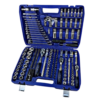
For most mechanics and serious DIY users, the best value is not choosing one type over the other. Keep a chrome socket set for hand tools and a separate impact socket set for power tools. That gives you slim, clean sockets for precision work and heavy-duty sockets ready for high-torque jobs.
A practical starting point is a 1/4 inch and 3/8 inch chrome set for everyday work, plus a 1/2 inch impact set covering common metric sizes. Add deep impact sockets for wheel studs and recessed nuts, then build out with impact extensions, adaptors and a protective alloy-wheel socket where your work demands it.
The right socket is a small part of the job, but it carries every bit of torque between the tool and the fastener. Use chrome for hand power, impact sockets for impact power, and your tools will last longer while the work stays safer and faster.
