








A car lift for home garage use changes the jobs you are willing to take on. Exhaust repairs, suspension work, underbody rust treatment and gearbox servicing stop meaning a full day on axle stands or a trip to a workshop. But a lift is not a purchase to make on price alone. It must suit the vehicle, the building and the work you actually plan to do.
For serious DIY mechanics, the right lift can be one of the best upgrades in the garage. The wrong one can leave you short on ceiling clearance, unable to open doors properly or, worse, working outside the equipment’s safe limits. Start with the garage, then match the lift to the job.
Manarola 4 Ton 2 Post Car Lift With Electric Lock Release / Auto Lock | Single Phase
Choosing a car lift for home garage work
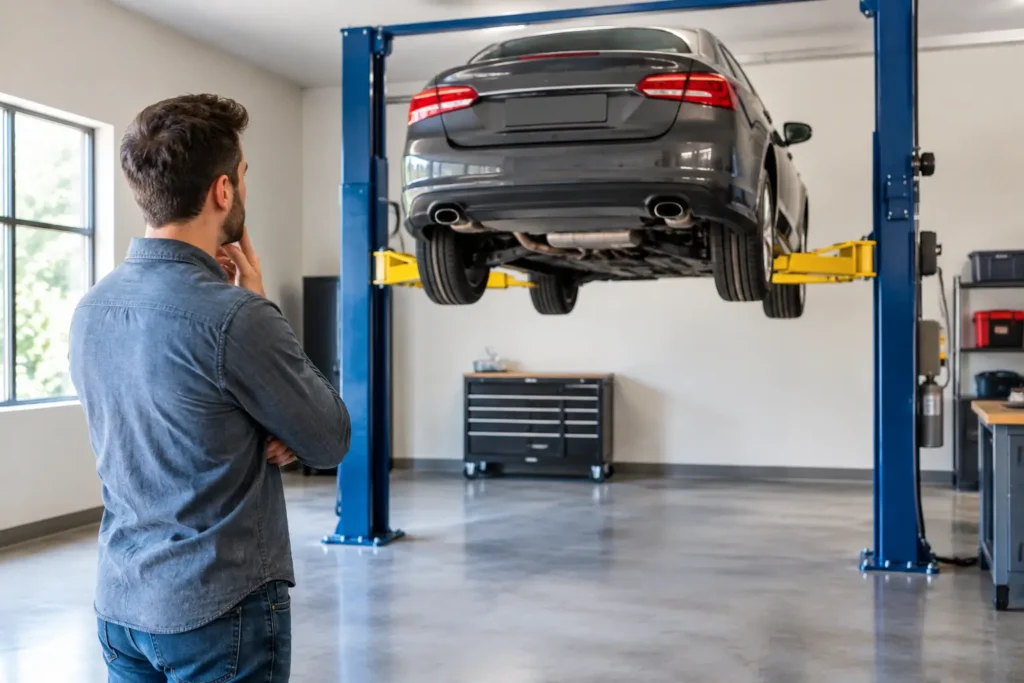
The first decision is whether you need a lift for regular repairs, vehicle storage or occasional inspections. A two-post lift gives the best access to wheels, brakes, suspension and the underside of the vehicle. A four-post lift supports the vehicle on its wheels and is often the stronger choice for storage, wheel alignment work or owners who prefer straightforward drive-on loading. A scissor lift takes up less room and can suit garages where posts would be impractical, although underbody access is more limited around the lifting platforms.
For most home mechanics who service their own cars, a two-post lift is the most useful all-round option. The wheels hang free, so tyre changes, brake work and suspension repairs are easier. It also occupies less floor length than a four-post model. The trade-off is that correct arm positioning matters every time, and installation demands a suitable concrete base.
A four-post lift is a practical choice where storage is the priority. Drive on, secure the vehicle and raise it out of the way to free valuable floor space below. It is also reassuring for vehicles with awkward lifting points. However, ramps can obstruct certain jobs, and lifting a car with the wheels free usually requires additional jacking equipment.
Scissor lifts are worth considering for lower garages and mobile-style servicing bays. They are compact, quick to position and ideal for tyres, brakes and general checks. Do not assume compact means compromise-free, though. Check the raised height, platform length and access around the centre of the vehicle before buying.
Manarola 4 Ton 2 Post Car Lift With 12 Months Warranty | Single Phase
Measure the garage before looking at capacity
A lift advertised with an impressive lifting capacity is no use if it cannot be installed safely in the space. Measure internal width, length and ceiling height carefully, including light fittings, roof trusses, garage door tracks and electric openers. A vehicle raised to working height can need substantially more headroom than the lift columns alone suggest.
Think about the tallest vehicle you may own, not just the hatchback currently on the drive. An SUV, van or 4×4 can quickly expose a height issue. Leave room to walk around the vehicle, open doors where needed and position a tool trolley without constantly working around the posts or ramps.
Floor condition is equally important. Most fixed lifts require sound, level reinforced concrete of a specified thickness and strength. The manufacturer’s installation instructions are the authority here. Do not guess based on a garage slab that looks solid. Older domestic floors may be thinner than expected, cracked or laid over unsuitable ground. A qualified installer or concrete professional can assess the base before anchors are fitted.
Power also needs planning. Many home lifts run from a standard single-phase supply, which is convenient for domestic garages, while larger commercial equipment may require three-phase power. Check the voltage, circuit requirements and whether a dedicated supply is needed. An electrician should carry out any required electrical work. This is heavy-duty workshop equipment, not a plug-in accessory.
Get the lifting capacity right
Capacity should exceed the heaviest vehicle you expect to lift, with a sensible margin. Do not use kerb weight as a shortcut without checking what it includes. Accessories, tools, fuel, passengers’ items and vehicle modifications all add weight. If you own a heavier electric vehicle, large SUV or long-wheelbase van, verify its actual gross weight and lifting-point requirements.
A 3-tonne or 3.5-tonne lift may cover many cars and light commercial vehicles, but suitability depends on more than the headline figure. Consider arm reach, pad height, maximum lifting height and whether the lift can safely pick up your vehicle’s chassis points. Low cars may need low-profile arms or pads; wider vehicles need enough arm spread; long vehicles need proper balance.
Never exceed the rated capacity, and never lift a vehicle from points the manufacturer does not approve. Before raising it fully, lift it just clear of the ground, check that it is stable and confirm the arms or platforms remain correctly positioned. That short pause prevents costly mistakes.
Two-post lifts: clear access, greater responsibility
A two-post lift earns its place in a working garage because it gives proper access. You can remove wheels, drop subframes, inspect brake lines and carry out underseal work without fighting around ramps. For a mechanic who wants to work efficiently at home, that matters more than a flashy specification sheet.
Look for automatic arm restraints, reliable safety locks, quality lifting pads and clear controls. Symmetrical and asymmetrical arm designs both have their place. Asymmetrical lifts can help with door clearance and vehicle positioning, while symmetrical layouts may suit wider or more evenly balanced loads. The best choice depends on your garage dimensions and typical vehicle types.
Be realistic about installation. Posts must be set out accurately, anchored to the approved slab and levelled correctly. Cables, hydraulic lines and safety systems need to be fitted and tested as specified. If you are not trained and equipped to install lifting machinery, pay for professional installation. Saving money at this stage is false economy.
Four-post lifts: storage and stability
A four-post lift makes sense when you want an easier drive-on setup or need a second parking space. It supports tyres on runways rather than lifting directly from chassis points, making loading familiar and stable. For classic cars, seasonal vehicles and weekend projects, it can be a very practical garage investment.
Check ramp length and vehicle approach angle, particularly for low-slung cars. Also check whether the lift includes, or can accept, a jacking beam if you want to remove wheels. Without one, many brake and suspension jobs become less convenient. A four-post design can be a better fit for storage, but it is not automatically the best option for every repair task.
Safety equipment is part of the purchase
The lift itself is only one part of a safe setup. Good lighting, a clear floor, wheel chocks where appropriate and correctly rated jacking equipment all matter. Keep children and bystanders away while lifting or lowering a vehicle. Do not work beneath a lift that is not resting on its mechanical safety locks, and never rely solely on hydraulic pressure.
Read the operating instructions before the first lift, even if you have used workshop equipment before. Each design has its own locking system, arm configuration and maintenance points. Regularly inspect cables, hoses, anchor bolts, pads, locks and controls. If something binds, leaks, frays or operates unevenly, take the lift out of service until it is checked.
A lift should be maintained like any other hard-working piece of workshop equipment. Clean it, lubricate the specified parts and follow the service schedule. Reliability comes from correct installation and consistent maintenance, not from assuming a heavy machine can look after itself.
Buy for the work you will do next year
A cheap lift that does not fit your vehicles or garage is not a bargain. Focus on verified load capacity, suitable dimensions, safety features, warranty cover and the availability of replacement parts. Compare the full cost too: delivery, installation, electrical work and any preparation of the concrete base should be included in the budget from the start.
Irish Tools Shop supplies affordable, reliable workshop lifting equipment alongside the jacks, axle stands, impact sockets and service tools needed to make the most of a proper home setup. Buying compatible equipment at the same time can save delays when the next repair cannot wait.
Measure twice, check the vehicle data and choose a lift that gives you safe working room rather than just enough clearance on paper. When the garage is set up properly, every job underneath the car becomes faster, cleaner and far more manageable.
