






A floor jack that struggles to reach a low sill, drops too quickly on release or flexes under a working vehicle is a false economy. The top garage floor jack features are not cosmetic extras. They determine how safely, quickly and confidently you can lift cars, vans and 4x4s for brake work, tyre changes, suspension repairs and inspections.
For a serious home garage or a busy workshop, the right trolley jack should suit the vehicles you actually service, not just look good on a specification sheet. Capacity matters, but so do lifting range, chassis strength, hydraulic control and the practical details that make repeated use less of a fight.
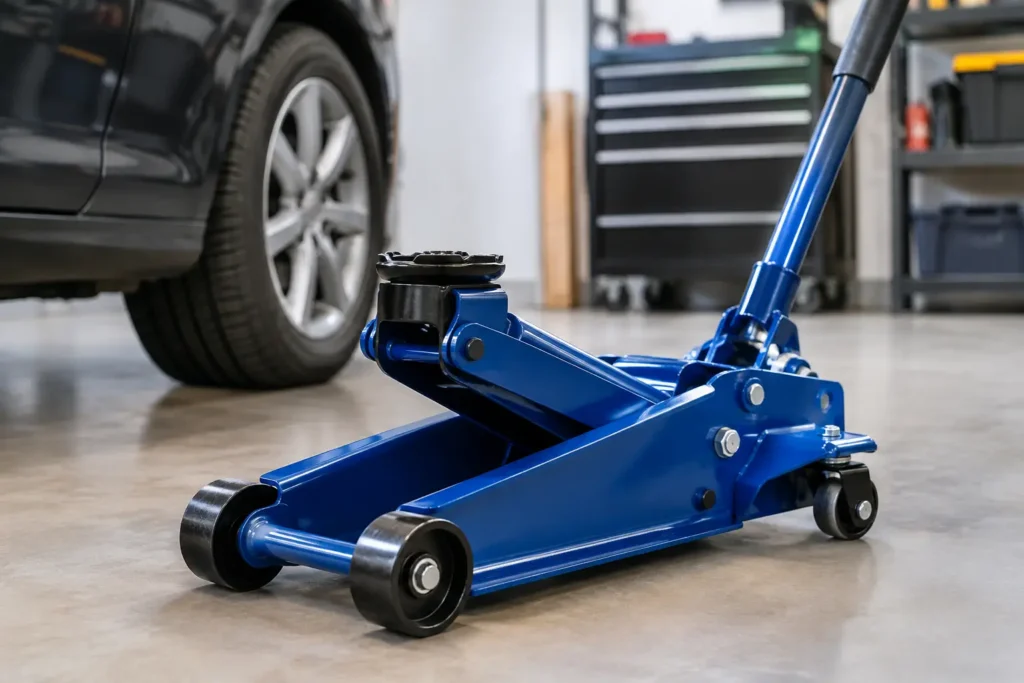
3 Ton Trolley Jack Heavy Duty Hydraulic Floor Jack Fits Caravan Van 4×4 Garage
Top garage floor jack features that matter
Rated lifting capacity with real headroom
A 2-tonne trolley jack is often enough for ordinary cars, but the jack’s capacity is not the same as the full vehicle weight. You are generally lifting one end or one corner at a time, yet that does not mean choosing the lightest possible model is wise. Vehicle weight distribution, uneven ground, added equipment and the demands of daily use all need consideration.
For mixed vehicle work, a 3-tonne garage floor jack gives useful headroom. It is a sensible choice for heavier saloons, SUVs, vans and regular workshop use. A 4-tonne model can be the better fit for commercial vehicles, although it will usually be larger and harder to move around a tight bay.
Buy for the heaviest vehicles you expect to lift, with a margin left over. Never assume a jack should be used at its stated maximum every day. The rating must be clearly marked, and the unit should have a solid, stable stance rather than relying on a tall, narrow frame.
Heavy Duty 2 Ton Hydraulic Long Chassis Reach Trolley Floor Jack For Car Caravan Van Jeep
A lifting range that suits low and high vehicles
Minimum saddle height is one of the first specifications to check. A standard jack may not fit beneath lowered cars, sports models or vehicles with damaged tyres. A low-profile trolley jack starts closer to the ground, making it far more useful when clearance is limited.
Maximum lift height matters just as much. A jack that gets the wheels clear of the ground may be enough for a quick tyre change, but it can be frustrating for suspension work or placing a vehicle securely onto axle stands. Taller lifting capability gives more room to work, especially on SUVs and vans.
The best all-round option often combines a low entry height with a high lift range. There is a trade-off: longer chassis models can take up more floor space. In a compact garage, measure your available room before choosing a long-reach, heavy-duty jack.
Fast lifting without sacrificing control
A dual-pump hydraulic system raises the saddle faster than a basic single-pump design. This cuts wasted movement when lifting several vehicles a day and is especially useful on jacks with a long lift range. It is not essential for occasional DIY work, but it soon earns its keep in a busy workshop.
Fast lifting is only useful if the descent is controlled. Look for a precise release valve that allows a gradual, measured lowering action. A vague or overly sensitive handle release makes it harder to settle a vehicle onto axle stands safely. Good control is more valuable than shaving a few seconds from the lift.
The handle should be long enough to provide leverage without forcing you to lean over the vehicle. A two-piece handle can save storage space, while a foam or rubber grip helps protect bodywork if the handle contacts a bumper or wing.
Build quality is a garage floor jack feature, not an extra
A trolley jack works under high pressure and carries heavy loads close to people and vehicles. The chassis, lifting arm, wheels and hydraulic assembly all need to be made for the job. A heavy steel frame generally offers excellent durability and stability, although aluminium designs can be easier to carry to track days or mobile jobs.
Check the finish as well. A durable paint or powder-coated surface helps resist chips, oil residue and workshop moisture. It will not stop poor storage from causing corrosion, but it helps a hard-working jack stay serviceable for longer.
Pay attention to the wheels and castors. Wide front wheels and smooth rear castors help the jack roll into position and allow it to move slightly as the suspension geometry changes during lifting. Poor wheels can bind, scrape and make accurate positioning awkward. On a clean, level concrete floor, quality castors make a noticeable difference.
A broad base is also worth paying for. It improves stability under load and reduces the tendency for a jack to feel unsettled when lifting a heavier vehicle. Do not use any floor jack on sloped, loose or damaged surfaces, regardless of how strong it appears.
Saddle design and vehicle protection
The saddle is the contact point between the jack and the vehicle, so its design deserves more attention than it usually gets. A large, shaped saddle offers a more secure contact area than a small flat pad. It should locate properly on the manufacturer-approved jacking point, never on thin floorpan metal, plastic trims or vulnerable suspension components.
A rubber saddle pad can help protect painted pinch welds and reduce metal-to-metal marking. It is useful, but it does not correct a poor lifting point or replace proper care. Some vehicles need a specific jack pad or adaptor to support the designated lift point correctly.
For workshops servicing different makes, a removable pad and a saddle that accepts suitable adaptors can add flexibility. Make sure any adaptor is rated for the task and sits securely. Improvised blocks, loose timber and makeshift packing are not acceptable substitutes.
Reliable hydraulics and practical servicing
A jack should rise smoothly, hold its load consistently and lower without jerking. Signs of weak hydraulics include oil leaks, a saddle that creeps downward under load, spongy pumping or a release valve that will not regulate properly. These faults should be addressed before the jack is used again.
A serviceable design is a practical advantage for buyers who expect years of use. Accessible filler plugs, replaceable wheels and available seals can make maintenance more straightforward. However, not every budget jack is intended for extensive rebuilding, so warranty cover and clear product specifications still matter when comparing prices.
Keep the lifting arm and moving joints clean, check for visible hydraulic leaks and store the jack with the saddle fully lowered where possible. Basic care costs very little and helps prevent failure when the jack is needed most.
Safety features are non-negotiable
A floor jack is a lifting tool, not a device for supporting a vehicle while you work underneath it. Once the vehicle is raised, support it on correctly rated axle stands placed at approved support points. Lower the vehicle gently onto the stands and check stability before starting any work.
A dependable garage setup should include a level hard floor, wheel chocks, axle stands with a suitable load rating and adequate lighting. Keep people clear while lifting and lowering, apply the handbrake where appropriate, select park or first gear, and follow the vehicle manufacturer’s lifting guidance.
Some jacks include overload protection, which can help prevent lifting beyond the intended rating. It is a worthwhile safeguard, but it should never be treated as permission to ignore capacity limits. Safe practice still comes first.
Weight, storage and daily usability
Heavier jacks tend to feel more planted and usually use thicker components, but they are less convenient if you need to lift them into a van or store them on a shelf. Aluminium jacks suit mobile mechanics and enthusiasts who value portability. Steel models often offer better value for permanent workshop use.
Consider handle length, chassis length and storage height as well as capacity. A jack that is technically ideal but cannot be stored safely or rolled easily through your workspace can slow down everyday jobs. For a professional garage, buying a dependable 3-tonne low-profile model is often the practical middle ground.
Irish Tools Shop focuses on affordable, professional-grade workshop equipment, so buyers can compare lifting capacity, height range and construction before choosing the jack that matches their workload. Spend on the features that improve stability, access and control, then pair the jack with correctly rated axle stands. That is the setup that keeps routine work moving safely.
