






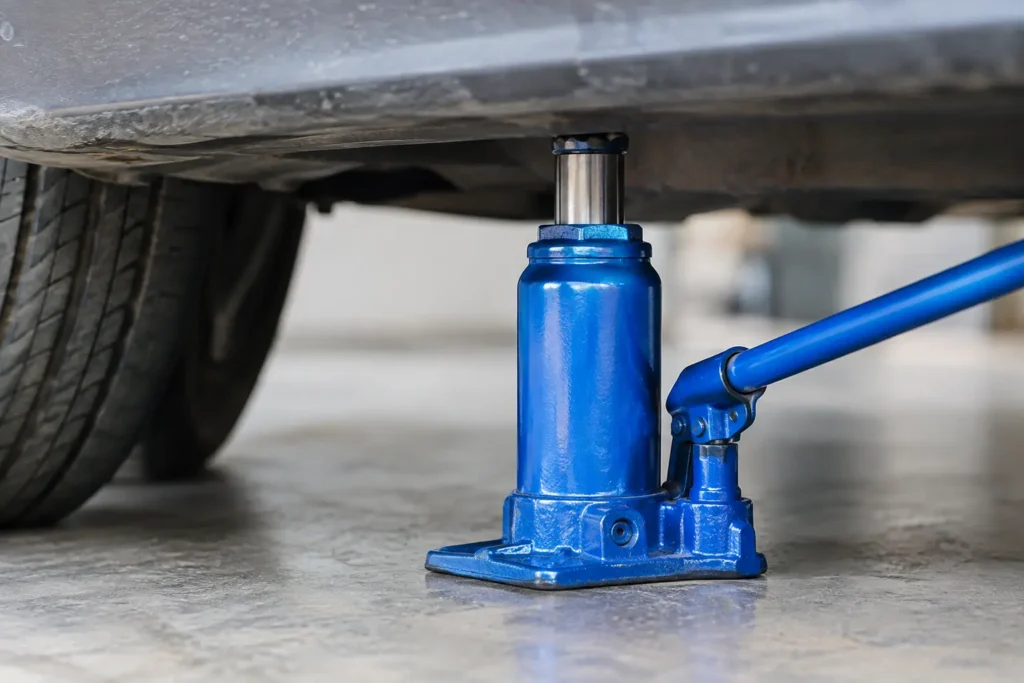
A trolley jack that slowly drops after lifting a vehicle is not a minor annoyance. It can turn a straightforward brake, suspension or tyre job into a serious safety risk. If you are asking, “why does hydraulic jack sink?”, the usual answer is that hydraulic pressure is escaping internally or externally. The important part is finding out where, and taking the jack out of service until it is safe to use.
A working jack should lift smoothly, hold its stated load within normal operating conditions, and lower only when the release valve is deliberately opened. Some initial settling can happen as tyres, suspension bushes or the vehicle position settle, but a continuing drop at the lifting pad is not normal.
3 Ton Trolley Jack Heavy Duty Hydraulic Floor Jack Fits Caravan Van 4×4 Garage
Why Does a Hydraulic Jack Sink?
Hydraulic jacks work by forcing oil from a reservoir into a lifting cylinder. When the pump handle is operated, a series of check valves directs oil into the cylinder and raises the ram or saddle. To hold the load, the system must remain sealed. If oil bypasses a valve, slips past a worn seal or escapes through a damaged fitting, pressure falls and the jack sinks.
The most common causes are low hydraulic oil, air trapped in the system, a release valve that is not seating properly, worn internal seals, or damaged valves. External leaks are easier to spot, but an apparently dry jack can still sink because oil is leaking past an internal seal and returning to the reservoir.
A jack may also seem to be failing when the issue is outside the hydraulic unit. Soft tarmac, uneven concrete, a bent lifting point, a poorly positioned saddle or a vehicle settling on its suspension can all make the load drop or move. That is why the first check should always cover the ground, vehicle position and lifting point as well as the jack itself.
Check the Setup Before Blaming the Jack
Park on firm, level concrete wherever possible. A trolley jack needs a stable surface so its wheels can roll slightly as the suspension rises. On rough ground, paving slabs, gravel, soil or soft tarmac, the wheels can dig in and force the saddle to shift. The result can look exactly like a sinking jack.
Use the correct manufacturer-approved jacking point. Lifting on thin floorpan metal, a corroded sill or an unsuitable suspension component can damage the vehicle and create an unstable load. Make sure the saddle is centred beneath the lifting point and that the jack is aligned with the vehicle rather than pushed in at an angle.
Check the jack’s rated capacity too. A 2-tonne jack is suitable for many cars, but capacity alone is not the whole story. The axle load, vehicle balance, lifting height and the position of the load all matter. A jack used close to or beyond its limit may lower, become unstable or suffer permanent seal damage.
Most importantly, a hydraulic jack is for lifting, not supporting a vehicle while you work underneath it. Once the vehicle is raised, place correctly rated axle stands under solid support points and lower the vehicle gently on to them. Never put any part of your body beneath a vehicle held only by a jack.
Low Oil and Air in the Hydraulic System
Low oil is one of the simpler causes to correct. If the reservoir level is low, the pump can draw in air rather than hydraulic oil. Air compresses, unlike oil, so the jack may feel spongy, lift slowly, fail to reach full height or sink under load.
Look for the filler plug and check the level with the jack fully lowered, following the instructions for that model. Use the specified hydraulic jack oil. Do not top up with engine oil, brake fluid, power steering fluid or random workshop oil. The wrong fluid can damage seals, affect valve operation and create a larger repair bill than the original fault.
After topping up, the jack may need bleeding. The exact method varies, but it commonly involves opening the release valve, pumping the handle several times with no load, closing the valve and then testing the lift again. Some jacks have a dedicated bleed procedure, so check the manual before forcing anything.
If oil was low, do not assume topping up has solved the underlying problem. Hydraulic oil does not normally disappear. Inspect the ram, pump piston, seals, filler plug and valve area for wet patches, drips or oil collecting dust. A visible leak means the jack needs repair before it goes back into regular service.
A Faulty Release Valve Can Let Pressure Escape
The release valve controls lowering. On many trolley jacks, it is operated by twisting the handle. If it is not fully closed, has been over-tightened, is contaminated with dirt or has a damaged seat or O-ring, it can allow oil to bypass slowly. The saddle then creeps down even though the handle appears to be in the closed position.
First, lower the jack completely and clean the valve area. Check that the handle mechanism engages properly and that the release valve closes with firm, sensible pressure. Do not overtighten it. Excess force can damage the valve seat and make the problem worse.
If the jack holds briefly but starts sinking within minutes, an internal bypass through the release valve or check valves is a strong possibility. This is not a fault to ignore or compensate for by repeatedly pumping the handle. Repeated pumping can mask the issue for a short time, but it does not make the load secure.
Worn Seals and Internal Valve Wear
A jack that has seen daily workshop use eventually wears. Ram seals harden, pump seals lose their shape, and tiny particles in old oil can score valve surfaces. These faults allow hydraulic oil to travel where it should not, reducing the pressure holding the load.
Internal seal failure often leaves no obvious external oil leak. The jack may lift a vehicle without much trouble, then slowly lower it while the handle and release valve remain untouched. That pattern points more towards internal bypass than an air problem.
Whether repair makes financial sense depends on the jack. On a quality, serviceable workshop jack, a seal kit and fresh oil can be worthwhile. On a budget jack with a damaged frame, scored ram, worn wheels or hard-to-source parts, replacement is usually the safer and more cost-effective choice. The cost of a dependable replacement is small compared with vehicle damage, lost workshop time or an injury.
Why Does Hydraulic Jack Sink After Lifting?
The timing of the fault helps narrow it down. If the jack drops immediately after lifting, check that the release valve is properly shut, the load is centred, and the jack is on level ground. If it lowers slowly over several minutes, internal seal leakage or a valve problem is more likely.
If it sinks only near maximum height, low oil, trapped air or overloading should move higher on the suspect list. If it sinks only with one particular vehicle, inspect that vehicle’s lifting point and consider whether suspension movement is creating the impression of a hydraulic fault.
A useful safe test is to lift a suitable load only in a clear area, then observe the saddle from the side without placing hands, feet or body parts beneath it. Mark the starting height and watch for movement. Better still, have the jack assessed by a competent repairer if the cause is not obvious. Never test a suspect jack by working under a supported vehicle.
When to Repair and When to Replace
Stop using the jack immediately if there is a cracked chassis, bent lifting arm, damaged saddle, badly pitted ram, leaking oil, missing wheels or uncontrolled lowering. Structural damage is not a seal-kit job.
A clean, serviceable jack with a known oil or air issue may be recoverable with the correct fluid and bleed procedure. A jack that continues to creep down after this work needs professional attention or replacement. For garages and frequent DIY users, choosing a properly rated trolley jack alongside rated axle stands is the sensible route. Capacity, minimum height, maximum lift height, saddle construction and spare-parts availability are all worth checking before buying.
Irish Tools Shop stocks lifting equipment built for practical garage work, from affordable trolley jacks to axle stands for safe vehicle support. Match the equipment to the vehicles you work on, keep it maintained, and do not wait for a slow leak to become the reason a routine job goes wrong.
