






A seized grease nipple, a cramped suspension joint and a queue of vehicles waiting for service are where a cheap grease gun quickly shows its limits. This grease gun review focuses on what matters on the workshop floor: getting grease into the joint cleanly, quickly and without fighting the tool every few pumps.
For occasional home maintenance, a basic lever gun can be excellent value. For daily chassis work, agricultural equipment or fleet servicing, speed and access become more important than the lowest ticket price. The right choice depends on how often you grease, where the nipples sit and whether compressed air or battery platforms are already part of your set-up.
Grease Gun Review: Choose the Drive Type First
The power source affects more than convenience. It determines the pressure you can generate, the control you have at the fitting and how much effort each lubrication job requires.
Manual lever grease guns
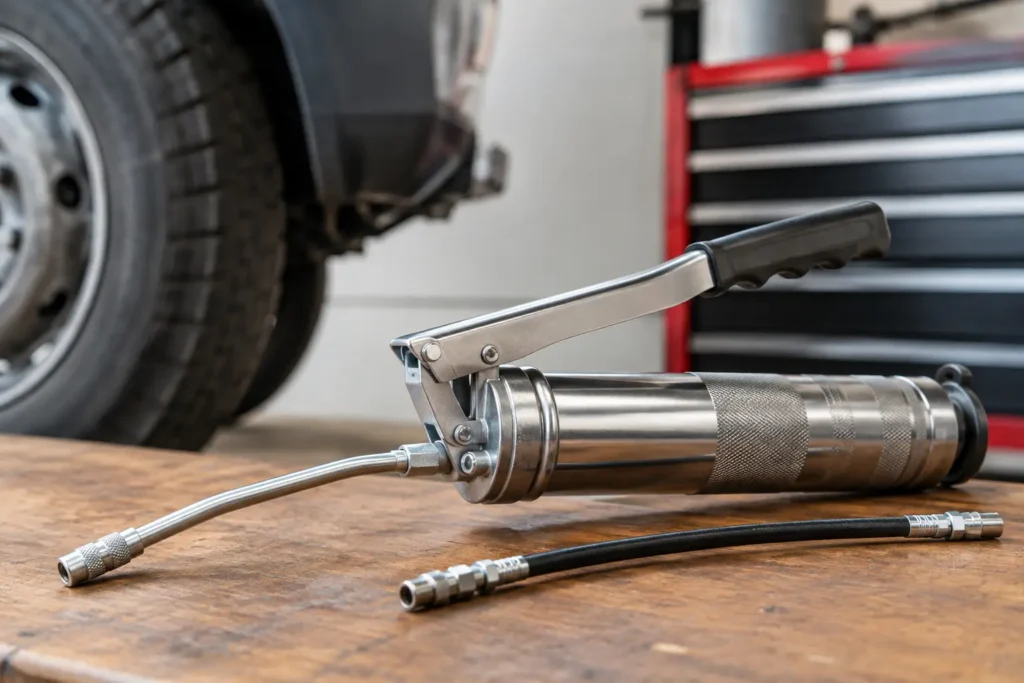
A lever grease gun is the traditional workshop choice for good reason. It is simple, affordable and capable of producing serious pressure when operated properly. There is no battery to charge, no airline to connect and fewer components to go wrong. Keep one in a service trolley and it will cover everything from trailer hubs to steering joints, provided access is reasonable.
The trade-off is physical effort. Holding the coupler firmly on a nipple while working a long lever can be awkward under a vehicle, especially when the fitting is tucked behind a wishbone or close to a brake line. Lever guns are strongest where there is room for two hands and where a blocked or tight joint needs extra pressure.
A pistol-grip manual gun is worth considering for lighter, more frequent jobs. It can be operated one-handed, which helps when you need the other hand to guide a flexible hose. It usually delivers less force per stroke than a long-lever model, so it is not always the best answer for stubborn fittings.
Neilsen 20V Cordless Grease Gun With Battery, Charger & Case
Pneumatic grease guns
For garages with a reliable compressor, an air-powered grease gun makes repetitive work faster and easier. Pull the trigger and the tool delivers a steady supply of grease without the repeated pumping of a manual unit. That reduces fatigue when servicing several vehicles, plant machinery or trailers in one shift.
Air models suit fixed workshop bays particularly well. The limitation is the hose. An airline can snag around wheels, ramps and axle stands, while a small compressor may struggle if several air tools are being used at once. Check the required operating pressure and air consumption before buying. A pneumatic gun is good value only when your compressor has the capacity to support it.
Cordless battery grease guns
Cordless grease guns are the quickest option for mobile work and high-volume greasing. They are popular with mechanics who work around larger vehicles, recovery equipment, agricultural machinery and site plant because there is no airline trailing across the floor. A trigger-controlled motor also gives consistent delivery, helping you finish routine lubrication rounds much faster.
Battery models cost more upfront, and the battery system matters. If you already use compatible cordless tools, choosing the same platform can keep spare batteries and chargers to a minimum. Look for a variable-speed trigger, a clear battery gauge and a practical way to relieve pressure after use. A high-output tool is useful, but only if it remains manageable when working at shoulder height or beneath a vehicle.
One Hand Pistol Type Air Grease Gun Suits 400cc Cartridge (30-150Psi)
What Separates a Good Grease Gun From a Frustrating One
Maximum pressure is a headline specification, but it should not be the only one you compare. High pressure helps push grease through long lines and resistant joints, yet a worn coupler or damaged nipple can still make a powerful gun messy and ineffective. Buy the complete working set-up, not just the biggest number on the box.
Hose length and fitting access
A rigid extension is tidy and precise for open, accessible nipples. A flexible hose is far more useful around steering racks, suspension arms, prop shafts and machinery guards. Many serious users need both. The hose should be long enough to reach awkward fittings without forcing the gun into a poor angle, but not so long that it constantly drags on the ground.
The coupler is equally important. A standard four-jaw coupler suits most work, but it must grip securely without refusing to release after pressure builds. A locking coupler can save time on awkward fittings because it stays attached while you operate the gun. It is especially useful when one hand is needed to hold a hose clear of moving parts or sharp edges.
If your regular work includes recessed nipples, needle adaptors and right-angle attachments can be worthwhile additions. They are not replacements for a proper coupler, but they can turn a difficult maintenance point into a straightforward job.
Cartridge capacity and loading
Most grease guns use standard cartridges, making refills simple and clean. Check cartridge size before ordering, particularly if you already keep a preferred grease grade in stock. A gun that accepts both cartridge and bulk loading provides more flexibility, although bulk filling is messier and better suited to a controlled workshop environment.
Transparent barrels or follower rods with clear position markings help prevent dry pumping. This is a small feature, but it saves wasted time when a gun appears to be faulty simply because the cartridge has run empty or air has entered the system.
Build quality where it counts
The handle, trigger, barrel threads and hose connection take the real strain. Look for solid metal construction, clean threading and a secure cap rather than focusing only on cosmetic finish. A tool used in a working garage will be dropped, covered in grease and stored in a busy trolley drawer. It needs to tolerate that treatment.
Also consider serviceability. Replacement hoses, couplers and seals are far cheaper than replacing a whole gun. For a tool used every day, access to practical spares matters more than an impressive-looking case.
Match the Grease Gun to the Job
For a home garage servicing a car, van, trailer or mower a few times a year, a quality manual pistol-grip or lever gun is usually the sensible buy. Spend enough to get a dependable hose and coupler, then keep it loaded with the grease you use most often.
For a professional garage, a lever gun remains a useful backup even if pneumatic and cordless models handle the daily workload. It works during compressor issues, flat batteries and roadside jobs. A pneumatic gun is a strong choice for a dedicated service bay, while a cordless model earns its keep where technicians move constantly between ramps, yard work and larger equipment.
Do not pay for cordless speed if the gun will only be used once a month on easily reached fittings. Equally, do not expect an entry-level manual gun to be the fastest option for a busy commercial lubrication schedule. Buying to suit the workload is how you get genuine value.
Keep the Tool Working Properly
Grease guns fail most often through poor storage, contaminated grease or trapped air. Wipe the coupler after each use, keep the cap fitted and avoid leaving the tool where dust and metal filings can collect around the hose end. Before connecting to a vehicle, inspect the nipple. A clogged, bent or damaged nipple should be replaced rather than forced.
If the gun loses prime after a cartridge change, loosen the head carefully, bleed trapped air and re-tighten it before pumping again. Never point a high-pressure grease gun at skin. Grease injection injuries require urgent medical treatment, even when the wound looks minor.
Irish Tools Shop stocks workshop equipment for mechanics and serious DIY users who need affordable, reliable tools without waiting around for essential kit. When choosing a grease gun, prioritise the fittings you actually service and the pace you need to work at. A well-matched gun keeps routine maintenance moving and helps expensive components last longer.
