






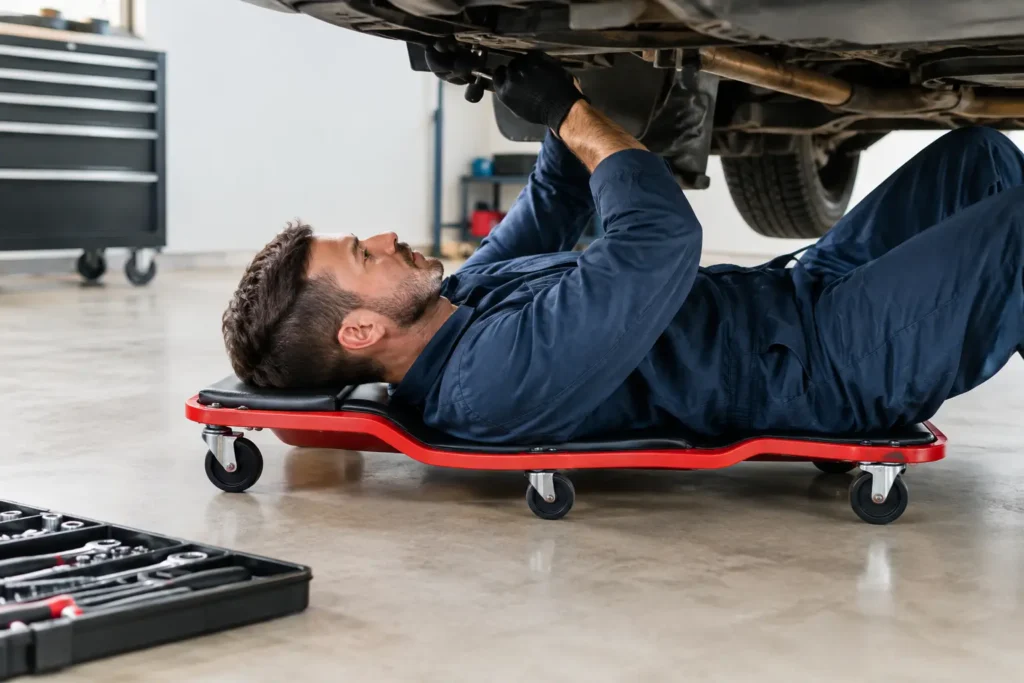
A garage floor is hard, cold and unforgiving. Spend half an hour tracing a leak, checking brake pipes or reaching a gearbox fitting from underneath, and a cheap creeper quickly becomes a false economy. The best garage creepers mechanics choose are not simply the lowest-priced boards on castors. They roll straight, support the body properly and stand up to daily workshop use without cracking, bending or filling the floor with loose wheels.
For a working garage, the right creeper saves time on every under-vehicle job. It lets you move into position without dragging yourself across concrete, keeps your shoulders off the floor and gives you a stable base when access is tight. The right choice depends on the vehicles you service, the condition of your floor and how often the creeper will be used.
What makes a garage creeper worth buying?
The basic design is simple: a low-profile frame, a padded bed and swivel castors. The details decide whether it is useful after six months of real work. Mechanics should look beyond the headline price and assess frame strength, load rating, wheel quality and ground clearance together.
A creeper needs to carry the user without flexing noticeably through the middle. Excessive flex feels uncomfortable, but it can also leave your body lower than intended and make it harder to slide out from beneath a low vehicle. Steel frames are a strong choice for demanding commercial work, while heavy-duty moulded polymer creepers can be lighter, easier to clean and resistant to oil and workshop chemicals. Neither material is automatically better. Build quality matters more than the label.
The castors are just as important. Small, hard wheels can work adequately on smooth painted concrete, but they tend to jam on rough surfaces, expansion joints and loose workshop debris. Larger, free-running castors make a major difference when you need to move sideways under a vehicle. If a creeper does not roll cleanly when new, it will not improve once it has collected grit and oil.
Best garage creepers for mechanics: choose by workload
There is no single best design for every garage. A mobile technician, a busy independent workshop and a serious home mechanic may all need different features. Buying for the job avoids paying extra for features that will not be used, while preventing the frustration of an under-specified creeper.
Heavy-duty steel-frame creepers
A steel-frame creeper is the practical choice where equipment sees regular, hard use. These models usually offer a firm platform and a higher user weight capacity. They suit mechanics who spend long periods underneath cars, vans and 4x4s, particularly when servicing suspension, exhausts, drivetrain components or underbody protection.
Look for a properly braced frame, securely fixed castors and a durable padded surface. A padded headrest is more than a comfort extra. It helps keep your head stable while inspecting components overhead and reduces the pressure that builds up at the neck during longer repairs.
Steel does bring a trade-off. It can be heavier to carry around the workshop, and damaged paint can eventually allow corrosion. For a fixed garage bay, that extra weight is rarely a problem. For frequent transport between jobs, a lighter alternative may make more sense.
Low-profile creepers for modern vehicles
Many newer cars sit lower than older vehicles, even after they are raised on a trolley jack and safely supported on axle stands. In this situation, low overall height matters. A slim creeper gives valuable room to manoeuvre below undertrays, sill covers and exhaust sections without forcing an awkward position.
Check the total height with the padding included, not just the frame depth. Thick padding may feel comfortable in a showroom description but can remove the clearance you need beneath a low-slung vehicle. A shaped, ergonomic bed with modest padding is often a better working solution than an oversized cushion.
Low-profile designs are also useful under sports cars and vehicles with limited lifting points. However, do not use a low creeper as an excuse to work beneath a vehicle that has not been raised correctly. A creeper is an access tool, not a safety support. Use correctly rated lifting equipment and axle stands on firm, level ground before going underneath.
Moulded creepers for fast, clean workshop use
One-piece moulded creepers are popular in busy garages because they are easy to wipe down. There are no stitched seams or absorbent fabric sections to hold oil, coolant or brake dust. A contoured moulded shape can also support the shoulders and back well, provided the design is wide enough for the user.
This style suits technicians who need a lightweight creeper that can be moved between bays quickly. It is also a sensible option for a home garage where storage space is limited. Some moulded models include moulded trays or compartments for small fasteners and tools, which can be handy during underbody work.
The limitation is impact resistance over time. Avoid thin plastic bodies that feel brittle or flex heavily before any load is applied. A quality moulded creeper should feel solid around the castor mounts, as these areas take repeated stress when rolling over uneven floors.
Convertible creeper seats
A convertible creeper that changes from a flat board into a low seat is useful for brake servicing, wheel work and jobs at sill height. It can replace two basic pieces of garage equipment in a smaller workshop. For a serious DIY user, this can offer excellent value.
For full-time under-car work, however, a dedicated flat creeper is usually more comfortable and lower to the ground. Convertible hinges add moving parts, and the raised sections may not suit every body shape when used flat. Choose one for versatility, not because it is automatically the strongest option.
Check these specifications before ordering
Do not buy a creeper based on photographs alone. The dimensions and construction details tell you whether it will fit the workshop and the user. Pay particular attention to the maximum load rating. This should comfortably exceed the user’s weight, allowing for workwear, tools in pockets and the repeated strain of moving over imperfect floors.
Length and width affect comfort. A narrow creeper can feel restrictive across the shoulders, while a very short one may leave the legs unsupported. Taller users should check the usable bed length rather than assuming every full-size creeper offers the same support. A broad shoulder area and a raised or shaped head section usually make long jobs less tiring.
Castor count and mounting design deserve a close look. Six castors generally provide stable support and smoother weight distribution, although a well-built four-castor model can still perform well. More important is that the wheels are firmly attached, rotate freely and are positioned to reduce the risk of tipping when you shift your weight.
Also consider the workshop floor. Smooth sealed concrete is forgiving. Older concrete, block paving or a garage floor with cracked areas demands better wheels and a stronger chassis. No creeper performs perfectly over rough ground, but poor castors turn a straightforward job into a fight with the floor.
Comfort is a productivity feature, not a luxury
A mechanic who is constantly readjusting position works slower and gets fatigued sooner. Good back support, a sensible headrest and easy rolling all contribute to better access and cleaner work. Comfort matters most on inspections and repairs that require repeated trips beneath the vehicle, such as tracking an intermittent leak or fitting exhaust components.
That said, extra padding is not always an advantage. Thick foam can soak up fluids, tear at the edges and raise the user too close to the underside of the vehicle. Durable, oil-resistant vinyl padding is a practical balance for many garages. It is comfortable enough for longer jobs and simple to clean after use.
A headrest should support without locking your head into one position. Adjustable headrests can be useful, but fixed designs often have fewer parts to fail. If several technicians will use the same equipment, a wider, neutral profile usually works better than an aggressively shaped seat that only suits one person.
Make your creeper last longer
Even affordable professional-grade equipment needs basic care. Wipe off oil, grease and chemicals after use, especially around castors and hinges. Debris wrapped around wheel axles is a common reason a creeper stops rolling properly. A quick clean at the end of the day is cheaper than replacing wheels early.
Store the creeper off the main floor traffic route where possible. It prevents damage from dropped parts, trolley jacks and vehicle tyres. Check castor fixings periodically and tighten any fasteners before looseness becomes a cracked mounting point. If padding splits, repair or replace it promptly so the base material is not exposed to fluid contamination.
When building out a garage, pair a dependable creeper with correctly rated axle stands, a quality trolley jack and good lighting. That combination makes under-vehicle work faster, safer and far less punishing. Irish Tools Shop customers looking for value should prioritise a creeper built for the jobs they actually perform, then spend the saving on the lifting and safety equipment that supports every repair.
The best purchase is the creeper that rolls freely on your floor, fits below the vehicles you service and remains comfortable at the end of a long job. Get those three points right, and it will earn its place in the workshop from the first service onward.
