






A new set of pads is no good if the caliper piston will not return cleanly into its bore. The best brake piston tools make that critical part of a brake job controlled, quicker and far less likely to damage a seal, dust boot or caliper body. For busy garages and capable home mechanics, the right kit pays for itself by avoiding seized pistons, uneven pressure and wasted time at the ramp.
Brake pistons do not all move in the same way. Front calipers on many vehicles simply need a straight, even push. Rear calipers with an integrated handbrake mechanism commonly need to be wound back while pressure is applied. Choosing the wrong tool can turn a straightforward pad change into a damaged caliper or a job that has to stop halfway through.
What Makes the Best Brake Piston Tools?
A worthwhile brake piston tool is not judged by the number of adapters alone. It must apply force squarely, fit the caliper design in front of you and stand up to repeated use. Cheap, poorly machined adapters can slip from the piston slots, while weak threaded bars can bind under load. That is frustrating on a driveway and costly in a working workshop.
The best option depends on the vehicles you service most often. A general repair garage needs broad coverage across common European, Japanese and Korean vehicles. A mechanic mainly working on vans and fleet vehicles may get more value from a heavy-duty press and a smaller wind-back kit. A DIY user servicing one or two family cars can usually avoid paying for an oversized master kit, provided they confirm the required adapter before buying.
Look for hardened steel adapters, a substantial forcing screw, clearly marked left and right-hand threads, and a case that keeps every component accounted for. A decent case matters more than it sounds. Missing one adapter can make a complete kit useless on the next vehicle through the door.
Straight Compression Tools
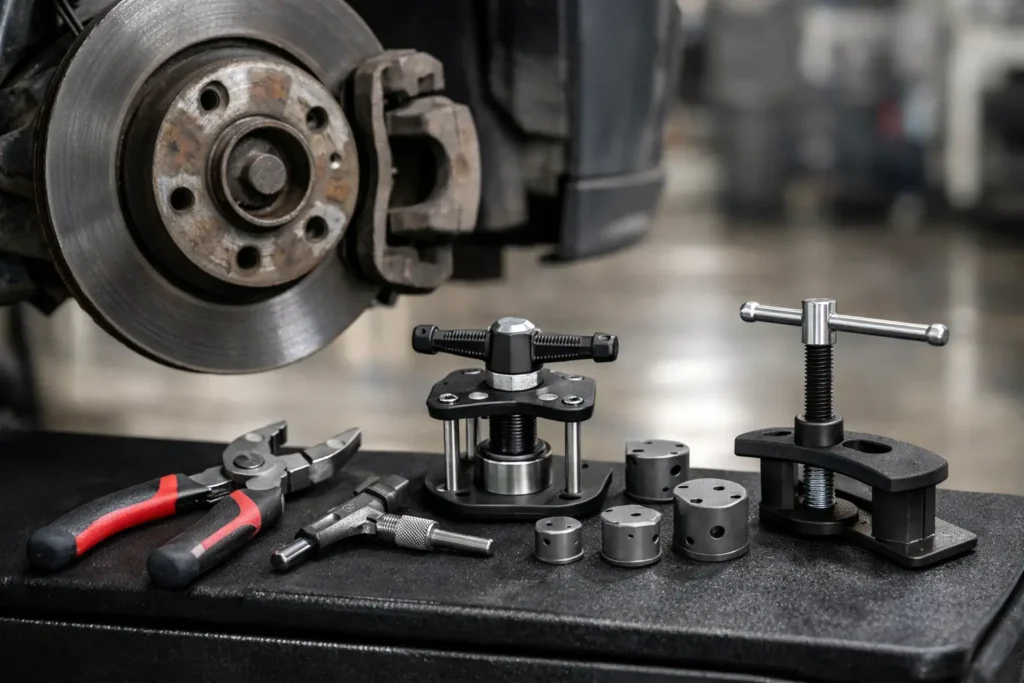
A straight compression tool is designed for pistons that push directly back into the caliper. Basic clamp-style spreaders are compact and affordable, making them useful for occasional work where access is good. They can work well on single-piston floating calipers, but they need to be positioned carefully so the piston goes back evenly.
For regular brake work, a ratcheting caliper press is usually the better buy. It applies more balanced pressure and is easier to use in tight wheel arches. Twin-piston and multi-piston calipers benefit from a tool with wide, stable plates, as forcing one piston in at a time can push the others outward or place uneven load on the caliper.
Wind-Back Kits for Rear Calipers
Rear brake calipers with a mechanical parking brake are where a dedicated wind-back kit earns its place. These pistons often retract only when they are rotated and pressed simultaneously. Trying to force them back with a G-clamp can damage the internal handbrake mechanism, strip the piston face or split the dust boot.
A proper kit includes a threaded spindle, reaction plate and vehicle-specific adapters with pins that locate in the piston recesses. Many kits include both clockwise and anti-clockwise threaded spindles. This is essential because different manufacturers use different piston thread directions. If a kit only winds one way, its vehicle coverage is immediately limited.
Do not assume every rear piston needs to be wound back. Some electronic parking brake systems require the actuator to be placed in service mode with a suitable diagnostic tool before the piston is retracted. Other designs use a conventional push-back piston. Check the vehicle procedure before applying force.
The Brake Piston Tool Types Worth Buying
For most independent garages, a complete wind-back kit and a quality ratcheting caliper press are the most practical starting point. Together, they handle the majority of routine pad and disc work without relying on improvised methods.
A universal wind-back kit suits mixed vehicle work because it provides the adapter range needed for everyday servicing. Check the advertised vehicle coverage, but treat it as a guide rather than a guarantee. Manufacturers can change caliper suppliers between model years, and imported vehicles can differ from UK or Irish-market specifications.
A ratcheting piston press is the sensible tool for front calipers and non-wind-back rear calipers. It is quicker than a screw clamp, applies force more evenly and reduces the chance of twisting the piston. Choose a model with solid spreading plates and a mechanism that does not feel loose under pressure.
Air-powered caliper presses are built for volume. They can save real time where brake jobs are a daily part of the workshop schedule, particularly when working on larger calipers or multiple vehicles. They require a suitable air supply and remain an investment rather than a necessity for occasional users. The speed is valuable, but manual tools still offer better feel when a piston is reluctant to move.
Heavy-duty hydraulic presses and specialised piston spreaders have their place in commercial garages, performance workshops and fleet maintenance. They are not automatically the best choice for every buyer. If your work is mainly standard passenger cars, a reliable manual kit is often more cost-effective, easier to store and simpler to use at the vehicle.
Check These Details Before You Buy
Before ordering, consider the calipers you see most often, not just the biggest kit on the shelf. A kit with 22 adapters may be excellent value if it covers your typical jobs. A kit with 50 poorly finished adapters that includes no useful vehicle applications is not.
Pay close attention to thread direction. Kits with left and right-hand operation give much stronger all-round coverage. Also check whether the reaction plate is thick enough to stay rigid and whether the spindle has a comfortable handle or drive head for controlled turning.
Case quality deserves a quick inspection too. Blow-moulded cases are common and perfectly suitable when their clips, hinges and moulded component locations are secure. In a workshop, tools get moved between bays and loaded into service vans. A loose kit soon becomes a box of unidentified discs and adapters.
For trade users, buying a second, smaller compression tool is sensible insurance. A wind-back kit may be tied up on one ramp while another technician needs to push back a front caliper. Low-cost essential tools can prevent expensive downtime.
Using Brake Piston Tools Without Causing Damage
Start by inspecting the caliper, piston face and dust boot. If the boot is torn, heavily corroded or leaking fluid, retracting the piston may only hide a fault that needs proper repair. A piston that will not move with reasonable, controlled force is a warning sign, not a reason to reach for a longer breaker bar.
Open the brake fluid reservoir and monitor the level before retracting pistons. As the piston moves back, fluid returns to the reservoir. If it has been topped up after previous pad wear, it can overflow and damage painted surfaces. Extract excess fluid safely where required, using clean equipment and following the vehicle manufacturer’s procedure.
On wind-back calipers, match the adapter pins fully to the piston slots before turning the spindle. Keep the tool square to the caliper and apply steady pressure while winding. If the adapter jumps or the piston starts to tilt, stop and reset it. Forcing it at an angle can damage the threads or tear the seal.
With electronic parking brakes, use the correct service mode before starting. Never force an electrically operated rear piston back against the actuator. Once the pads are fitted, follow the relearn or bedding procedure specified for that vehicle, then pump the brake pedal until it is firm before moving the car.
A Better Value Tool Setup for Brake Work
There is no need to buy premium-brand tooling for every task, but brake tools must be dependable. A low-cost kit is good value only when the spindle runs cleanly, the adapters fit accurately and the components can withstand repeated load. Saving a few pounds on a tool that rounds off during its third use is not a saving.
For a practical setup, pair a broad-coverage wind-back kit with a ratcheting piston press, impact sockets for wheel removal, a torque wrench for correct wheel bolt tightening and a brake fluid tester where fluid condition is part of the service. This combination covers the work that comes through most garages without filling the toolbox with single-purpose extras.
Irish Tools Shop focuses on affordable, reliable workshop equipment for mechanics and serious DIY users who need tools that work hard without premium distributor pricing. When comparing brake piston tools, prioritise fitment coverage, build quality and the jobs you actually carry out over flashy packaging or an inflated adapter count.
The right brake piston tool should make the caliper retract smoothly, leave the seals untouched and keep the job moving. Buy for the vehicles you service, keep the kit complete, and treat resistance as a diagnosis to investigate rather than a problem to force through.
