






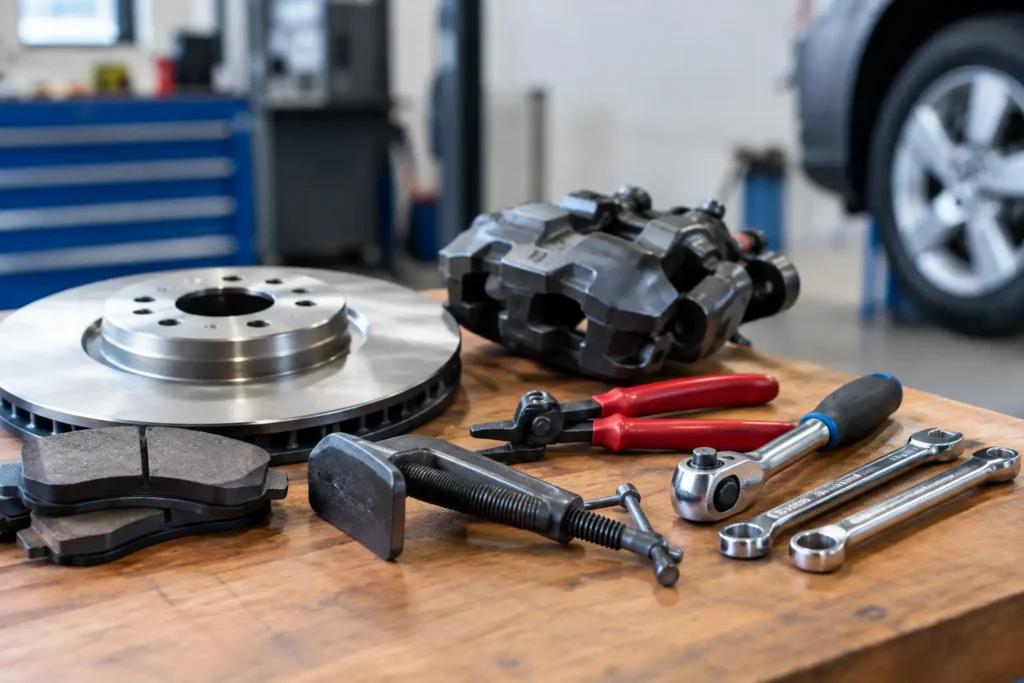
A brake job stops being profitable the moment a seized caliper piston, rounded bleed nipple or stubborn carrier bolt holds up the ramp. The right brake tools keep routine servicing moving, protect expensive components and help deliver work that is safe enough to stand behind. For a working garage or serious home workshop, the priority is not buying every specialist item available. It is buying dependable equipment that covers the brake work actually coming through the door.
Brake systems are safety-critical, but that does not mean every task requires premium-priced dealer tooling. A solid core kit, matched to the vehicles you see most often, will handle pads, discs, caliper servicing and fluid changes efficiently. Add specialist tools when the job volume justifies them.
Start With the Brake Tools Used on Every Job
The basics do most of the heavy lifting. A quality impact socket set is essential for wheel bolts, caliper carrier bolts and stubborn fasteners, while a breaker bar gives controlled leverage where an impact gun is not appropriate. Use six-point sockets wherever possible. They grip more of the fastener and reduce the chance of rounding a corroded bolt.
A torque wrench is not optional. Wheel bolts, caliper bolts and carrier bolts all have specified settings, and guessing is poor practice. Under-tightening creates a safety risk. Over-tightening can stretch bolts, damage threads or make the next repair unnecessarily difficult. Keep the wrench in its rated range and return it to its lowest setting after use.
You also need practical hand tools: combination spanners, hex keys, Torx bits, screwdrivers, pliers, wire brushes and a hammer. Modern braking systems use a wide mix of fixings, particularly on European vehicles, so a complete bit socket set saves wasted time searching for one unusual profile halfway through a job.
A trolley jack and correctly rated axle stands are equally important. Never work under a vehicle supported only by a jack. Stable support gives you room to remove wheels, inspect hoses and suspension components, and apply force to seized fasteners without putting anyone at risk.
Caliper Wind-Back Tools: Buy for Vehicle Coverage
Rear brake calipers are where basic toolkits often fall short. Many rear pistons must be rotated as they are pushed back because the handbrake mechanism is built into the caliper. Trying to force one back with a clamp can damage the internal mechanism, tear the piston seal or leave the pads sitting incorrectly.
A caliper wind-back kit with left- and right-hand threaded adaptors is one of the best-value brake service purchases for a mixed vehicle workshop. Check the supplied adaptor plates against the makes you regularly service. A kit that covers common Volkswagen Group, Ford, BMW, Vauxhall, Renault, Peugeot, Citroën and Japanese applications will suit many independent garages, but coverage always depends on the exact vehicle and caliper design.
For front calipers, a piston compressor or heavy-duty caliper press speeds up pad replacement. A press applies pressure evenly and gives better control than levering against the disc or pad backing plate. It is especially useful on multi-piston calipers, where pushing one piston in too quickly can force another out.
Electronic parking brakes need a different approach. On many vehicles, the parking brake motor must be placed into service mode using suitable diagnostic equipment before the piston can be retracted. A manual wind-back tool alone is not the answer. Check the procedure before starting, because forcing an electronic caliper can turn a straightforward pad change into an expensive replacement.
Brake Bleeding Equipment That Saves Time
A firm brake pedal depends on clean fluid and a system free from air. Traditional two-person bleeding still works, but pressure and vacuum equipment can make the job faster and more repeatable, particularly in a busy workshop.
A pressure bleeder feeds fluid through the master cylinder reservoir at controlled pressure. It is usually the best option for full fluid changes because one technician can work around the vehicle without repeatedly getting in and out of the driver’s seat. The reservoir cap adaptor must fit properly. A poor seal means leaks, lost pressure and wasted brake fluid.
Vacuum bleeders draw fluid through the nipple at the caliper or wheel cylinder. They are useful for quick work and can be convenient where access is limited. However, air may be pulled past the bleed nipple threads, creating bubbles in the hose that look like trapped air in the brake line. If the pedal remains soft, do not assume the job is complete simply because the fluid appears clear.
Brake fluid testers are a sensible low-cost addition, especially when inspecting vehicles before a service. Moisture-contaminated fluid boils at a lower temperature and can contribute to brake fade under heavy use. Testers provide a useful indication, but they do not replace manufacturer service intervals or a proper assessment of the fluid’s condition.
Use the correct fluid specification. DOT 4, DOT 4 LV, DOT 5.1 and mineral oil systems are not interchangeable just because the bottle looks similar. Keep containers sealed, avoid spills on paintwork, and dispose of old fluid responsibly. Brake fluid absorbs moisture once opened, so buying oversized containers only makes sense if your workshop will use them quickly.
The Small Brake Service Tools That Prevent Comebacks
The least expensive brake tools often prevent the most frustration. A brake pipe spanner grips more sides of a union than an open-ended spanner, which matters when working on older steel lines. A damaged union can easily turn a caliper replacement into a brake pipe repair.
Brake line clamps can be useful when replacing a flexible hose or caliper, but use them carefully. Excessive force can damage an ageing hose internally. In some cases, minimising fluid loss with a reservoir cap method or completing the repair promptly is the better option.
A wire brush, scraper and hub cleaning tool are essential when fitting new discs. Rust and debris trapped between the hub face and disc can create run-out, leading to pedal pulsation and a customer returning with a complaint. Clean the mounting surface properly, then check for excessive corrosion or damage before fitting parts.
A dial indicator is worth having for garages dealing with repeat disc vibration concerns. It helps identify lateral run-out at the hub or disc rather than relying on guesswork. For routine pad and disc work it may not be used every day, but it earns its place when diagnosing problems accurately matters more than fitting parts quickly.
Keep a set of bleed nipple caps, replacement slider pin boots, anti-rattle clips and suitable brake lubricant within reach. These items are cheap, yet missing or damaged hardware can cause noise, uneven pad wear and premature failure. Do not use copper grease on every contact point by default. Follow the vehicle manufacturer guidance and use lubricant compatible with rubber components where required.
Choosing Brake Tools for a Garage or Home Workshop
Buy according to workload, not catalogue size. A home mechanic doing occasional family-car servicing can start with a wind-back kit, piston press, torque wrench, good sockets, axle stands and a basic bleeding kit. A professional garage should add pressure bleeding equipment, diagnostic capability for electronic parking brakes, brake pipe tools and measuring equipment.
Build quality matters most where force, accuracy and safety are involved. Cheap sockets that split under impact, poorly machined wind-back adaptors and inaccurate torque wrenches cost more than their purchase price when they damage a vehicle or delay a repair. On the other hand, there is little value in paying for advanced specialist tooling that will sit unused in a drawer.
Consider storage as part of the purchase. Brake service involves fluid, grease, small clips and multiple adaptors. A labelled case for wind-back plates and a clean drawer for bleeding equipment reduce lost parts and keep contamination away from brake components. A tool chest or mobile trolley also lets technicians bring the right equipment to the ramp instead of making repeated trips across the workshop.
Irish Tools Shop focuses on affordable, reliable workshop equipment for buyers who need working tools without inflated distributor pricing. When choosing, compare what is included, the tool’s operating range, adaptor coverage, material quality and warranty support rather than judging value by the headline price alone.
A Better Routine for Brake Work
Before removing a wheel, inspect the visible condition of the tyre, brake hose and suspension. Once the caliper is off, check pad wear patterns, slider movement, piston condition, disc thickness and the condition of clips and shims. A new set of pads will not fix a seized slider or a binding piston.
Open the master cylinder reservoir before retracting pistons and watch the fluid level. If the reservoir is already full, fluid can overflow as the piston returns. On vehicles with heavily worn pads, inspect the fluid rather than automatically topping it up first.
After reassembly, torque all relevant fasteners to specification, pump the pedal until it is firm before moving the vehicle, and confirm the brake fluid level. If any brake hydraulic work has been carried out, check carefully for leaks. A short, controlled road test and correct bedding-in advice finish the job properly.
The best brake tool is the one that removes uncertainty from the work. Buy the essentials first, keep them clean and organised, and add specialist equipment when it saves more time than it costs. That is how a brake service bay stays productive without wasting money on tools that never earn their keep.
