






A tyre that is only a few PSI low can cause uneven wear, poorer handling and a return customer who thinks their repair has failed. This tyre inflator buying guide is built for mechanics, garage owners and serious DIY users who need equipment that reads accurately, works quickly and stands up to regular use.
The cheapest inflator is not always poor value, but the wrong one soon becomes a nuisance. A weak chuck leaks at the valve, a vague gauge causes pressure errors, and a short hose turns a simple job into an awkward stretch across the workshop floor. Buy for the vehicles you see, the air supply you have and the frequency of use.
Tyre Inflator Buying Guide: Start With the Job
Before comparing gauges, fittings and price tags, decide where the inflator will work. A fixed garage bay with a suitable compressor needs a different setup from a mobile technician working from a van or a motorist keeping an emergency unit in the boot.
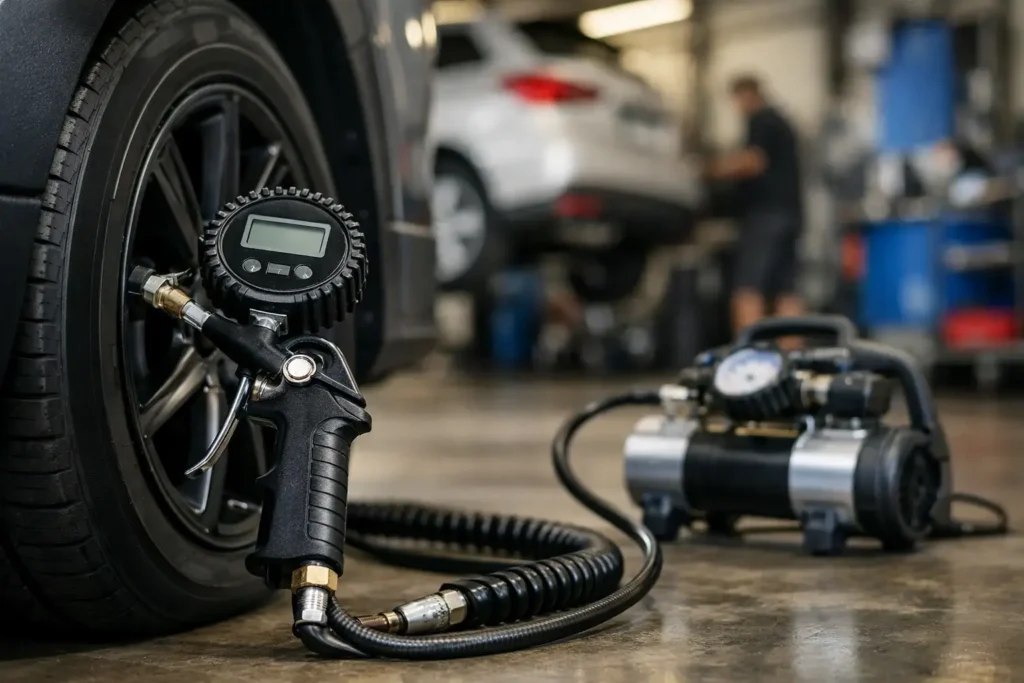
For daily workshop use, a compressed-air inflator with a hose and clip-on or lever-style chuck is normally the strongest choice. It offers fast inflation, no charging downtime and dependable performance when paired with a compressor that can maintain adequate airflow. It is also the sensible option for garages handling cars, vans, 4x4s and light commercial vehicles throughout the day.
For occasional home use, a 12V inflator can be practical, especially where a compressor is not available. Check its duty cycle closely. Many compact units are made for topping up tyres, not inflating several tyres from low pressure one after another. If it needs a ten-minute rest after a short run, it is not the right tool for a busy garage.
Cordless tyre inflators are convenient for quick checks and call-outs, but battery platform and runtime matter. They are useful alongside workshop equipment, not always as a replacement for it. Larger tyres on vans and 4x4s demand more air volume, so a small cordless model may take longer than expected.
Gauge Accuracy Is Not a Luxury
A tyre inflator is only as useful as its gauge. If the reading is out by several PSI, you are either under-inflating or over-inflating every vehicle that comes through the door. That affects tyre wear, fuel economy, ride quality and customer confidence.
Analogue gauges remain popular because they are simple, easy to read and do not need batteries. A quality dial gauge is well suited to workshop environments, particularly where it has a protective rubber surround. Look for a clear scale with sensible increments, rather than a crowded face that makes it difficult to set 32, 34 or 36 PSI accurately.
Digital gauges make target pressures quicker to read, particularly in poor light or when working at an angle. They can be a good choice for technicians carrying out frequent pressure adjustments, but they need battery management and should be protected from hard knocks. A digital display is not automatically more accurate than an analogue gauge – build quality and calibration are what count.
For normal car and van work, an inflator covering roughly 0-60 PSI is usually sufficient. A wider-range model can be useful for commercial applications, trailers and certain 4×4 requirements, but do not assume a higher maximum pressure makes it better. A gauge that spends most of its life reading between 25 and 45 PSI should be easy to read in that range.
Check Calibration in Real Workshop Conditions
No gauge should be treated as beyond question. Compare your inflator against a known accurate pressure gauge periodically, especially if it has been dropped, used heavily or left in a cold van. If several inflators are in use, make one verified gauge the reference point.
This small check can prevent repeated pressure errors across dozens of vehicles. It also helps identify when a budget inflator has reached the point where replacement is better value than continued guesswork.
Match Airflow to Your Compressor
Compressed-air tyre inflators do not consume huge volumes of air compared with spray guns or air-hungry impact tools, but they still rely on a compressor that can keep up. A small direct-drive compressor may handle occasional top-ups, while a larger belt-drive unit with a proper receiver is more comfortable in a busy working environment.
Pay attention to the inflator’s operating pressure and connector type. Most garage air systems are set up around standard workshop pressures, but fittings vary. If your airline uses Euro quick-release couplers, make sure the inflator arrives ready for that fitting or budget for the correct adaptor. A good inflator with the wrong connector is not ready to earn its place on the wall.
Hose length matters more than it appears. A short hose may be fine at a dedicated tyre station, but it becomes limiting around lifts, wider vehicles and vehicles parked outside the bay. A longer, flexible hose reduces strain on the valve and lets the technician work without dragging the compressor line across paintwork or wheels.
Avoid relying on badly kinked or cracked airline hoses. Leaks reduce effective pressure, make inflation slower and force the compressor to cycle unnecessarily. The inflator may be blamed, but the real issue is often the airline feeding it.
Choose a Chuck That Seals First Time
The chuck is the working end of the tool. A poor seal means hissing air, false readings and wasted minutes on every wheel. For a garage, a clip-on chuck is often the quickest option because it leaves both hands free to operate the trigger and monitor the gauge. Lever chucks are also dependable and easy to replace when worn.
Screw-on chucks can provide a secure connection but are slower during high-volume work. They may suit portable inflators and occasional use better than a tyre bay where speed matters. Whichever type you choose, look for solid metal construction, a reliable internal seal and a connection that reaches standard valves without forcing the hose against the wheel.
A bleed button is worth having. It allows controlled pressure reduction when a tyre has been over-inflated, without removing the chuck and checking repeatedly. That saves time and gives a cleaner, more professional result.
Do Not Buy on Maximum PSI Alone
Product listings often lead with maximum pressure, but this figure rarely tells the whole story. Nearly every general automotive inflator can exceed the pressures used by passenger vehicles. What separates useful workshop equipment from a frustrating purchase is accuracy, hose quality, chuck reliability, trigger control and how well it survives being used every day.
Consider these practical buying priorities before choosing:
- A clearly readable, consistent gauge suited to your normal pressure range.
- A durable chuck that seals quickly on standard tyre valves.
- A hose long enough for the bays, lifts and vehicle sizes you work with.
- Compatible airline fittings and an operating pressure that suits your compressor.
- A solid body and protected gauge for a busy workshop environment.
For a home garage, a lower-cost inflator can be the right call when it is used once or twice a month and stored properly. For a tyre fitter or general repair garage, spending more on a dependable air inflator usually saves money through faster jobs, fewer faulty readings and less replacement downtime.
Consider Vehicle Types Before You Buy
Cars are straightforward, but a garage rarely sees cars alone. Vans, trailers, caravans and 4x4s may need higher pressures and take longer to inflate because of their larger tyre volume. If these jobs are common, choose an air-powered model with a comfortable trigger, sturdy hose and gauge range that remains easy to read above 50 PSI.
For lorry or agricultural work, standard passenger-vehicle equipment may not be suitable. Higher-pressure systems, different valve access and heavier-duty hoses can change the requirement completely. Check the actual pressure specifications of the vehicles you service rather than buying an inflator based on the occasional car tyre.
Tyre pressure also needs checking cold wherever possible. A tyre that has just been driven into the workshop will show a higher reading as it warms up. Follow the vehicle manufacturer’s specified pressures and account for load, towing and operating conditions where required. An accurate inflator cannot correct an incorrect target pressure.
Build a Tyre Station That Saves Time
An inflator works best as part of an organised tyre service area. Keep it close to a clean airline connection, a verified pressure gauge and valve caps. Store it on a hook or reel rather than leaving it on the floor, where it can be run over, dropped or damaged by oil and debris.
If you regularly carry out tyre repairs, wheel changes or pre-MOT checks, keeping the inflator ready to hand prevents small delays adding up. Irish Tools Shop focuses on affordable, reliable workshop equipment because everyday tools like these need to work without holding up the next job.
Choose the tyre inflator that suits the work you actually do, then look after the hose, chuck and gauge. A dependable reading and a proper seal may only take seconds, but they are the kind of small details customers notice when they drive away.
