






A missing 10mm socket is not a small problem when a vehicle is on the ramp, a repair is waiting and the customer expects it back that afternoon. Proper workshop storage keeps essential tools where they belong, protects expensive equipment from damage and gives your work area the order needed to get jobs finished faster.
For a home garage, mobile mechanic setup or busy trade workshop, storage is not an afterthought. It is working equipment. The right combination of tool chests, cabinets, shelving and wall storage can free up floor space, reduce wasted movement and make every tool easier to find before it becomes a delay.
Start With the Work You Actually Do
The best storage layout depends on the work carried out in the space. A general DIY garage may need a compact rolling cabinet, a few shelves for consumables and secure space for power tools. An automotive workshop needs more capacity, stronger drawer runners and a layout that keeps frequently used tools close to work bays.
Think about what is used every day rather than what simply needs somewhere to sit. Socket sets, spanners, pliers, screwdrivers, impact tools, diagnostic equipment and brake service tools should be within easy reach. Less frequently used items, such as seasonal tools, specialist pullers or spare parts, can be stored higher up or further from the main bench.
Also consider the size and weight of your equipment. A drawer full of impact sockets is far heavier than a drawer of trim tools. A light-duty cabinet may look adequate when empty but can quickly become difficult to open or unstable once loaded. Check drawer load ratings, total cabinet capacity and wheel capacity on mobile units before buying.
Tool Chests and Roller Cabinets for Daily Use
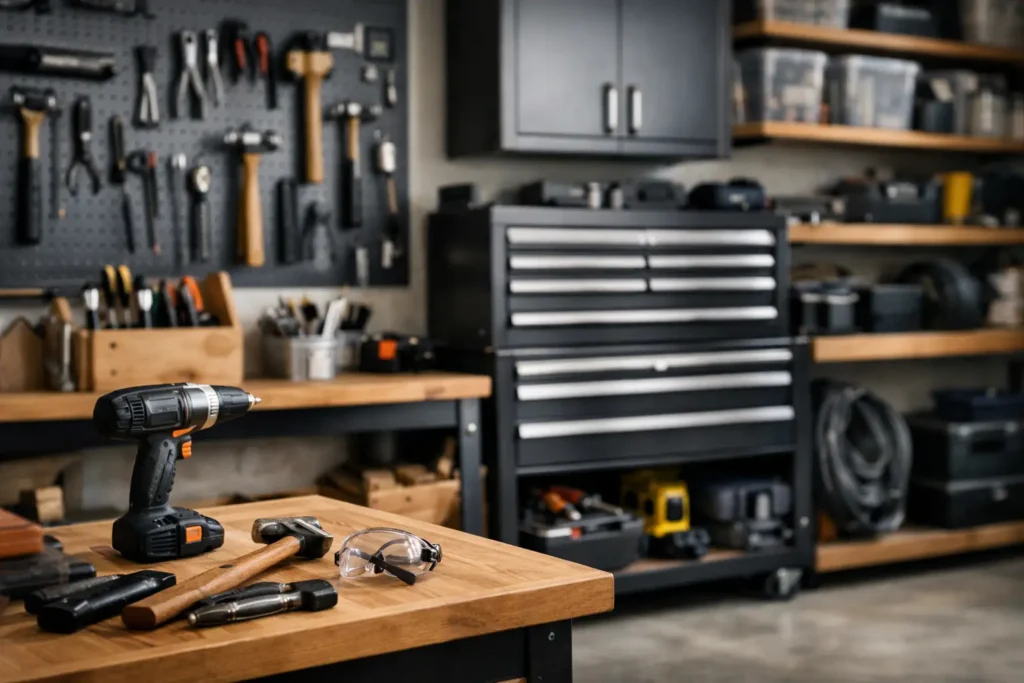
A tool chest and roller cabinet setup is often the backbone of automotive workshop storage. It puts a large number of hand tools into organised drawers while keeping the full unit mobile. That matters when working around ramps, vehicles, axle stands and engine cranes.
Top chests suit mechanics who need a compact bench-height arrangement. They can sit on a cabinet, workbench or existing storage unit and keep smaller hand tools neatly separated. Roller cabinets offer greater overall capacity and give you a usable top surface for parts, fasteners or a tool tray during a job.
Drawer depth is as important as the number of drawers. Shallow drawers are ideal for spanners, screwdrivers, punches and measuring tools. Deep drawers are better for power tools, air tools, socket rails and larger service kits. A cabinet with only deep drawers can turn into a pile of equipment; one with only shallow drawers may leave nowhere for bulky gear.
Look for steel construction, smooth ball-bearing runners, secure drawer retention and a central locking system. These are practical details, not sales jargon. Drawers that stick under load waste time, while a lockable chest helps protect tools in shared garages or commercial premises.
If your workspace changes constantly, choose a roller cabinet with strong castors and a brake system. Mobility is useful, but it must not come at the expense of stability. Park the cabinet on a level surface, lock the wheels and avoid opening several loaded drawers at once.
Workshop Storage for Power Tools and Air Equipment
Power tools need different storage from hand tools. Drills, grinders, impact wrenches and sanders are awkward shapes, often supplied in cases and easily damaged if stacked carelessly. Keeping them in their original cases works well for occasional use, but it is not always efficient in a busy garage.
For regularly used equipment, dedicate a deep cabinet drawer or a lower shelf with enough space to lift tools out safely. Store batteries and chargers together, but keep charging areas clear of oil, fuel, rags and metal swarf. Label chargers where several battery platforms are in use, especially in shared workshops.
Air tools also benefit from assigned storage. Keep impact wrenches, air ratchets and blow guns close to the compressor or primary work bay, with fittings and adapters stored in a small organiser. Hoses should be hung on a proper reel or wall hook rather than left across the floor, where they become a trip hazard and collect damage.
Heavy equipment needs a lower storage position. Trolley jacks, axle stands, transmission jacks and large tool cases should never be placed on high shelving simply to save floor space. Low-level storage makes them safer to lift, easier to inspect and quicker to move into position.
Use Wall Space Before Expanding the Floor
Floor space is expensive in every garage. Once a tool chest, workbench, compressor and lifting equipment are in place, there is rarely much room left. Wall-mounted storage gives you useful capacity without making the workshop harder to move around.
Pegboards, tool panels and heavy-duty hooks are effective for frequently used hand tools. The advantage is visibility: a quick look shows what is missing and where each item should return. This is particularly useful for pliers, hammers, pry bars, wire brushes and other tools that are often grabbed during a repair.
Wall storage does have limits. Do not overload light panels with heavy impact tools or large socket sets unless the fixing system is rated for the weight and securely mounted to a suitable wall. Heavy shelving needs proper anchors and must be installed with the load in mind, not just the empty unit.
A workbench with a back panel combines storage and workspace in one area. Keep the bench top for the job in hand, not permanent clutter. Small parts trays, magnetic holders and labelled bins can keep bolts, clips and fittings under control without covering the surface.
Shelving, Bins and Parts Organisation
Shelving is where workshops either become efficient or turn into a collection of unidentified boxes. Strong steel shelving is ideal for fluids, consumables, boxed tools, electrical supplies and spare parts, but only if stock is sorted properly.
Use clear, labelled bins for fasteners, cable ties, fuses, gloves, abrasives and fittings. Labels should be readable from where you stand. If every container says “miscellaneous”, the storage system has already failed.
Separate consumables by type and size. For example, keep common bolts, washers and clips in individual bins, then group those bins by automotive system or thread type. Brake-cleaner cans, lubricants and other workshop chemicals should be stored upright and away from ignition sources, with leaks dealt with immediately.
For garages handling regular servicing, create a simple replenishment point. When the last box of gloves, grinding discs or cable ties is opened, add it to the next order rather than waiting until stock runs out during a job. This reduces last-minute delays and makes purchasing more predictable.
Plan the Layout Around Safety and Speed
Good workshop storage should support safe working, not just create a cleaner-looking room. Keep emergency access clear, leave walking routes open and avoid placing cabinets where doors, vehicle lifts or ramps need to move. A cabinet that blocks access to a fire extinguisher or electrical isolation point is in the wrong place.
Put your most-used tools between knee and shoulder height where possible. This reduces repeated bending and reaching throughout the day. Store sharp tools securely, lock away valuable diagnostic equipment and keep heavy items low. It is a simple layout rule that pays off over hundreds of jobs.
Consider how far you walk for routine tasks. If tyre work is common, keep impact sockets, torque wrenches and wheel accessories near that bay. If you regularly carry out brake repairs, locate brake tools, flare spanners and fluid equipment together. Storage by task is often quicker than storage by tool type alone.
In a smaller garage, a mobile unit may be better value than adding several fixed cabinets. In a high-volume workshop, fixed drawer banks and dedicated stations can be the stronger long-term choice. There is no single perfect setup – the right answer is the one that fits your workload, available space and budget.
Buy Storage That Will Not Need Replacing Early
Cheap storage can be false economy if the drawers flex, castors fail or locks give up after a few months of use. Affordable does not mean lightweight. Prioritise steel construction, sensible load capacity and hardware designed for regular opening, closing and movement.
Measure the available space before ordering. Check cabinet height under benches, drawer clearance when open and whether a roller cabinet can pass around vehicles or through doorways. It is also worth allowing room for future tools. Most workshops do not stay static for long.
Irish Tools Shop supplies practical workshop equipment for mechanics, tradespeople and serious DIY users who need dependable storage without premium distributor pricing. Choosing a chest, cabinet or shelf unit with the right capacity now can save repeated upgrades later.
Start with the tools that slow you down most often, give every one of them a proper home and build outward from there. A well-organised workshop does not just look professional – it helps you work that way.
