






A mechanic hand tool set is not just a box of shiny sockets. It is the kit you reach for when a brake caliper bolt will not shift, a battery terminal needs cleaning, or a service job has to be finished before the vehicle leaves the ramp. Buy too little and every job turns into a search for missing sizes. Buy poorly and rounded fasteners, split ratchets and worn cases soon cost more than the saving.
For a working garage, mobile mechanic or serious home workshop, the right set should cover common automotive jobs without paying for drawers full of tools that never get used. The best choice depends on the vehicles you work on, the jobs you take in and whether this is your first core kit or an expansion of an existing tool collection.
What a mechanic hand tool set should cover
A useful set starts with socket coverage. Most modern cars require metric sockets, while older vehicles, imported machinery and some specialist work may call for imperial sizes. If your work is mainly cars and vans in Ireland and the UK, metric should be the priority. A sensible range usually begins around 4 mm or 5 mm and runs up to 24 mm or 32 mm, depending on the drive size included.
Drive sizes matter more than headline piece count. A 1/4 inch drive ratchet is ideal for trim, clamps, small brackets and confined engine-bay work. A 3/8 inch drive is the everyday middle ground for servicing, suspension fixings and general repairs. A 1/2 inch drive handles larger, tighter fasteners such as wheel bolts, hub hardware and heavier suspension work. One ratchet cannot do every job efficiently, so a set with all three gives far better workshop coverage.
Look beyond standard six-point sockets too. Deep sockets are regularly needed for long studs, spark plugs and nuts sitting on threaded shafts. Spark plug sockets, extension bars, universal joints and wobble extensions save time in awkward places. A decent set also includes a breaker bar or sliding T-bar for initial loosening, although seized wheel bolts and crankshaft bolts may still require an impact tool.
Spanners should be matched to the socket range wherever possible. Combination spanners are the everyday choice, with an open end for quick access and a ring end for stronger purchase. Stubby spanners help in cramped spaces, while ratchet spanners can speed up repetitive work. They are useful, but they should not replace standard combination spanners when maximum strength is needed.
Do not buy on piece count alone
A 200-piece set can be a better buy than a 300-piece set if the first contains the tools used every day. Big numbers often include screwdriver bits, small hex keys, duplicate adaptors and assorted items that inflate the total without improving real repair capability.
Check the contents list before looking at the number on the case. A serious mechanic hand tool set should offer a balanced spread of sockets, ratchets, extensions, spanners, screwdrivers, pliers and bits. The exact mix matters more than marketing claims.
Pay particular attention to the socket profile. Six-point sockets grip the flat sides of a fastener and are generally the better option for tight or corroded bolts. Twelve-point sockets can be useful where access is limited because they engage more easily at different angles, but they are more likely to damage a worn fastener under high load. Ideally, a garage kit has six-point sockets in the sizes used most often.
Chrome vanadium steel is a common and reliable material for hand tools. It is not a guarantee of quality on its own, but it is a sound starting point when paired with proper heat treatment, clean machining and a durable finish. A polished chrome finish is easy to wipe clean and resists corrosion, while a satin finish can offer better grip with oily hands. Neither finish makes a weak tool strong, so inspect the specification and warranty rather than buying on appearance alone.
The tools that make routine jobs faster
Sockets and spanners get most of the attention, but the smaller hand tools often decide whether a set is genuinely useful. Quality screwdrivers with hardened tips reduce cam-out and damage to screw heads. Pliers should include combination pliers, long-nose pliers and side cutters at a minimum. Water-pump pliers are valuable for hose clips and larger fittings, while locking pliers can hold damaged parts when a conventional grip is no longer possible.
Bit sets are another area where quality matters. Automotive work commonly needs Phillips, flat, Pozidriv, Torx and hex bits. Security Torx bits are worth having for interior trim, electronics and certain sensors. Cheap bits round quickly, especially in Torx fasteners, so it is usually better to buy a set with fewer dependable bits than a large assortment made from soft steel.
For brake work, suspension jobs and engine repairs, a standard hand tool kit is only the foundation. It will not replace a torque wrench, brake piston rewind kit, impact socket set, ball joint separator or puller set. Keeping these specialist tools separate makes sense because not every buyer needs them on day one. It also lets you build your workshop around the work you actually carry out.
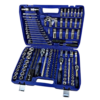
Manarola 85PC Cantilever Tool Metal Box With Tools – 1/4″ & 1/2″ Drives
Choose storage that suits the way you work
A blow-moulded carry case is practical for mobile work, occasional repairs and keeping a first kit together. The drawback is that cases can become frustrating when tools are used daily. Empty spaces are hard to identify once the trays are dirty, and a damaged hinge can turn an organised kit into loose tools in the boot of a van.
For a busy garage, foam trays or modular drawer inserts in a tool chest are often the better long-term option. They make missing tools obvious, reduce wasted time and protect socket finishes. A larger mechanic hand tool set in a chest can also be expanded gradually with specialist drawers for electrical tools, brake equipment and diagnostic items.
There is a trade-off. A case is portable and usually lower cost, while a chest improves organisation but requires more space and investment. For a mobile technician, start with a well-stocked case and add a compact trolley or portable top box as the tool collection grows. For a fixed workshop, buying a quality chest early can prevent duplicate purchases later.
Build for the jobs in front of you
If you mainly service family cars, focus on metric sockets, combination spanners, Torx bits, screwdrivers, pliers and 1/4 inch to 1/2 inch drive ratchets. Add a torque wrench and a good set of impact sockets before spending heavily on unusual specialist tools. These are the items that support oil services, brakes, batteries, suspension repairs and common engine-bay work.
If you work on commercial vehicles, agricultural machinery or older cars, larger socket sizes, imperial spanners and heavier-duty 1/2 inch drive equipment become more relevant. You may also need 3/4 inch drive tools for larger fasteners, but these should be bought for a clear job requirement rather than included in a general kit.
DIY buyers should avoid the temptation to buy the cheapest possible bundle. A basic set can be excellent value when it has the right core tools and a clear warranty. However, a kit that lacks common sizes will force extra purchases straight away. Spending slightly more on useful coverage is usually cheaper than replacing a poor starter set piece by piece.
Check these details before ordering
Before committing to a set, confirm that the drive sizes and socket ranges fit your work. Check whether sockets are six-point or twelve-point, whether deep sockets are included, and whether the ratchets have a fine enough mechanism for restricted access. A higher tooth count allows smaller movements between clicks, which is valuable around bulkheads and tight engine bays.
Also check the case dimensions or chest layout, especially if storage space is limited. Warranty coverage matters because ratchets and moving components take real punishment in workshop use. Finally, consider delivery speed when a missing tool is holding up a repair. Irish Tools Shop supplies affordable, reliable garage and mechanic equipment for buyers who need practical specification, honest value and tools that can get straight to work.
A good set should earn its space every week. Start with the tools that handle the vehicles on your ramp or driveway now, keep them organised, and add specialist equipment only when the work proves you need it.
