






35 Piece 1/2″ Square Drive Deep Impact Hex Socket Set | 78mm Long | 6 Point | Colour Coded
A rounded nut, a split chrome socket, and a wasted hour usually start the same way – using the wrong socket on the wrong job. If you are working on suspension, wheel nuts, engine work, or stubborn fasteners, knowing how to pick impact sockets saves time, protects tools, and stops cheap mistakes.
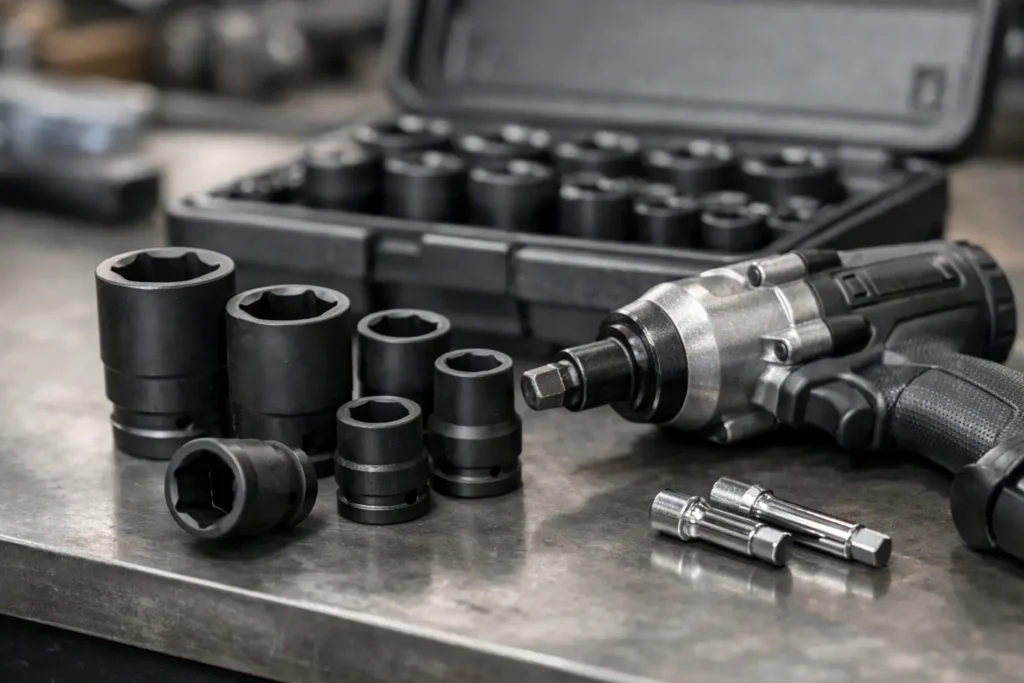
Impact sockets are built for hammering force from impact wrenches, air tools, and high-torque cordless machines. They are not just standard sockets with a darker finish. The steel, wall thickness, and shock handling are different, which is why choosing properly matters if your tools earn their keep.
How to pick impact sockets for real workshop use
The first thing to get right is the drive size. Most buyers do not need every socket in every size. They need the right range for the work they actually do.
A 1/2in drive impact socket set is the standard choice for most automotive and garage work. It covers wheel nuts, brake carriers, suspension bolts, and plenty of general repair tasks. If you want one set that handles the biggest share of common jobs, this is usually the smartest buy.
A 3/8in drive set suits lighter mechanical work where access is tighter and the fasteners are smaller. Think engine covers, brackets, smaller mounting bolts, and general under-bonnet jobs. It is more compact, but it is not the best choice for repeated high-torque work on seized fixings.
A 3/4in or 1in drive set belongs in heavier workshop and commercial use. If you are working on larger vehicles, plant, agricultural machinery, or serious chassis fasteners, stepping up in drive size gives you the strength and coverage required. The trade-off is cost, weight, and bulk.
If you are unsure, buy for the jobs you do most often, not the odd job once every six months. For many mechanics and serious DIY users, a solid 1/2in set plus a smaller 3/8in set is a practical combination and better value than overbuying a large mixed kit you rarely use.
US PRO 3 Piece 1/4″ Drive Magnetic Quick Release Bit Extensions
Choose the correct socket size range
Once the drive size is sorted, look at the actual socket sizes included. This is where plenty of buyers either overspend on duplicate sizes or end up short on the ones they need most.
For automotive use in the UK and Ireland, metric impact sockets are usually the priority. Common sizes such as 10mm, 13mm, 17mm, 19mm, 21mm, 22mm, and 24mm see constant use across cars, vans, and general workshop tasks. If you mainly work on modern vehicles, a metric set should come first.
Imperial sizes still matter for some older equipment, certain imported machinery, and mixed trade environments. If you work across automotive, agricultural, and workshop repair, having both can make sense. If not, paying for a full imperial set may not be the best use of your budget.
It also pays to check whether the set skips sizes. Budget kits sometimes look competitive on price but miss key middle sizes. That is fine until the exact size you need is the one not in the box.
Deep or shallow impact sockets?
This depends on access and fastener length. Shallow impact sockets are better where space is limited. They are often stronger in feel, easier to control, and ideal for standard fasteners where stud length is not an issue.
Deep impact sockets are the better choice for wheel nuts, long studs, and recessed fixings. If you regularly work on wheels or suspension, they are hard to do without. Many buyers end up needing both, but if you are starting with one set, think about your most frequent jobs. Wheel and tyre work leans deep. General repair often leans shallow.
Material and finish matter more than branding claims
If you want impact sockets that last, look at the construction before the badge. A proper impact socket is typically made from chrome molybdenum steel. This material is designed to absorb repeated shock loads better than standard chrome vanadium sockets.
That does not mean every chrome molybdenum socket is equal. Machining quality, fit, wall consistency, and heat treatment still separate a dependable set from one that rounds fasteners or cracks under regular use. A black phosphate finish is common and useful because it helps resist corrosion without the brittle behaviour associated with chrome-plated hand sockets used under impact.
This is one area where buying purely on the lowest price can cost more later. Very cheap sets can be fine for occasional use, but daily workshop use demands better tolerances and more reliable steel. Affordable and reliable is the target. Dirt-cheap and disposable rarely works out well in a busy garage.
6-point or 12-point sockets?
For impact work, 6-point sockets are usually the right choice. They grip the flats of the fastener better and reduce the risk of rounding under heavy torque. That is exactly what you want when dealing with tight, corroded, or overtorqued nuts and bolts.
A 12-point socket can be handy in some situations for easier alignment, but for impact applications it is generally less forgiving. If your priority is strength and fastener protection, stick with 6-point.
US PRO 12 Piece 3/4″ Drive 6 Point 80mm Length Metric Deep Impact Socket Set | 24mm – 41mm
Check wall thickness and access before you buy
Not every impact socket suits every vehicle. Some wheel designs, recessed nuts, and tight engine bay clearances need thinner walls or a more compact profile. Others need extra reinforcement because the torque is severe and access is open.
This is where it depends on the work. A heavy-wall socket may offer confidence on stubborn suspension bolts, but it can be useless inside a tight alloy wheel recess. Thin-wall impact sockets are often the answer for wheel fitting and removal, especially on modern alloys. They also help reduce the chance of marking the wheel when used correctly.
If wheel work is a major part of your day, it is worth buying impact sockets designed for that purpose rather than forcing a standard bulky socket into a narrow recess.
Retention features and fit are worth attention
A proper impact socket should fit the anvil securely and seat well on the fastener. Look for a clear retention hole or ring groove if your wrench uses pin or hog-ring retention. It sounds minor, but a poor fit on the gun or a loose fit on the nut creates frustration and extra wear.
Good fit also affects safety. Under high torque, any slop between socket and fastener increases the chance of slipping, rounding, or cracking. In a professional setting, that costs time. In a home garage, it can cost knuckles, panels, or wheel finish.
Buy a set or buy singles?
If you are building a workshop kit from scratch, a set is usually the better-value route. You get the core sizes together, proper storage, and a lower cost per socket. For most buyers, that is the sensible starting point.
Singles make more sense when you already have a working set and need to replace the high-use sizes or fill a gap. The truth is some sockets wear faster simply because they do more work. Wheel nut sizes and common suspension sizes often take the most punishment.
Do not pay for a huge case full of rarely used sizes if your actual work is predictable. A compact, hard-working set you use daily is a better buy than an oversized kit that spends its life on a shelf.
How to pick impact sockets without overspending
Price matters, especially when you are kitting out a garage or replacing several tools at once. The trick is to spend where it affects performance and skip extras that do not.
Pay for the right steel, the right drive size, and the right size range. Pay attention to whether you need deep, shallow, or thin-wall options. Be less concerned with flashy presentation, oversized cases, or gimmicks that do not improve durability.
For trade users, downtime is expensive, so proven reliability is worth the extra few pounds. For serious DIY use, a well-made mid-range set is often the sweet spot. You want sockets that can handle real torque without stepping into premium pricing for no practical gain.
A specialist retailer such as Irish Tools Shop makes this easier because you can compare workshop-focused options without paying inflated distributor prices for basic essentials.
11 Piece 1/2″ Square Drive 6 Point Deep Hex Impact Socket Set -78mm Long | Colour Coded
Common buying mistakes
The most common mistake is using hand sockets with an impact wrench and assuming they will cope. They might for a while, then they split. The next mistake is buying the wrong drive size and compensating with adaptors on every job. Adaptors have their place, but relying on them constantly adds weak points and reduces efficiency.
Another mistake is buying a set based only on piece count. More pieces do not automatically mean better value. A smaller, better-chosen set with the sizes you actually need is often the stronger purchase.
Lastly, do not ignore storage. A decent case helps keep sockets organised, prevents loss, and speeds up work. In a busy workshop, that matters more than people admit.
If the socket will see regular impact use, buy it for the work in front of you, not for the marketing on the box. Get the right drive, the right size range, and the right depth, and the set will pay for itself every time a stubborn fastener comes loose without a fight.
US PRO 12 Piece 3/4″ Drive 6 Point 80mm Length Metric Deep Impact Socket Set | 24mm – 41mm
