






A toolchest with tools is more than a convenient way to fill a corner of the garage. For a mechanic, technician or serious DIY user, it is the working base for faster jobs, cleaner benches and fewer wasted minutes hunting for a 13 mm socket. Buy the right combination and you get organised storage plus the core hand tools needed to start working straight away. Buy the wrong one and you can quickly run out of drawer space, discover weak slides under load or pay for a tool selection that does not suit the work you actually do.
Start with the work, not the number of pieces
A large piece count looks good on a product page, but it is not a reliable measure of value. A 300-piece set may include useful sockets, bits, spanners and pliers, yet still lack the longer breaker bar, deep sockets or speciality tools required for regular automotive repair. Start by looking at the jobs on your ramp, driveway or workbench each week.
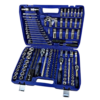
For general servicing, a well-chosen chest should cover metric combination spanners, 1/4 in, 3/8 in and 1/2 in drive sockets, ratchets, extensions, universal joints, screwdrivers, pliers, Allen keys, Torx keys, hammers and a sensible bit set. These are the tools that earn their drawer space on brake work, suspension jobs, engine bay repairs and routine maintenance.
If you work on older vehicles, seized fixings and underbody repairs, strength matters as much as range. Prioritise impact-rated sockets where an impact wrench is used, a solid breaker bar, deep sockets and quality grips. For newer vehicles, Torx, spline and trim tools may be just as essential. There is no benefit in buying a huge kit packed with duplicate small tools while missing the sizes and drive types your work demands.
Pre-loaded drawers save time, but leave room to grow
The main advantage of a pre-equipped chest is speed. You avoid piecing together a starter collection tool by tool, and fitted trays make it obvious when something has not been returned. This is particularly useful for a new garage bay, a mobile mechanic setting up a van, or a DIY user moving beyond a loose toolbox.
The trade-off is that no supplied kit is perfect for every workshop. Leave at least one or two drawers free for the specialist equipment you will add later, such as brake wind-back kits, pullers, diagnostic equipment, air fittings or electrical terminals. A chest that arrives full to the top can become restrictive long before its frame wears out.
Check the toolchest with tools construction
A chest must support the weight of its contents every day, not just look tidy when it arrives. Filled drawers become heavy quickly, especially when they hold 1/2 in drive sockets, power tools or brake service equipment. Look closely at the cabinet material, drawer runners, handles, castors and locking system before comparing piece counts.
A steel cabinet with a durable powder-coated finish stands up better to knocks, oil marks and the damp conditions found in many garages. Light-duty storage can suit occasional household use, but a busy workshop needs a more substantial frame and drawers that do not twist or bind when loaded.
Drawer depth and runners decide daily usability
Shallow top drawers are ideal for spanners, screwdrivers, pliers and measuring tools. Deeper lower drawers are where you store socket sets, impact tools, torque wrenches, cordless tools and larger cases. Check the internal drawer dimensions rather than judging the cabinet by its overall width. A chest can look large while offering very little usable depth.
Ball-bearing drawer slides are a practical choice for regular use because they allow a full drawer to move smoothly under weight. The more heavily you intend to load the chest, the more attention you should pay to runner quality and stated drawer capacity. Avoid overfilling a drawer simply because it closes. Repeated strain on runners leads to rough operation and can make tools harder to access when time matters.
A central lock also has value in shared garages, commercial units and home workshops. It will not replace proper site security, but it helps keep tools contained and prevents drawers opening while the cabinet is moved. On a roller cabinet, locking castors are equally useful. A loaded chest should stay firmly in position while you pull on a ratchet or open a full drawer.
Choose tools you will use, not tools you recognise
Inspect the supplied tool categories and sizes. For most vehicle work in Ireland and the UK, metric sizes are the priority, although mixed imperial and metric coverage can be useful for classic cars, machinery and certain imported equipment. Make sure sockets include common sizes rather than jumping over the ones used most often.
Six-point sockets are usually the stronger choice for stubborn fasteners because they grip more of the nut or bolt head. Twelve-point sockets can be useful in tighter access areas and for certain fasteners, so a balanced set has a place for both. Deep sockets are worth having for studs and recessed nuts, while spark plug sockets, extensions and wobble adapters make many engine bay jobs less frustrating.
Spanners should have clear size markings and a finish that remains easy to wipe clean. Ratchets should feel positive in the hand, with a reliable direction lever and a mechanism fine enough to work in confined spaces. With screwdrivers and pliers, comfortable grips matter during repetitive work, but the steel construction and tip quality still come first.
Be realistic about quality levels. An affordable professional-grade kit is a strong option for regular servicing, repair work and serious home use. A specialist technician completing high-volume work may still choose to add premium ratchets, precision torque equipment or manufacturer-specific tools over time. The chest and core kit should give you a dependable foundation, not force you into paying premium prices for tools you do not need.
Get the cabinet size right for the space
Measure the floor area before ordering. Include room to open the widest drawers fully and enough clearance to move safely around the chest. In a tight single-bay garage, a medium roller cabinet can be more useful than an oversized unit that blocks access to the vehicle or workbench.
Height matters too. A roller cabinet can double as a convenient work surface for laying out parts, although it is not a substitute for a heavy fabrication bench. A top chest adds storage without using more floor space, but make sure it can be reached comfortably and that the combined unit remains stable. If you are placing it beneath a bench or shelf, measure the clearance with the lid and drawers in mind.
For mobile work, choose a cabinet with strong castors, a sensible overall weight and handles positioned for controlled movement. It depends on the floor surface: smooth concrete suits larger castors well, while cracked floors and thresholds can make a fully loaded chest difficult to manoeuvre. In that case, a fixed chest with separate portable cases may be the better working arrangement.
Compare value beyond the sale price
The cheapest toolchest with tools is rarely the lowest-cost choice if drawers fail, the tool range is incomplete or you need to replace core items immediately. Compare the cabinet build, number of usable drawers, included drive sizes, tool material, warranty terms and delivery cost as one package.
A good deal is one that puts useful equipment into service quickly. Buyers setting up a fresh workspace often benefit from a complete kit because it reduces multiple orders and avoids delays when a job requires a basic tool that has not yet been bought. Irish Tools Shop focuses on that practical balance: dependable workshop equipment, competitive pricing and fast delivery for buyers who need to get on with the job.
Sale pricing can make a larger cabinet or broader kit worthwhile, but do not let a discount decide the specification. If a lower-priced chest has the drawer layout and core tools you need, it may be the stronger purchase. If you expect your collection to grow fast, spending a little more on extra drawer capacity can prevent an early upgrade.
Set it up so every tool earns its place
Once the chest arrives, take ten minutes to organise it around the way you work. Keep frequently used sockets, ratchets and screwdrivers in the upper drawers. Store heavy socket rails and power tools low down to improve stability. Put brake, electrical or engine-specific tools together so a job does not involve opening every drawer.
Use the supplied trays where they make sense, but do not be afraid to adjust the layout. Foam inserts, socket rails and drawer dividers help keep equipment from rolling together and make missing items easy to spot. Wipe tools before returning them, especially after brake fluid, coolant or underseal work. A clean, organised cabinet protects the tools and makes the next repair start properly.
Choose for the work you have now, leave capacity for the jobs ahead, and your chest will become one of the hardest-working pieces of equipment in the workshop.
