






A warning light on the dash is not a diagnosis. It is a starting point. The right vehicle diagnostic scanner guide helps you buy a tool that reads the fault properly, supports the vehicles you see and earns its place in the workshop rather than sitting unused in a drawer.
For a serious DIY user, mobile mechanic or busy independent garage, a scanner can save hours of guesswork. But not every diagnostic tool does the same job. A cheap code reader may be enough to identify a basic engine fault. A workshop dealing with modern diesel, hybrid and multi-brand vehicles will need far more coverage.
Start with the work you actually carry out
The best scanner is not automatically the one with the longest function list. It is the one that handles the jobs in front of you reliably. Before comparing prices, look at the age, makes and systems of the vehicles you work on.
If you mainly service your own car or help family and friends, an entry-level OBD2 reader can read and clear engine fault codes, show live data and check whether a repair has switched the engine management light off. This is useful, affordable equipment for basic fault finding, but it has limits. It may not access ABS, airbag, body control, gearbox or service functions.
For regular repair work, choose a multi-system diagnostic scanner. These units access more control modules and normally offer service resets, electronic parking brake functions, battery registration and oil service reset. That is the practical middle ground for many independent workshops and serious home garages.
A professional scanner is the right call when daily throughput matters. It should provide broad vehicle coverage, full-system scans, live data graphs, bi-directional or active tests, coding support where appropriate, and regular software updates. The higher initial price is easier to justify when it reduces diagnostic time across several jobs every day.
What a vehicle diagnostic scanner should read
Modern cars are made up of separate electronic modules. Reading the engine control unit alone will not diagnose every warning light or running problem. A useful scanner must access the systems relevant to the repairs you take on.
Engine diagnostics are the minimum. This includes reading diagnostic trouble codes, checking freeze-frame data and viewing live information such as coolant temperature, fuel trims, airflow readings, oxygen sensor activity and boost pressure. Live data matters because a stored code points towards a circuit or condition, not always the failed part.
ABS and airbag access are equally valuable. A wheel speed sensor issue, steering angle fault or airbag circuit fault can leave a vehicle unsafe or unable to pass its MOT or NCT. A basic reader may show no information at all, while a full-system scanner gives you the code, module and live values needed to test the fault properly.
Gearbox, body, climate control, parking sensor and instrument cluster coverage is worth having if you work on newer vehicles. The same applies to electronic parking brake servicing. Rear brake pad replacement on many models requires the motors to be placed into service mode. Forcing the caliper back without this function can damage the mechanism and create an expensive avoidable repair.
Do not confuse code reading with diagnosis
This is where costly mistakes happen. A scanner reporting an EGR, injector, DPF or sensor-related code does not prove that component needs replacing. Wiring damage, poor connections, low system voltage, vacuum leaks, carbon build-up and software issues can all create similar symptoms.
Use the scanner as part of a proper test process. Read all codes before clearing anything, record freeze-frame information, inspect the related wiring and compare live data with the vehicle’s expected operating conditions. Where possible, use active tests to command a fan, pump, solenoid or actuator and confirm whether the component responds.
A scan tool works best alongside dependable workshop basics: a multimeter, battery tester, wiring information, pressure gauges and suitable hand tools. Diagnostic equipment cuts down uncertainty, but it cannot replace sound mechanical checks.
Key functions worth paying for
When two scanners appear similar, compare the practical functions rather than the size of the screen or the number of vehicle logos in the advert. These are the features that usually make a difference in real repair work:
- Full-system scanning to check engine, ABS, SRS, transmission and body modules from one menu.
- Live data and graphing for comparing sensor readings and spotting intermittent faults.
- Active tests for commanding components and proving a circuit or actuator without dismantling parts first.
- Service functions such as oil reset, brake service mode, battery registration, steering angle calibration and DPF-related functions.
- Vehicle identification by VIN to reduce manual selection errors and speed up the job.
- Clear update policy so you know whether software coverage is included, limited by time or charged annually.
Not every vehicle supports every function, even with a high-specification unit. Always check compatibility against the makes, models and years you service most. A tool advertised with coding or calibration features may only support them on selected vehicles.
Handheld, tablet or Bluetooth scanner?
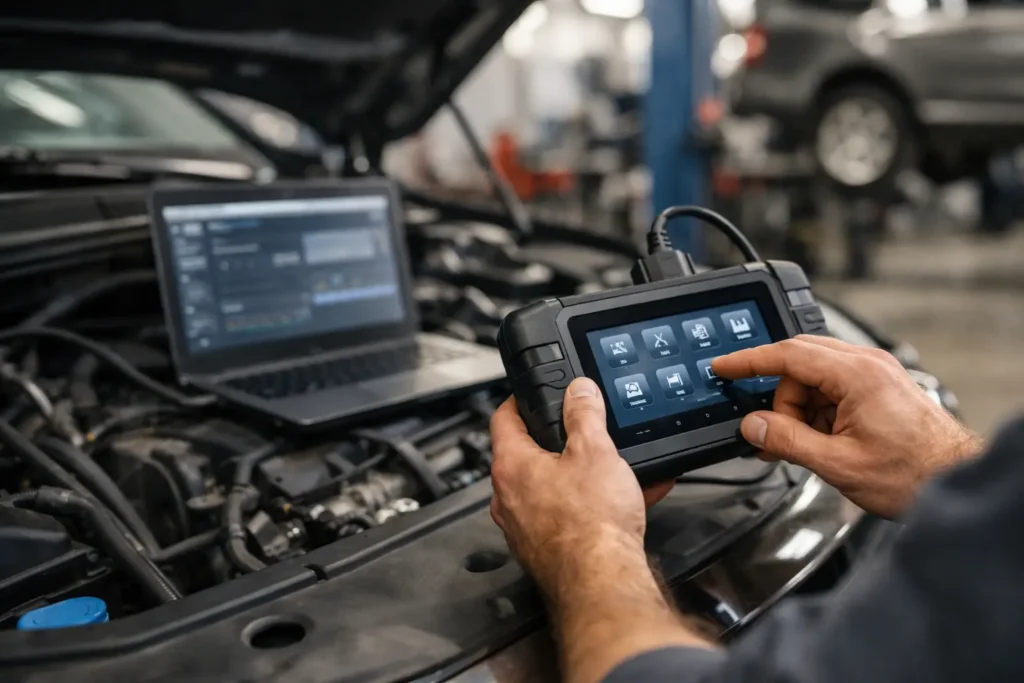
A handheld scanner is a solid choice for buyers who want a dedicated, straightforward tool. It is usually ready to use quickly, can be kept in a tool chest and is less dependent on a phone battery or mobile signal. For service work and code reading, a well-built handheld unit often offers excellent value.
Tablet-style diagnostic scanners suit workshops that want a larger display, easier live data graphing and more advanced menus. They are generally more expensive, but the screen size is useful when sharing readings with a customer or working through several modules on a modern vehicle.
Bluetooth dongles paired with a phone or tablet are compact and low-cost. They can be useful for a DIY owner who wants occasional engine data and code reading. However, quality varies widely. Cheap unbranded adapters can have limited protocol support, unreliable connections and poor app coverage. They are not the best choice for a garage that needs repeatable results on customer vehicles.
Coverage, updates and subscriptions
A scanner is only as useful as its vehicle coverage. Older petrol and diesel vehicles are often straightforward under OBD2, but later models use manufacturer-specific systems and more complex modules. If you see Ford, Volkswagen Group, BMW, Mercedes-Benz, Vauxhall, Peugeot, Renault and Japanese makes regularly, check that the unit supports them at the level you need.
Also consider the vehicles you expect to see next year. Hybrids, EVs and newer diesels bring different service requirements, from battery system information to DPF procedures and electronic cooling controls. You do not need to pay for specialist EV functions if you will never work on those vehicles, but a growing garage should avoid buying a scanner already behind the market.
Software updates deserve close attention. Some scanners include updates for a fixed period, then charge a subscription. Others provide lifetime updates with a more limited function set. Neither option is automatically better. A paid update plan can make sense if it adds useful coverage and keeps a daily-use tool current. The important point is to know the ongoing cost before you buy.
Build a sensible diagnostic setup
A scanner should be protected like any other piece of workshop equipment. Keep it charged, update it before a busy week and use a stable battery support unit when carrying out long diagnostic sessions, programming or service procedures. Low vehicle voltage can create false faults and interrupt functions at the worst possible moment.
Keep a record of scans before and after repair. This helps confirm the fault, supports your job card and gives the customer a clear explanation of the work completed. It also stops a recurring issue being treated as a new problem every time the vehicle returns.
For affordable professional-grade diagnostic equipment and the workshop tools that support it, Irish Tools Shop gives garages and serious DIY buyers a practical place to build their setup without paying inflated distributor prices.
Buy for the next job, not the biggest claim
A basic reader is enough when you only need occasional engine fault codes. A full-system scanner with service functions is the better value purchase for routine repair and maintenance. If diagnostics are a daily part of your business, active tests, live data graphing and dependable updates are worth paying for because they save labour time.
Choose the scanner that matches your work, verify its vehicle coverage and learn how to test beyond the code. The right tool will not just clear warning lights – it will help you find the reason they came on in the first place.
