







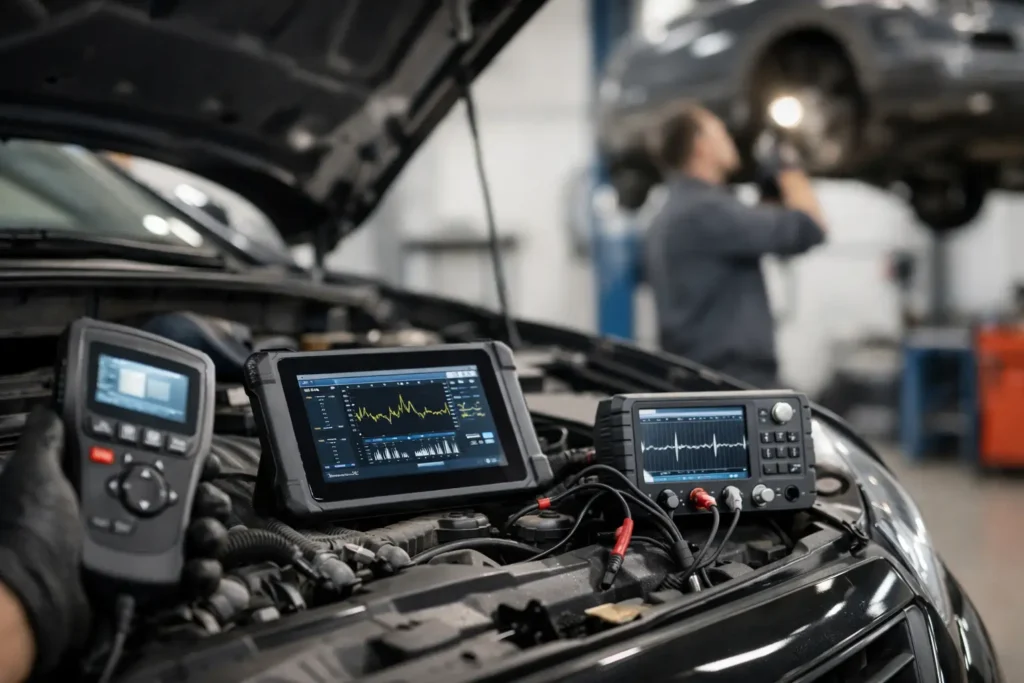
A warning light, a no-start fault or an intermittent misfire can waste hours when the guesswork begins. The right diagnostic tools give you a clear starting point: read the fault, test the circuit, confirm the repair and get the vehicle back on the road without replacing parts that were never faulty.
For a working garage, mobile mechanic or serious home workshop, diagnostics are not just about plugging in a scanner. A useful setup combines vehicle code reading with electrical testing, battery checks and practical mechanical inspection. Buy for the work you do most often, but leave enough capability to deal with the jobs that turn up without warning.
Diagnostic tools that earn their place in a workshop
A basic OBD2 code reader is often the first tool to reach for on vehicles with an engine management light. It can read and clear generic fault codes, show whether the fault is current or stored, and check readiness monitors after a repair. For routine servicing and straightforward fault finding, this is a cost-effective starting point.
A more capable diagnostic scanner is the better choice for regular repair work. Look for coverage of engine, ABS, airbag, transmission and service systems, rather than engine codes alone. Live data is where a scanner becomes genuinely useful. Viewing coolant temperature, fuel trims, oxygen sensor activity, air flow readings, wheel speeds and battery voltage can show whether a component is behaving as it should before you order a replacement.
Vehicle coverage matters as much as the number of functions printed on the box. A scanner may work well for generic OBD2 faults but have limited access to manufacturer-specific modules, service resets or actuator tests. If your garage sees a regular mix of Ford, Volkswagen Group, BMW, Mercedes-Benz, Vauxhall, Peugeot, Renault or Japanese vehicles, choose diagnostic equipment with suitable system coverage and software support.
Do not treat fault codes as a final diagnosis. A code points to a system or condition, not always the failed part. A code for a sensor circuit can be caused by damaged wiring, poor earths, low system voltage or a connector full of corrosion. The scanner tells you where to look. Testing proves what needs repair.
The diagnostic tools beyond the scanner
A multimeter for electrical fault finding
A dependable digital multimeter is one of the best-value tools in any garage. It checks voltage, resistance, continuity and charging output, helping you trace faults that a scan tool alone cannot confirm. Use it to test battery voltage, alternator charging, sensor reference voltage, fuses, relays and wiring continuity.
For automotive work, select a meter with clear readings, protected input ports and leads that can handle regular workshop use. Back-probe pins, crocodile clips and fused test leads make the job safer and more accurate. Cheap leads that split or give poor contact create bad readings and wasted time, so this is not the place to cut every corner.
When measuring a live circuit, use the correct range and connect carefully. Never probe an airbag circuit with unsuitable equipment, and do not use resistance testing on a powered circuit. Good diagnostic practice protects both the vehicle and the technician.
Battery and charging system testers
Low voltage causes a surprising number of vehicle faults. Modern cars rely on stable voltage across multiple control modules, and a weak battery can trigger warning lights, communication errors, poor starting and unreliable stop-start operation.
A battery tester gives a quicker, clearer answer than checking resting voltage alone. It can assess battery condition, starting performance and charging voltage, helping you separate a tired battery from an alternator or cable fault. This is particularly useful during winter, after a vehicle has been standing, or when customers report intermittent electrical problems.
Test lights, circuit testers and smoke machines
A test light remains useful for fast checks at fuses, lamps and simple power feeds, but it has limits. On modern low-current circuits, a multimeter is usually the safer choice because a traditional bulb test light can place too much load on sensitive electronics.
A powered circuit tester can speed up work on wiring, relays and motors by supplying power and earth while showing voltage readings. It is effective in experienced hands, but it must be used with care. Supplying power to the wrong terminal can damage a module.
For air leaks, vacuum issues and EVAP faults, a smoke machine can save a great deal of time. A controlled smoke test makes split hoses, loose intake joints and leaking seals visible. It is a specialist purchase, but for garages handling frequent engine-management work, it can pay for itself quickly.
How to choose diagnostic tools for your workload
Start with the vehicles and jobs you actually see. A home mechanic maintaining one or two family cars may only need a reliable code reader, multimeter, battery tester and basic test leads. A busy independent garage needs broader vehicle coverage, live data, service functions and the ability to access several control modules quickly.
Screen size, menu speed and update process matter in day-to-day use. A tool that is difficult to navigate slows down fault finding, even if its specification looks impressive. A wired scanner is often dependable and ready to use whenever you need it. Wireless tools are convenient around the vehicle, but they depend on a phone or tablet battery, connection quality and compatible software.
Consider the ongoing cost before buying. Some professional scanners require paid updates or subscriptions for new vehicle coverage and advanced functions. That can be worthwhile if the tool earns money every week. For lighter use, a unit with solid core coverage and no heavy annual commitment may offer better value.
Build quality should match the workshop. Rubber protection, a tough lead, strong connectors and a carry case are practical features, not decoration. Diagnostic equipment is frequently moved between bays, left on a wing cover or used outdoors at a roadside job. A fragile unit becomes an expensive false economy.
A faster fault-finding routine
The best tools work when there is a disciplined process behind them. Begin by confirming the complaint. Ask when the fault occurs, whether warning lights appeared first and what work has recently been carried out. Then make basic checks: battery condition, loose connectors, damaged wiring, fluid levels, vacuum pipes and obvious mechanical issues.
Next, carry out a full code scan and record the faults before clearing anything. Freeze-frame data can show engine speed, temperature, load and voltage at the time a fault was logged. Check live data against the vehicle’s condition and compare related readings. If one wheel-speed sensor is reporting differently from the others, for example, inspect the sensor, wiring and reluctor ring before fitting parts.
After repair, clear codes only when appropriate, run the vehicle through the conditions that caused the problem and scan again. A repair is not confirmed because the warning light went out in the workshop. It is confirmed when the system operates correctly and the fault does not return.
Common buying mistakes to avoid
The cheapest reader is not always the best deal if it cannot access the systems you need. Equally, paying for advanced coding and programming functions makes little sense if you only need to read engine codes and check a battery. Match the tool to the revenue or time saving it can deliver.
Another common mistake is relying on a scanner without electrical test equipment. Diagnostic codes are useful, but a multimeter, quality leads and a battery tester are often what prove the cause. Keep them together in a dedicated diagnostic case or drawer so they are ready when a vehicle arrives.
Finally, avoid buying on claimed vehicle coverage alone. Check whether the equipment supports the makes, model years and functions relevant to your work. Clear specifications, warranty cover and readily available replacement accessories are worth considering when the tool will be used every day.
A well-chosen diagnostic setup does more than clear dashboard lights. It cuts down parts swapping, improves repair confidence and keeps workshop time focused on paid work. Start with dependable essentials, add specialist equipment where it earns its keep, and make every test lead, scanner and meter work as hard as the rest of your garage.
