






A seized bolt can turn a straightforward brake, suspension or engine job into an afternoon of broken sockets, rounded heads and missed deadlines. If you are asking what tools remove seized bolts, the answer is rarely one magic tool. The quickest safe result comes from matching the tool to the bolt’s condition, its location and the risk of damaging the component around it.
For most garages and serious DIY users, the core setup is simple: quality six-point impact sockets, a breaker bar, a powerful impact wrench, penetrating fluid, controlled heat and a proper extractor set. Buy cheap, poorly fitting tools and the fastener usually rounds before it moves. Use the right equipment in the right order and even heavily corroded bolts can often be removed without drilling or replacing expensive parts.
What tools remove seized bolts without rounding them?
Start with the tool that gives the bolt the best possible chance of surviving: a correctly sized six-point socket. A six-point socket grips the flats of the bolt head rather than the corners, which matters when corrosion has already weakened the head. Twelve-point sockets can be useful in tight areas, but on a stubborn fastener they are more likely to slip and round the corners.
Use impact-rated sockets with an impact wrench. They are designed to tolerate repeated hammer blows and are less likely to crack than standard chrome sockets. For hand force, a good-quality six-point socket on a breaker bar is usually the first serious step. Avoid using a ratchet as a breaker bar. Ratchet mechanisms are made for turning, not for the sudden high torque needed to crack corrosion.
A breaker bar gives controlled leverage, while an impact wrench gives rapid rotational shock. They do different jobs. On an accessible suspension bolt or wheel fastener, an impact wrench can break the rust bond quickly. On a bolt where you need to feel what is happening, such as a small engine or interior fixing, a breaker bar is often safer.
Breaker bars and cheater bars
A long breaker bar is one of the best-value tools in any workshop. The longer handle increases leverage, allowing you to apply torque smoothly rather than yanking at a short ratchet. Apply steady pressure while keeping the socket perfectly square to the head.
A cheater bar over the breaker-bar handle can add more leverage, but it needs judgement. It may free a large chassis bolt, yet it can also snap a smaller bolt or damage the breaker bar if pushed too far. Do not use an extension pipe on a ratchet, adjustable spanner or low-quality handle. If the bolt feels as though it is twisting rather than turning, stop and move to heat or impact methods.
Impact wrenches and impact drivers
An air or cordless impact wrench is often the fastest answer for seized wheel bolts, caliper-carrier bolts, subframe fixings and other high-torque automotive fasteners. The repeated impacts help shock rust loose without putting one continuous load on the bolt. A compact impact wrench is useful in wheel arches and engine bays, while a higher-torque model suits heavy workshop work.
For smaller screws and bolts, especially where a socket will not fit, an impact driver with the correct bit can be effective. Use quality bits and keep firm pressure in line with the fixing. A worn Phillips or Torx bit will cam out quickly, leaving a much harder repair.
Do not assume maximum impact power is always best. On rusty bolts threaded into aluminium, excessive force can strip the threads or shear the bolt. Short bursts, followed by a small tightening movement and more penetrating fluid, are often more effective than holding the trigger flat out.
Penetrating fluid is part of the tool kit
Penetrating fluid is not a substitute for proper tools, but it makes every removal method work better. Wire-brush exposed threads first, then apply fluid where the bolt enters the nut, bracket or threaded hole. Give it time to travel into the corrosion. Five minutes may help on a light surface rust problem; a badly seized exhaust or suspension fixing can benefit from repeated applications over several hours.
After soaking, tap the head of the bolt or nut lightly with a hammer. The aim is not to flatten it. The vibration helps break the rust bond and encourages the fluid to work into the threads. Then try moving the fastener a fraction tighter before loosening it. That small reverse movement can crack corrosion without immediately loading the bolt to its breaking point.
Heat tools for bolts seized by rust and thread-locker
When fluid, a socket and controlled leverage do not work, heat is often the next sensible move. A propane or MAP gas torch heats the nut or surrounding metal so it expands slightly, helping it release its grip on the bolt. This is particularly useful on exhaust fittings, suspension hardware and bolts fitted with high-strength thread-locker.
Heat the component around the bolt where possible, not the bolt itself. For example, heat a seized nut to expand it away from the stud. Allow a brief cool-down, apply penetrating fluid once the part is no longer hot enough to ignite it, then use an impact wrench or breaker bar.
An induction heater can be a safer, more precise option in a professional garage. It heats ferrous nuts and bolts rapidly without an open flame, making it useful near fuel lines, wiring looms, rubber bushes and painted surfaces. It still requires care, but it reduces the fire risk associated with a torch.
Never apply heat near fuel, brake cleaner, aerosol vapours, battery gases or unknown fluids. Move or shield vulnerable parts, keep a suitable fire extinguisher nearby and wear gloves and eye protection. If heat risks damaging a wheel bearing, bush, sensor or hose, consider cutting the fastener instead.
Bolt extractor tools for rounded or snapped bolts
Once a bolt head is rounded, damaged or snapped, standard sockets are no longer enough. This is where extractor tools earn their place in a working garage.
Twist sockets, sometimes called bolt-grip sockets, have reverse spiral internal teeth that bite into rounded bolt heads and nuts. Hammer the correct size firmly over the damaged fastener, then turn it with a breaker bar or impact wrench. They are excellent for wheel bolts, corroded nuts and rounded hex heads with enough material left to grip.
For a bolt snapped flush or below the surface, use a drill, left-hand drill bits and a screw extractor. Centre-punch the broken bolt accurately before drilling. A left-hand bit may catch and wind the broken section out while drilling, which is the best outcome. If it does not, drill the correct pilot hole and fit an extractor carefully.
Do not force a screw extractor. They are hard but brittle. If one snaps inside the bolt, removal becomes considerably more difficult because ordinary drill bits will not cut it. Use steady pressure, keep the drill square and increase the hole size gradually if required. On critical components, it can be quicker and more reliable to drill the bolt out fully and repair the thread with a thread insert.
Nut splitters, cold chisels and cutting tools
A seized nut that cannot be saved does not always need drilling. A nut splitter cracks the nut without damaging the stud, making it useful where there is room around the fixing. A cold chisel can also split a nut or turn it around its axis, though it requires control and is more likely to mark nearby components.
An angle grinder, reciprocating saw or cut-off tool is the final practical option for severely rusted bolts, exhaust clamps and suspension fixings due for replacement. Cutting is often faster than fighting a corroded fastener for an hour. The trade-off is obvious: you must have replacement bolts, nuts or studs ready, and you need to protect brake lines, fuel lines, wiring and rubber parts from sparks and accidental contact.
A sensible removal sequence for seized fasteners
The best approach is progressive. Clean the visible threads, apply penetrating fluid and use a six-point socket that fits exactly. Try a breaker bar with steady force, then use an impact wrench if the fixing and surrounding component can take it. Add controlled heat when corrosion or thread-locker is the problem.
If the head begins to round, stop before it becomes unrecoverable and use a twist socket. If the bolt snaps, centre-punch, drill and extract it. When the fastener is clearly beyond saving, split or cut it and replace it. This approach protects expensive vehicle parts and prevents a simple job becoming a recovery job.
Build a kit that saves workshop time
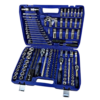
A dependable seized-bolt kit does not need to be premium-priced, but it must be strong enough for repeated use. Prioritise a deep and shallow six-point impact socket set, breaker bar, impact wrench, penetrating fluid, heat source, twist sockets, left-hand drill bits and extractors. Add a torque wrench for refitting, because a new bolt overtightened today can become the next seized bolt tomorrow.
Irish Tools Shop stocks affordable, reliable workshop equipment for the jobs that cannot wait, from impact socket sets and air tools to extraction tools and garage essentials. Choose tools that fit the work you do most, rather than buying one oversized solution for every fastener.
The key is knowing when to stop applying force. A bolt that has not moved after the correct socket, fluid and controlled leverage is telling you to change method. Reach for heat, impact or extraction tools early, and you will save parts, time and a great deal of workshop frustration.
