







A trolley jack gets a car off the ground. Good portable ramps get it up quickly, evenly and without filling the garage with lifting gear. The best portable car ramps are not simply the cheapest pair that claims a big weight rating. They need to suit your vehicle’s clearance, tyre width, working surface and the jobs you actually carry out.
For regular oil changes, inspections, underbody cleaning and front-end repairs, ramps are often the faster choice. Drive on, secure the vehicle and get to work. There is no repeated jacking at each corner, no balancing act on a small saddle and less equipment to store when space is tight. But the wrong ramp can scrape a low bumper, slide across smooth concrete or leave you with too little room underneath.
What Makes the Best Portable Car Ramps?
A usable pair of ramps should be strong, stable and easy to move. Portability is not only about low weight. It also means a shape that stacks neatly, a handle or carry point that does not dig into your hand, and dimensions that fit behind a workbench or in the boot of a van.
Start with four specifications: rated capacity, ramp angle, tyre track width and lifting height. Get those right before comparing colour, moulding style or promotional price.
- Rated capacity tells you the maximum vehicle weight the pair is designed to support. Choose a rating comfortably above your vehicle’s gross weight, not just its kerb weight.
- Ramp angle determines whether the front bumper, splitter or exhaust will clear the approach. A longer, lower incline is safer for low vehicles than a short, steep design.
- Tyre track width must accommodate the full tread with room to spare. Narrow channels can make positioning awkward, especially with wider performance tyres.
- Lift height controls how much working room you gain. More height is useful, but only if the ramp remains stable and your vehicle can safely climb it.
A pair rated at two tonnes may sound adequate for a small car, but capacity alone is not the full story. The rating should apply to the pair, be clearly stated by the manufacturer and match the intended use. For heavier SUVs, electric vehicles, 4x4s and loaded work vehicles, stepping up to a higher-capacity heavy-duty design is the sensible move.
Plastic, Steel or Rubber: Choose for the Job
Most home users will choose between reinforced plastic ramps and steel ramps. Both can be reliable when properly made and used on the correct surface. The right choice depends on the vehicles coming through the garage and how often the ramps will be used.
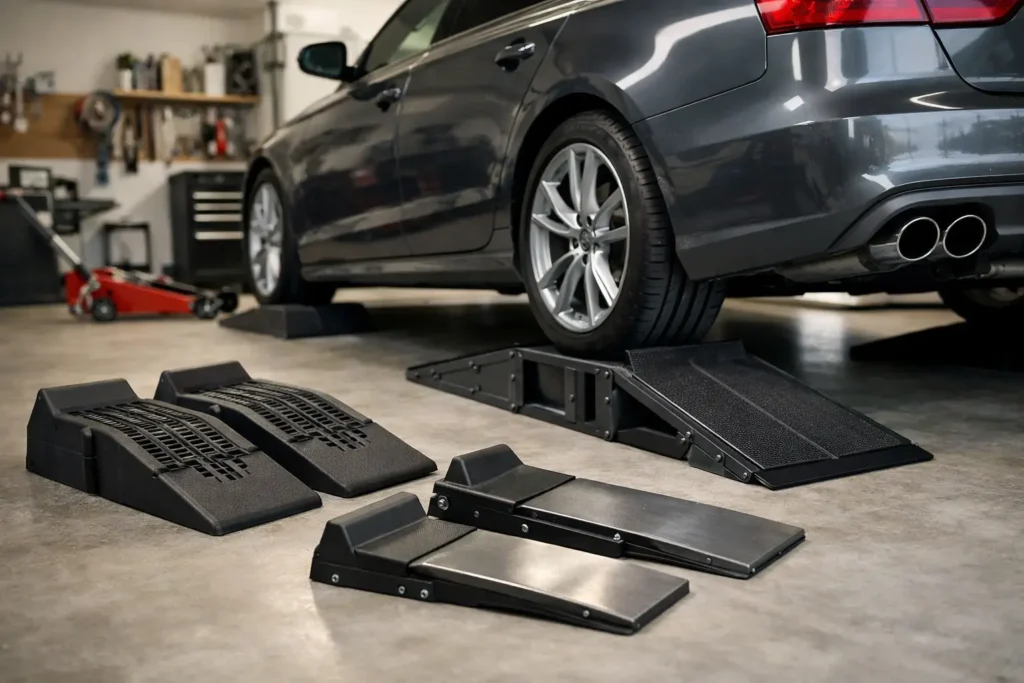
Reinforced plastic ramps
Moulded plastic ramps are popular because they are light, affordable and simple to store. A good set has ribbed construction, a broad footprint and a positive tyre stop at the top. They are ideal for routine servicing on cars and lighter vans, particularly where you need to carry them around rather than leave them in one bay.
Their limitation is that they are more dependent on condition and ground quality. Check for cracks, distortion, worn tread and damage around the stop before use. Do not leave them exposed to harsh sunlight for long periods, and avoid using a damaged plastic ramp because it still looks mostly intact.
Steel ramps
Steel ramps suit heavier workshop use and vehicles that demand a stronger, wider platform. They generally cope better with repeated loading, although they are heavier to handle and can take up more room. Look for welded construction, braced sections, a non-slip driving surface and feet that sit firmly on concrete.
Steel is not automatically safer because it is steel. Poor welds, narrow bases and smooth painted surfaces can still create problems. A well-designed, rated ramp with secure footing is what matters.
Rubber ramps and low-profile aids
Rubber ramps are usually used as approach extensions rather than the main lifting ramp. They help low cars climb onto steeper service ramps without scraping the bumper or undertray. For lowered vehicles, sports models and cars with long front overhangs, this extra gradual rise can be the difference between a practical setup and one that is unusable.
Match the Ramp to Your Vehicle Clearance
The most common buying mistake is choosing a ramp by capacity and forgetting clearance. A standard family hatchback may climb a conventional ramp without issue. A low saloon, modified car or vehicle with a front splitter may not get past the first third of the incline.
Measure from the ground to the lowest point at the front of the vehicle, then consider how far that point sits ahead of the front wheels. The lower and further forward it is, the gentler the ramp angle needs to be. A ramp with a high platform is no benefit if the vehicle cannot reach it.
Also consider the job. If you only need access to the oil filter, modest lift height may be enough. If you are working around the front suspension, removing an undertray or inspecting a long wheelbase van, extra height and a wider platform become more useful. Do not buy the tallest option by default. Higher ramps can be heavier, less convenient to store and unsuitable for lower cars.
Safe Setup Matters More Than Speed
Portable ramps are straightforward equipment, but they are not casual equipment. Use them on flat, solid ground – ideally clean concrete. Avoid loose gravel, wet paving, uneven tarmac and sloped driveways. The ramps need to stay put while the tyres climb, and the vehicle must remain level once it is raised.
Before driving on, inspect both ramps for cracks, bent sections, loose rubber feet, damaged stops or contamination from oil and grease. Position them straight with the wheels and check that they are spaced correctly. If a ramp shifts as the tyre contacts it, stop immediately and reset it rather than trying to correct the vehicle while moving.
Drive up slowly. A helper can guide you during the first few uses, especially if the tyre stop is hard to see from the driver’s seat. When the tyres reach the stop, apply the handbrake, select park or first gear as appropriate, switch off the engine and remove the key. Chock the wheels that remain on the ground before working underneath.
Never rely on ramps that are too narrow for the tyre, improvised timber blocks or ramps with no positive stop. Do not use ramps as a substitute for axle stands when the wheels need to come off, and never work beneath a vehicle supported only by a trolley jack. Different lifting jobs need different equipment.
Storage and Workshop Convenience
The best portable option is the one you will actually use. If ramps are too heavy to lift comfortably, they tend to stay in a corner while the trolley jack comes out again. If they are light but cannot support the vehicle safely, they are false economy.
For a home garage, choose a pair that nests or stacks together and can be carried without awkward edges. For mobile mechanics and tradespeople, compact dimensions matter just as much as capacity. A pair that fits securely in a van, does not rattle around and can be cleaned quickly after a job saves time on every call-out.
Think about the rest of your setup too. Ramps work well alongside wheel chocks, a creeper, drain pan, inspection lamp and basic service tools. For jobs that require wheel removal or access to brakes and suspension, a quality trolley jack and correctly rated axle stands are the better route. Irish Tools Shop stocks the workshop lifting equipment and everyday garage tools needed to build a safer, better-value setup without paying inflated trade-counter prices.
When Ramps Are the Better Buy
Choose portable car ramps when you mainly need quick access beneath the front or rear of a vehicle and want a stable, repeatable servicing position. They are particularly useful for oil and filter changes, visual inspections, exhaust checks, cleaning and underbody treatment. They also reduce the setup time that can make small maintenance jobs feel like a chore.
Choose a jack and axle stands instead when you need wheels off the ground, need independent access to each corner or are tackling brake, hub and suspension work. Many serious DIY garages benefit from owning both. Ramps handle fast servicing; jacks and stands handle repair work.
Buy for the heaviest vehicle you service regularly, check clearance before ordering and treat the stated rating as a safety limit, not a target. A properly matched pair of ramps turns routine maintenance into a quicker job, leaving more time for the work that actually needs your attention.
