






A jack that is cheap but wrong for the job costs more than money. It can slow down a brake job, damage a sill, leave you short on lifting height, or create an unsafe setup under a vehicle. In the floor jack vs trolley jack vs bottle jack comparison, the first point is simple: a floor jack and a trolley jack are usually the same tool. The real choice is generally a trolley jack versus a bottle jack.
For garages, mechanics and serious DIY users, that difference matters. One is built for fast, controlled vehicle lifting across a workshop floor. The other offers serious lifting force in a compact body, but with limits around access, starting height and stability. Choose by the vehicle, the ground conditions and the work you need to complete – not capacity alone.
Floor jack vs trolley jack: the same workshop tool
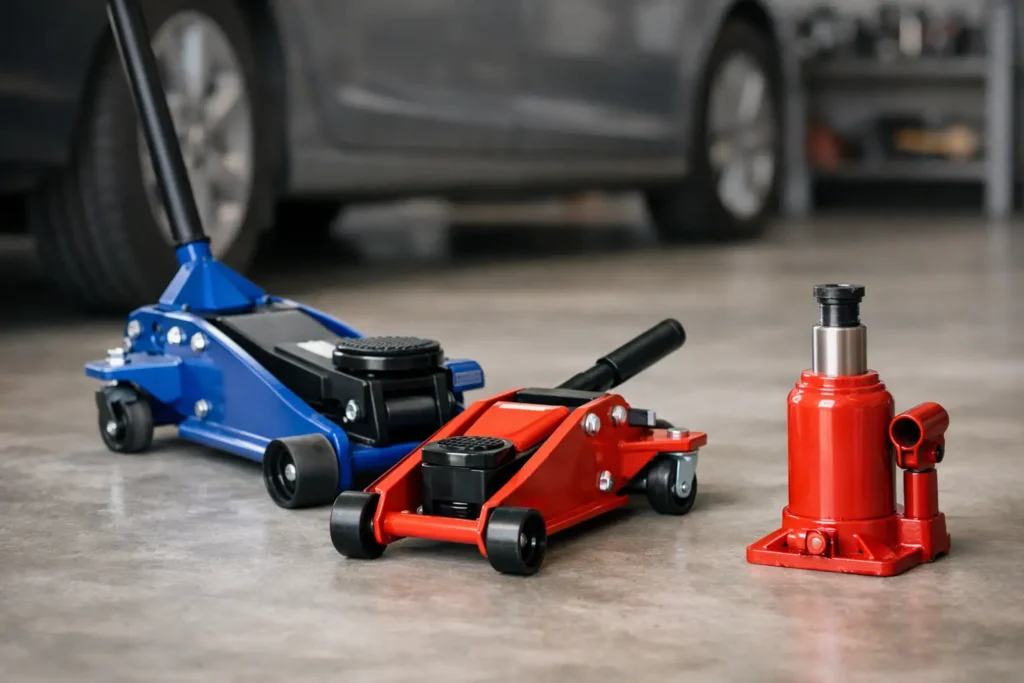
In Ireland and the UK, a trolley jack is the usual name for the wheeled hydraulic jack that rolls beneath a vehicle. In some catalogues and manuals, the same item is called a floor jack. Both names normally describe a low-profile hydraulic unit with a long handle, saddle and four wheels.
As the handle is pumped, hydraulic pressure raises the lifting arm and saddle. The wheels allow the jack to move slightly as the suspension and lifting arc change. That movement is not a design flaw. It helps the saddle stay correctly positioned under the designated jacking point instead of pulling sideways against it.
A trolley jack is the standard choice for tyre changes, brake work, suspension repairs, exhaust jobs and routine servicing. It is quick to position, offers a broad and stable base, and is easier to control than a compact jack when working regularly on cars and light commercial vehicles.
There are important differences between trolley jack models. A low-profile jack can reach under lowered cars or vehicles with limited clearance. A long-reach model is useful for deeper jacking points, especially on larger cars, vans and 4x4s. Heavy-duty 3-tonne models give workshop buyers more capacity headroom than a basic 2-tonne unit, although capacity does not automatically mean a higher lifting range.
Check the minimum height, maximum lift height and chassis length before buying. A jack with a 75 mm minimum height may suit a low car where a standard 135 mm unit simply will not fit. Conversely, a short low-profile jack can be less useful on a high van if it does not deliver enough final lift to remove the wheel comfortably.
What a bottle jack does differently
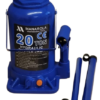
A bottle jack is a vertical hydraulic ram with a round or square base. It gets its name from its compact bottle-shaped body. Rather than using a long lifting arm, it lifts straight upwards through a piston and, on many models, an adjustable extension screw.
Its main advantage is lifting power in a small package. Bottle jacks are available in high capacities without the large footprint, long handle and storage space of a trolley jack. They are well suited to heavier vehicles, trailers, agricultural equipment, plant, recovery work and situations where the vehicle sits high enough to place the jack underneath.
That does not make a bottle jack the automatic answer for every heavy vehicle. Many bottle jacks have a relatively high closed height. If the axle, chassis point or sill is low to the ground, it may not fit at all. The compact base also demands firm, level support. On soft ground, gravel, tarmac on a hot day or uneven yard surfaces, a bottle jack can sink or lean. A strong load-spreading base plate may help on suitable outdoor jobs, but it does not turn unstable ground into a safe lifting area.
Bottle jacks are slower to reposition than trolley jacks and usually less convenient for frequent passenger-car servicing. Their vertical lift can also create side loading if the vehicle shifts and the jack is not kept square to the lifting point. Use only manufacturer-approved jacking points and make sure the jack is upright before pressure is applied.
Trolley jack vs bottle jack: the practical differences
For most car and van work in a garage, a trolley jack wins on speed, access and day-to-day stability. It slides into place, lifts predictably and has a long handle that keeps the operator clear of the vehicle. It is the sensible core lifting tool for a tyre bay, independent workshop or home garage.
A bottle jack wins where space and rated capacity are the priority. It fits in a recovery kit, service vehicle or tractor toolbox far more easily than a trolley jack. It can be a strong choice for a high-clearance 4×4, trailer or commercial vehicle, provided its height range matches the job and the ground is solid.
The key differences come down to these factors:
- Starting height: Trolley jacks, particularly low-profile models, suit cars with low sills and restricted underbody clearance. Bottle jacks often need more room below the vehicle.
- Lift height and reach: Trolley jacks lift through an arm, which can reach under a vehicle. Bottle jacks lift vertically and may need blocks or extensions to meet a high chassis point. Avoid improvised stacking.
- Stability: A trolley jack’s wide wheelbase is better suited to regular automotive work on a smooth concrete floor. A bottle jack has a smaller footprint and needs more care with positioning.
- Capacity and portability: Bottle jacks deliver high lifting ratings in a small unit. Trolley jacks are bulkier but faster and easier to use repeatedly.
A 2-tonne trolley jack is often adequate for one end of many cars, because it is lifting only part of the vehicle weight. However, vehicle weight distribution, lifting point position and added load all matter. For regular workshop use, a 3-tonne trolley jack provides useful margin and tends to have a stronger construction. Never assume a jack can safely lift a vehicle simply because the vehicle’s kerb weight looks lower than the rating.
Capacity is only one part of safe lifting
Rated capacity is the maximum load the jack is designed to lift under proper conditions. It is not permission to work beneath a vehicle supported by the jack. Hydraulic jacks are lifting devices, not support devices.
Once the vehicle is at working height, lower it securely onto correctly rated axle stands placed at approved support points. Keep the trolley jack or bottle jack in position as an additional safeguard where practical, but do not rely on hydraulic pressure alone. A gradual loss of pressure, a failed seal or an accidental release can turn a simple repair into a serious accident.
Before lifting, work on level, hard ground and apply the handbrake. Put manual vehicles in gear or automatics in Park. Chock the wheels that remain on the ground, particularly when lifting one end of the vehicle. Confirm the saddle contacts a solid jacking point, not a plastic undertray, floor pan, brake line, suspension arm or rust-weakened sill.
Take a moment to inspect the tool as well. A damaged saddle, bent handle, leaking ram, cracked wheel, loose release valve or visibly distorted body is reason to remove a jack from service. Clean the saddle and pivot areas, store the jack upright where possible, and follow its maintenance instructions. Heavy workshop equipment earns its keep only when it is kept fit for work.
Which jack should you buy?
Buy a trolley jack if you service cars or vans regularly, work mainly on a concrete garage floor, or need one dependable jack for brakes, wheels and underbody repairs. Prioritise a low minimum height for lowered vehicles, sufficient maximum lift for your tallest vehicle, and a realistic capacity for the work. A heavy-duty trolley jack is a practical investment when it will be used every day.
Buy a bottle jack if you need compact high-capacity lifting for trailers, 4x4s, commercial vehicles, farm equipment or roadside use. Measure the clearance beneath the intended lifting point with the vehicle at rest, then check the jack’s closed height and maximum extension. If it cannot fit at the start or reach safely at full lift, its capacity is irrelevant.
For a mixed workshop, owning both makes sense. A quality trolley jack handles the majority of car work quickly, while a bottle jack provides a compact high-capacity option for taller and heavier jobs. Add correctly rated axle stands and wheel chocks, and you have a lifting setup that is safer, faster and ready when the next vehicle arrives.
