






A fastener that looks almost right can cost you far more than a socket set. Use the wrong profile on a tight caliper carrier bolt, engine fastener or interior fixing and it can round out before the job has even started. If you are trying to understand the difference between spline torx and hex socket set options, the simple answer is that each is made for a different fastener shape. They are not interchangeable, even when they appear close at first glance.
For mechanics, garage owners and serious DIY users, having the correct bit socket on hand means faster work, cleaner results and fewer damaged fixings. Here is what separates spline, Torx and hex sets, where each type is used and what to buy for a working toolbox.
Spline, Torx and hex socket sets compared
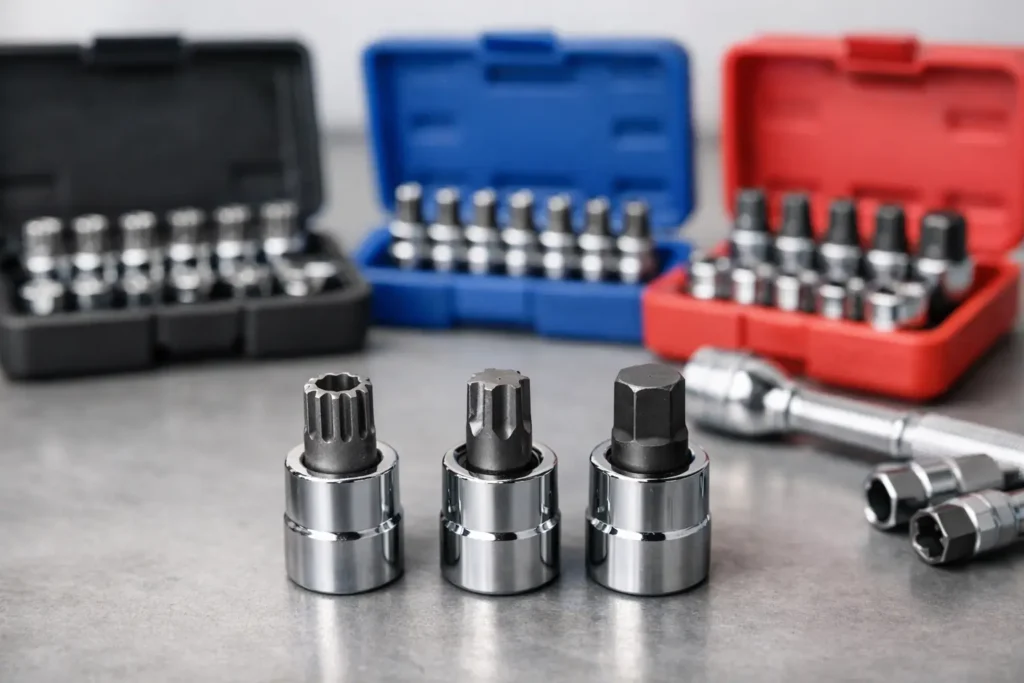
Hex, Torx and spline refer to the shape of the drive engagement between the tool and the fastener. A hex bit has six straight sides. A Torx bit has a six-lobed star profile. A spline bit normally has a 12-point, multi-tooth profile that is commonly found on European vehicle components.
The correct tool fills the fastener recess closely, spreading force across more of the contact area. That matters when bolts are corroded, factory-tightened or being removed with a breaker bar. A loose-fitting bit concentrates pressure at the edges, which is how bolts become rounded and tools get damaged.
There is one point worth checking carefully when shopping: the word spline is used in more than one way. In automotive tool kits, it usually means an internal multi-spline bit, also called XZN or triple-square in many applications. In ordinary socket descriptions, a spline or bi-hex socket can also describe a 12-point socket for turning an external bolt head or nut. Always look at the product photo, drive profile and listed sizes rather than relying on the word alone.
Hex socket sets: the standard for Allen fasteners
A hex socket bit, often called an Allen bit socket, has six flat sides and fits a recessed hex fastener. These are common across cars, motorcycles, machinery, bicycles, furniture and general workshop equipment. You will regularly find them on brake components, sump plugs, suspension fittings, gearbox parts and interior trim fittings.
The main advantage of a hex drive is simplicity. It is widely available in both metric and imperial sizes, easy to identify and reliable when the exact size is used. A proper hex bit seats fully against the bottom of the recess and gives solid contact across all six flats.
Hex bolts are also among the easiest to damage through poor tool choice. A metric 6 mm bit may feel as if it fits an imperial fastener, or vice versa, but a small amount of movement is enough to chew up the corners under load. Never force an undersized hex key or a worn ball-end key into a stubborn fastener. A straight, high-quality hex bit socket provides much better control.
For regular automotive work, common metric hex bit sizes from 3 mm to 12 mm cover a lot of ground. Larger sizes are useful for drivetrain, hub and suspension jobs, while smaller bits are valuable for trim and engine-bay work.
Torx socket sets: high grip for modern vehicles
Torx uses six rounded lobes rather than six straight flats. The design gives the bit more engagement with the fastener, allowing manufacturers to apply higher torque with less chance of cam-out. Cam-out is when the bit is pushed out of the fastener under force, damaging both parts in the process.
That is why Torx fittings are everywhere on modern cars and vans. You may find them on engine covers, door cards, dashboard fittings, seat rails, brake discs, intake components, light units and electronic modules. They are also common on power tools and appliances.
Torx sizes are marked with a T number, such as T20, T25, T30, T40 and T50. The number is not a measurement in millimetres, so guessing by eye is risky. A T30 may enter a T40 recess slightly, but it will not support the load correctly. Start with the largest bit that fully seats without force.
Standard Torx and security Torx must also be separated. Security Torx fasteners have a pin in the centre of the recess. They need a tamper-proof Torx bit with a small hole in its centre. A standard Torx bit will not fit over the pin, and drilling or levering the fastener is a poor substitute for carrying the right set.
You may also encounter Torx Plus. It looks similar to standard Torx but has a different lobe geometry and is designed for even higher torque. Do not assume a standard Torx bit is suitable for Torx Plus fittings, particularly on critical engine or transmission work.
Spline or XZN socket sets: common on European drivetrains
Spline bit sockets have a 12-point internal profile with narrow teeth. They are designed for high-torque use and are particularly common on Volkswagen Group, Audi, BMW, Mercedes-Benz and other European vehicles. Typical jobs include cylinder head bolts, driveshaft bolts, flywheel bolts, seat mounting bolts and brake carrier bolts.
Spline is often confused with Torx because both look like star-shaped profiles. The difference is clear when the bit is placed next to the fitting. Torx has six larger rounded lobes. XZN spline has 12 finer points and appears more densely toothed. A Torx bit will not correctly drive an XZN fastener, even if it appears to enter the recess.
Spline sizes are usually listed as M4, M5, M6, M8, M10, M12, M14, M16 and M18. Again, the M marking relates to the spline profile size, not the thread size of the bolt. Check the vehicle repair information where possible, especially for safety-critical or torque-to-yield fasteners.
Because spline fittings are often used where torque is high, bit quality matters. A cheap or poorly machined bit can twist, spread or crack, then damage the bolt at the same time. For workshop use, choose hardened, accurately machined bit sockets with a strong socket base and clear size markings.
US PRO 9 Piece 3/8″ Drive European Style Impact Spline Bit Sockets | 4mm – 14mm
Can you use one type in place of another?
In short, no. A Torx bit should not be used in a spline fastener, a spline bit should not be hammered into a Torx recess, and neither should replace a correctly sized hex bit. The profiles are engineered differently, so any apparent fit is usually contact at only a few points.
There are occasional emergency situations where an alternative bit can help remove an already damaged, non-critical fastener, but that is extraction work rather than normal servicing. It is not a method to rely on for brakes, steering, suspension, engine internals or driveline components.
The same rule applies to external socket profiles. A 12-point socket may fit a six-point external hex bolt, but a six-point socket gives broader contact on the flats and is normally the safer choice for seized bolts. Save 12-point sockets for 12-point heads or situations where access requires them.
Choosing the right set for your workshop
The best choice depends on the vehicles and jobs you handle. A general DIY toolbox should start with a metric hex bit socket set and a broad Torx set, including security Torx. These cover a large share of everyday repairs, maintenance and assembly work.
If you work on German and European vehicles, an XZN spline set is not optional for long. It is one of those sets that can sit untouched for weeks, then become the only tool that will remove a driveshaft or seat bolt correctly. Buying it before the job saves delays and avoids damaging expensive components.
For a garage or mobile mechanic, it makes sense to carry all three profiles in 1/4 inch, 3/8 inch and 1/2 inch drive where appropriate. Smaller drive sizes suit trim, electrical and confined engine-bay work. Larger drive bit sockets are needed when torque rises on suspension, brakes and drivetrain repairs.
Pay attention to material and intended use. Chrome vanadium sets are suitable for hand ratchets and general workshop use. If the bits will be used with an impact wrench, buy impact-rated sockets and bits, usually made from chrome molybdenum steel. Never use ordinary polished hand sockets on an impact gun. They can crack without warning.
A good set should also have a durable case, engraved or stamped markings and a useful spread of sizes instead of filler pieces. Irish Tools Shop customers often need tools that can go straight into a working garage, so buying a complete, clearly organised set is usually better value than repeatedly replacing single missing bits.
Check fit before applying force
Before putting a ratchet, breaker bar or impact wrench on the fastener, clean dirt, paint and corrosion from the recess. Push the chosen bit fully home and check that it sits square. If it rocks, bottoms out too early or will not enter fully, stop and identify the fitting again.
That ten-second check is cheaper than drilling out a rounded bolt, replacing a damaged bracket or losing time halfway through a job. Keep hex, Torx and spline bit sockets together in labelled cases, and the right profile will be ready when the work gets serious.
