







Manarola 4 Ton 2 Post Car Lift With 12 Months Warranty | Single Phase
A two-post lift can turn a cramped home workshop into a proper working bay. It gives clear access to brakes, suspension, exhausts, gearboxes and underbody servicing without spending every job crawling under axle stands. But the best two post lift for home garage use is not simply the cheapest model with the biggest capacity label. It must suit the vehicles you work on, the slab beneath it, the ceiling above it and the electrics available in the building.
For serious DIY mechanics, a correctly specified lift is one of the best-value workshop upgrades available. Buy the wrong one, or install it on an unsuitable floor, and a bargain soon becomes an expensive problem. Use these checks to choose equipment that is affordable, reliable and safe to use.
Start with capacity, but do not stop there
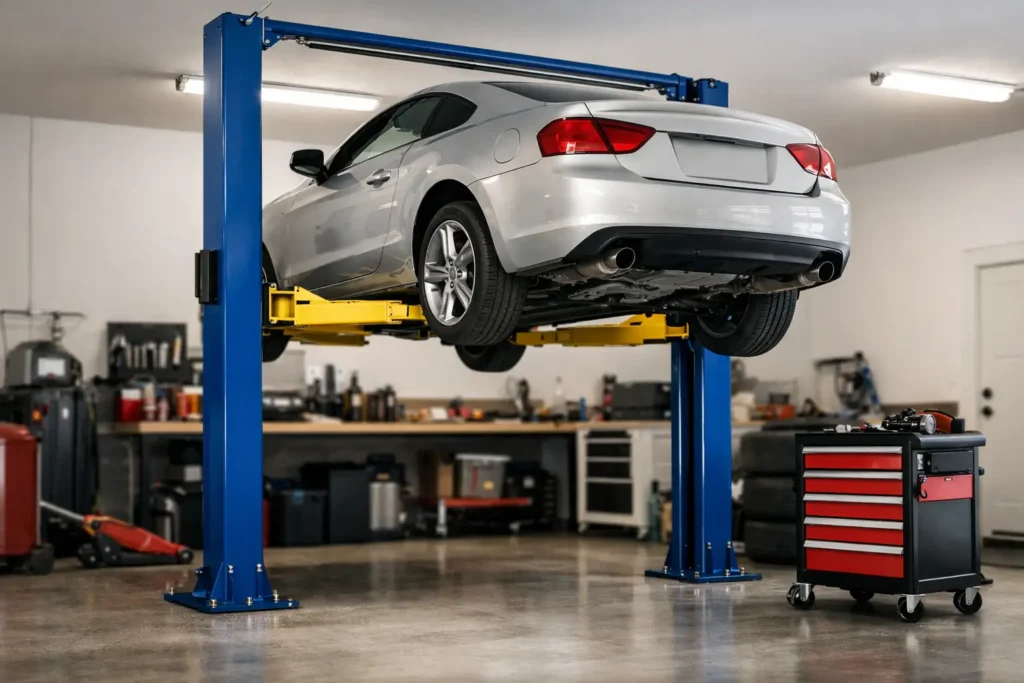
A 4-tonne two-post lift is the sensible all-round choice for most home garages. It covers the vast majority of cars, estates, SUVs and light commercial vehicles while leaving useful headroom over the vehicle’s actual kerb weight. A 2.5-tonne or 3-tonne lift may look cheaper, but it can quickly become restrictive once you add a heavier diesel SUV, a pick-up or a work van to the job list.
Capacity is not a licence to lift anything that weighs less than the headline figure. The vehicle must be positioned correctly, its lifting points must be sound, and its centre of gravity must remain within the lift’s safe working area. Long-wheelbase vehicles and vans can be awkward even when they are comfortably below the rated load.
Check the lifting arm design as carefully as the capacity. Symmetrical lifts place the vehicle centrally between the columns. They are straightforward and usually offer strong, balanced support, but can require more space in front and behind. Asymmetrical lifts position the vehicle slightly rearward, which can improve door clearance and make it easier to get in and out in a tighter bay. For a home garage where every inch matters, that difference can be worthwhile.
Manarola 4 Ton 2 Post Car Lift With Electric Lock Release / Auto Lock | Single Phase
Measure the garage before comparing two-post lifts
Many buyers measure the car and overlook the building. That is backwards. A lift must fit the garage with enough room to work safely around it, open doors and raise the vehicle fully.
Begin with internal ceiling height. A standard full-rise two-post lift commonly needs around 3.5 metres of clear height, although the exact requirement depends on the model, overhead beam and maximum lift height. Measure at the lowest point, not just at the highest point of a pitched roof. Steel beams, fluorescent fittings, roller-door tracks and roof braces all count.
A low-ceiling or baseplate lift can be the answer where overhead clearance is limited. These models route the equalisation cables across the floor rather than through an overhead bar. They can make a lift possible in a lower building, but the floor cable is a trip and trolley obstruction. For a garage used daily, an overhead-clear design is usually neater if the ceiling allows it.
You also need adequate bay width. The columns must be positioned to the manufacturer’s dimensions, with room to drive in without clipping mirrors and space to walk around the vehicle. Do not assume a garage that accepts a car will accept a lift. The columns, arms and door swing take up far more usable width than a parked vehicle alone.
Finally, check the height of the tallest vehicle you expect to raise. A high-roof van may fit through the garage door but still meet the roof before it reaches a useful working height. If you service mixed vehicles, choose the lift around the largest realistic job, not the small hatchback currently on the drive.
The concrete slab decides whether the lift is safe
A two-post lift transfers significant load through two columns and their anchor bolts. The concrete is not a minor installation detail. It is part of the lifting system.
Most lifts require a sound, level reinforced concrete slab, often at least 100 mm to 150 mm thick, though the required thickness, concrete strength and anchor specification vary by manufacturer. Follow the lift’s installation manual exactly. A thicker slab does not automatically make an unsuitable site acceptable if the concrete is cracked, weak, sloping or laid over uncertain ground.
Do not install a lift over expansion joints, drainage channels, inspection pits or areas where underfloor heating pipes may run. Fresh concrete also needs time to cure fully before anchors are fitted. If you do not know the slab depth or condition, arrange a professional assessment before ordering. A core sample is cheaper than repairing failed concrete or replacing a damaged vehicle.
Anchor bolts are safety-critical components, not optional extras to substitute with whatever is on the shelf. Use the supplied or specified anchors, tighten them to the required torque and inspect them as part of routine maintenance. If the manufacturer’s instructions call for professional installation, treat that as a requirement rather than a suggestion.
Manarola 3 Ton Mid Rise Scissor Lift – Electric Release | Single Phase
Choose power and hydraulics that suit the site
For home users, a single-phase 230V lift is often the simplest option because it can work from a suitable dedicated supply. It avoids the need for three-phase power, which is not available in many domestic garages. That said, a lift draws substantial current, so it should not be plugged into an overloaded extension lead beside a compressor, welder and heater.
Ask a qualified electrician to confirm the supply, circuit protection, earthing and isolator arrangement. This is particularly relevant in older garages, detached workshops and converted agricultural buildings. A correct electrical installation protects the motor, reduces nuisance tripping and makes the lift safer to isolate before maintenance.
Three-phase models can offer smooth operation and are a practical choice in established workshops with the supply already in place. For occasional home use, however, the extra installation cost can outweigh the benefit. The right answer depends on the building, not on which motor specification sounds more professional.
Hydraulic lifting is proven and dependable, but inspect the quality of the working parts. Look for protected hoses, clear hydraulic routing, reliable lowering controls, mechanical safety locks and readily available replacement pads, cables and seals. A lift is a long-term workshop purchase. Being able to obtain wear parts matters more than saving a small amount on day one.
What makes the best two post lift for a home garage?
The best two post lift for home garage buyers is normally a 4-tonne, 230V model with adjustable arms, mechanical locking positions and dimensions that genuinely match the building. It should be supplied with clear technical information, installation requirements and a proper warranty. Cheap lifting equipment with vague specifications is false economy.
Focus on the details that affect daily use. Adjustable screw pads or stackable adapters help reach factory jacking points on cars with different ride heights. A low pad height is useful for lowered cars. A wide drive-through clearance helps with larger vehicles, while a good lifting height saves your back during underbody work.
Do not confuse a two-post lift with a parking lift. Two-post designs are built for access to wheels and underbody components, making them ideal for repair work. Four-post lifts can be easier to drive onto and are excellent for storage or wheel-alignment setups, but they take more floor space and can obstruct access beneath the tyres. If your main jobs are servicing, brakes and repairs, two posts are usually the more useful layout.
Manarola 3 Ton Low Profile Full Rise Scissor Lift – Pneumatic Release | Single Phase
Installation and safe operating habits
Even a high-quality lift needs disciplined use. Read the supplied manual, use the approved lifting points for each vehicle and raise the vehicle a short distance first. Pause, check that all four pads are seated securely, then continue lifting. Once at working height, confirm that the mechanical safety locks are engaged before going underneath.
Keep the lifting area clear. Do not allow anyone to sit in the vehicle while it is raised, do not work beneath a lift that has not locked, and do not use the arms to support a vehicle with serious structural corrosion around its jacking points. A two-post lift can safely carry serious weight, but only when the vehicle and lift are correctly matched.
Routine checks should cover hydraulic leaks, hose damage, cable condition, arm restraints, lift pads, anchor bolts and lock operation. Clean the floor around the columns, because oil and loose tools create avoidable hazards when positioning a vehicle. Any unusual noise, uneven lifting or damaged safety component is a stop-work issue until it is checked and repaired.
Buy for the work you will do next year
The cheapest lift is rarely the best value if it limits the vehicles you can service or leaves no margin for safe installation. Set a realistic budget for the lift, electrical work, slab checks and fitting rather than spending every euro on the unit itself.
For buyers across Ireland and the UK, delivery access also deserves attention. These are heavy workshop machines, often delivered by pallet. Confirm that the delivery vehicle can reach the property and arrange suitable unloading equipment or assistance. Irish Tools Shop focuses on affordable professional-grade garage equipment, but the correct specification and installation plan should come before any purchase.
Choose a lift with honest capacity, suitable dimensions, safety locks, available parts and support you can rely on. Get those fundamentals right and the garage becomes faster to work in, safer under load and ready for far more than the occasional oil change.
Manarola 4 Ton 2 Post Car Lift With Electric Lock Release / Auto Lock | Single Phase
