







Getting the valve timing wrong on a Volvo diesel is not a minor inconvenience. One incorrect position during a belt job can turn a planned service into bent valves, damaged pistons and an expensive bay blockage. A Volvo timing tool kit for 2.0 litre diesel engines D4204T is built to prevent that risk by holding the engine at its specified timing positions while the belt and related components are replaced.
For a working garage, the right kit saves time as well as preventing damage. For a serious home mechanic, it removes the guesswork that marks, paint pens and improvised pins cannot safely cover. The key is buying a kit that matches the exact engine application and then using it as part of a proper timing-belt procedure, not as a substitute for the manufacturer’s repair data.
What a D4204T timing tool kit needs to do
The D4204T designation is associated with Volvo 2.0 litre four-cylinder diesel applications. However, an engine code alone is not always enough to confirm every detail of the timing service. Model year, power output, vehicle platform and engine suffix can affect the required locking arrangement. Check the vehicle registration, VIN data and workshop information before ordering or stripping the engine down.
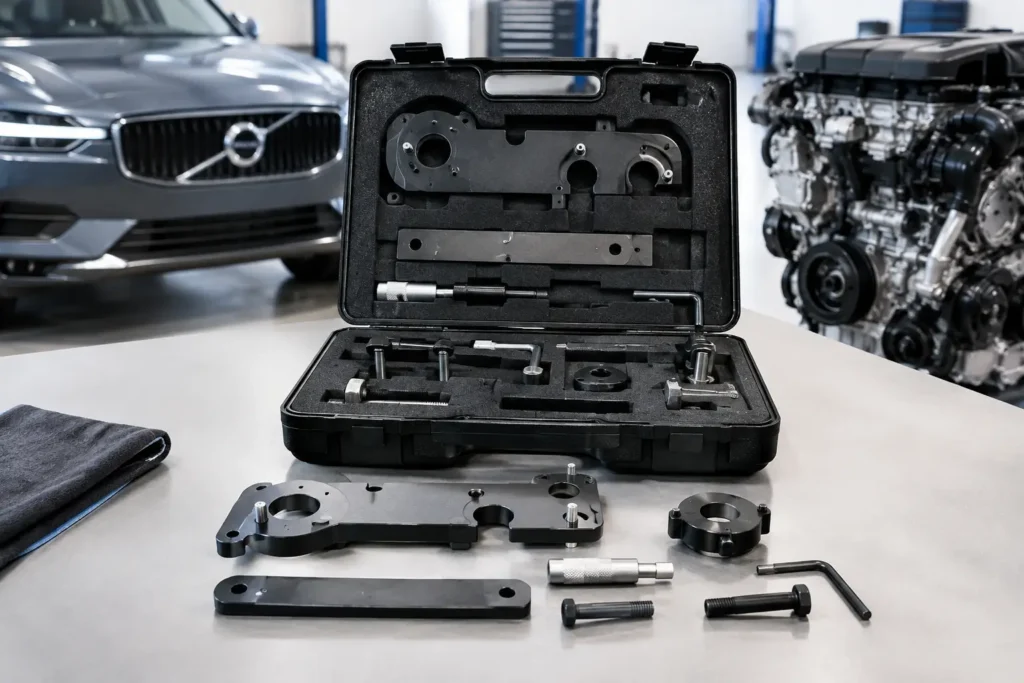
A correctly specified timing kit normally provides the dedicated tools needed to establish and retain the engine’s timing position. Depending on the kit design and application, this may include a crankshaft locking pin, camshaft alignment or locking plate, tensioner retaining pin and setting tools for associated pulleys. These are precision location tools, not general workshop pins. Correct diameter, length and engagement point matter.
The purpose is straightforward: the crankshaft and camshafts must remain in their prescribed positions while belt tension is released, the old belt is removed and the new components are fitted. A proper tool kit lets the technician set that relationship accurately before tensioning and rotating the engine by hand for verification.
Why universal tools are a false economy
A universal timing set can be useful for broad workshop work, but it is not automatically suitable for a D4204T diesel. A near-fit locking pin can sit in the wrong bore or fail to locate fully. A plate that looks close enough may not hold the camshaft in the correct position. The result can be a timing error that is only discovered once the engine is turned or started.
That is why a vehicle-specific or engine-family-specific Volvo timing tool kit for 2.0 litre diesel engines D4204T is the sensible purchase. It gives the workshop a repeatable method instead of relying on judgement. When several Volvos are serviced each month, that repeatability protects labour time, customer vehicles and the garage’s reputation.
Price still matters. There is no need to pay inflated dealer-tool prices for equipment that will be used carefully and correctly in a professional setting. Affordable professional-grade tooling is the target: accurately machined, clearly identified and supplied in a case that keeps the components together between jobs.
Confirm fitment before you buy
The most useful timing kit is the one that fits the vehicle on the ramp. Before choosing one, establish the full vehicle and engine details rather than working from a broad description such as Volvo 2.0 diesel. Record the registration, VIN, model year, engine code and power version. If the vehicle has had an engine replacement, verify the code stamped or labelled on the fitted unit too.
Then compare those details against the kit’s listed applications and OE tool references where available. Pay attention to wording such as engine code range, production date and compatible Volvo models. Do not assume that a kit covering a similar D4 or VEA diesel necessarily covers every D4204T version.
It is also worth checking what is included. Some kits are intended for timing-belt locking only, while others contain extra tools required for crank pulley work, tensioner positioning or related engine service operations. Buying a cheaper incomplete set can delay the job when one essential tool is missing.
For a garage that handles varied work, keep the kit identification with the job card or booking record. It makes it easier for the next technician to confirm what was used and reduces the chance of tools being returned to the wrong timing set.
Use the kit with the complete service parts
Timing tools hold positions. They do not replace worn components. If the timing belt is due, a proper service should be assessed as a complete operation. The belt, tensioner, idler pulleys and any specified single-use bolts should be checked against the repair procedure. On applications where the water pump is driven by the timing belt or accessed during the job, replacing it at the same time is often the practical choice.
The trade-off is simple. Reusing an ageing tensioner or pulley may reduce the invoice today, but it can mean repeating a labour-heavy job if that component fails later. On a diesel engine with tight packaging and serious consequences for timing failure, fitting quality service parts while access is available is usually better value.
Before dismantling, inspect for oil leaks around the covers, crank seal area and camshaft area. A new belt should not be installed into an oil-contaminated environment. Also check the auxiliary drive system, because damaged auxiliary belts, tensioners or pulleys can create further problems after the timing work is complete.
A disciplined workshop approach
The vehicle must be supported safely, with the battery isolated where required by the procedure and the engine properly supported if an engine mounting needs to be removed. Good access is not a luxury on timing work. It reduces the chance of forcing a cover, damaging a connector or losing a fastener in a confined engine bay.
Bring the engine to the specified setting using the correct direction of rotation. Fit each locking tool exactly as described in the relevant repair data. Never force a locking pin into place. If it does not insert cleanly, stop and recheck the engine position rather than rotating components against installed locks.
Once the belt is removed, avoid turning the crankshaft or camshafts independently unless the workshop procedure specifically instructs it. On interference engines, free movement can put valves and pistons into conflict. Fit the new components in the stated order, set belt tension with the correct tool and torque fasteners to the specified values using a calibrated torque wrench.
After removing the locking tools, rotate the engine manually through the required number of revolutions. Return it to the timing position and confirm that the locking tools re-enter as intended. This verification stage is where a careful technician catches a problem before reassembly. If alignment is not correct, do not attempt to compensate with force or assumptions. Reset the job and find the cause.
Tool quality, storage and workshop value
Timing tools do not need to look impressive on a wall. They need to locate accurately, resist workshop handling and remain identifiable. Look for cleanly machined contact areas, durable construction and a fitted storage case. Marked or etched tools are quicker to select than an unlabelled collection of pins and plates.
Inspect the kit before and after use. A bent pin, worn locating edge or damaged thread can compromise accuracy. Keep it clean and dry, and return every component to its allocated position in the case. This matters especially in busy garages where timing equipment is shared between technicians.
For independent workshops and capable DIY users, the cost of the correct kit is small beside the potential cost of timing damage. Irish Tools Shop focuses on affordable, reliable workshop equipment because essential tools should be available when the job demands them, not held back by premium pricing or slow sourcing.
A D4204T timing job deserves measured work, correct service information and a properly matched locking kit. Put those three things in place before the covers come off, and the job stays where it belongs: a controlled service repair rather than a costly engine rebuild.
