






A sump plug stripped in an aluminium pan, a warped brake disc or wheel bolts tightened unevenly can turn a routine job into an expensive comeback. Choosing torque wrenches properly means matching the tool to the fixing, the manufacturer’s specification and the work you carry out most often – not simply buying the highest torque figure on the box.
For mechanics, workshop owners and serious DIY users, a torque wrench is a control tool. It helps you apply the specified clamping force to critical fasteners without guessing. That matters on cylinder heads, brake calipers, suspension components, wheel nuts and engine assemblies, where both over-tightening and under-tightening carry real risks.
Torque Wrench 40-220Nm 1/2″ Square Drive Reversible 72T Ratchet Calibrated
Choosing Torque Wrenches Starts With the Torque Range
The stated range is the first specification to check. A torque wrench is most dependable through the central part of its working range. If a fastening specification is close to the minimum or maximum setting, choose a different wrench rather than forcing one tool to cover every job.
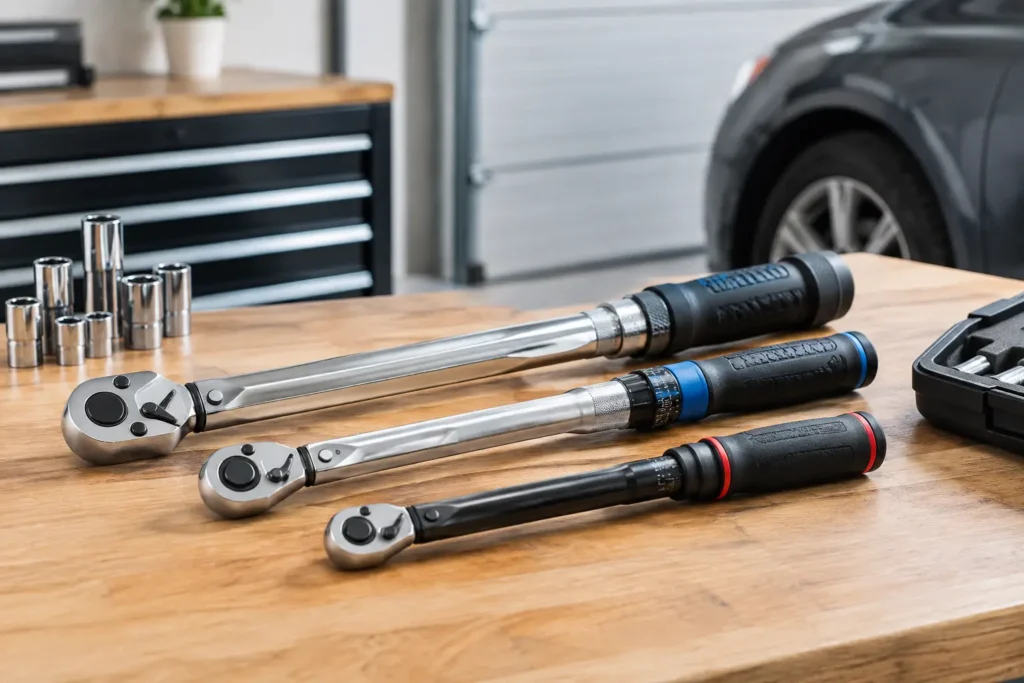
For general vehicle work, a 3/8in drive wrench with a range around 10-80 Nm or 20-110 Nm covers many medium-sized fasteners. This is useful for spark plugs, brake components, smaller suspension bolts and engine work. A 1/2in drive model, commonly covering roughly 40-200 Nm or 60-300 Nm, is the garage staple for wheel bolts, hubs, larger suspension fasteners and heavier vehicle repairs.
A small 1/4in drive torque wrench is worth having where low settings matter. Modern engines, motorcycle work, inlet components and smaller alloy threads can require figures that a large 1/2in wrench cannot measure accurately. At the other end, commercial and agricultural work may demand a 3/4in drive wrench for high-torque fasteners. Bigger is not automatically better. It is only better when the specified torque requires it.
Do not confuse a wrench’s maximum capacity with the torque you should apply. The correct setting always comes from the vehicle repair data, component instructions or fastener manufacturer. A wheel bolt tightened to the right value with a 1/2in wrench is safer than one tightened by feel with an impact gun.
US PRO 1/2″ Drive Bi-Directional Torque Wrench 40 – 220Nm | With Calibrated Certificate
Select the Right Drive Size for the Job
Drive size affects socket compatibility, access and the torque range the wrench is designed to handle. Most working garages benefit from more than one drive size because no single model is ideal for every fixing.
A 1/4in drive is compact and suited to low-torque precision tasks. A 3/8in drive offers excellent versatility in engine bays and brake work. The 1/2in drive is the best all-round choice for many automotive buyers because it accepts common impact and hand sockets while handling the higher settings used on wheels and suspension.
It can be tempting to use adaptors to make one wrench fit every socket. An adaptor is useful when access demands it, but it can add length, affect the effective lever arm and encourage unsuitable use. For daily workshop work, buying the correct drive size is the cleaner, safer solution.
Also consider head profile and ratchet direction. A slim, reversible ratchet head helps in tight engine bays, while a longer handle provides leverage on higher settings. The trade-off is access: a long 1/2in wrench is excellent beside a wheel hub but can be awkward under a dashboard or around compact engine components.
27 Piece 3/8″ Drive Torque Wrench 5 – 50NM With Sockets, Spark Plug Sockets & Extension Bars
Click, Beam or Digital: Which Type Suits You?
The click-type torque wrench is the practical choice for most garages. Set the required torque, tighten steadily and stop when the mechanism clicks. It is quick to use, straightforward to read and available at affordable professional-grade prices. It is not a substitute for attention, though. Keep pulling after the click and you can exceed the setting.
Beam-style wrenches use a pointer and scale. They are simple, durable and useful for checking work, but the reading can be harder to see in confined spaces. They demand a clear line of sight and a steady hand, which makes them less convenient for fast-paced servicing.
Digital torque wrenches provide a screen, audible warning and often a vibration alert as the target is reached. Some record readings or offer angle-tightening modes. These features are valuable for engine building and repeatable workshop procedures, but they come at a higher cost and require batteries. For routine wheel, brake and suspension jobs, a quality click wrench is often the best-value purchase.
Angle tightening deserves separate attention. Many modern engines use torque-plus-angle instructions, especially for head bolts and stretch bolts. A basic torque wrench alone does not measure the final angle. You will need an angle gauge or a compatible digital tool. Do not replace an angle stage with extra torque unless the repair procedure specifically permits it.
DSD 32 Piece 1/4″, 3/8″ & 1/2″ Torque Wrench Set With Drive Bits, Spark Plug & Sockets
Accuracy Is Worth More Than a Big Number on the Dial
A torque wrench should state its accuracy, commonly expressed as plus or minus a percentage. A specification of ±4% is typical for a good click-type wrench. Accuracy is useful only when the tool is used correctly and treated properly.
Before tightening, make sure the thread condition matches the manufacturer’s instruction. A dry torque figure applied to lubricated threads can produce substantially more clamping force than intended. Clean threads, correct washers, the specified lubricant or thread-locking compound, and an undamaged fastener all affect the final result.
Apply force through the handle grip, not halfway up the shaft or at the very end for extra leverage. Pull smoothly and squarely. Jerking the wrench, using it as a breaker bar or extending it with a pipe can damage the mechanism and makes the applied torque unreliable. Crack tight fasteners loose with a breaker bar first, then use the torque wrench only for final tightening.
For wheel bolts, tighten in the correct sequence, usually a criss-cross pattern, in stages. Bring each bolt up evenly before the final pass at the specified setting. This seats the wheel properly and avoids loading one fixing heavily while the others remain loose.
Features That Matter in a Working Garage
When comparing models, prioritise clear settings, a positive locking mechanism and easy-to-read scales. A handle that locks firmly helps prevent the setting changing while you work. Marked Nm scales are essential for most UK and Irish vehicle data, while ft-lb markings are useful when working from older manuals or equipment specifications.
A supplied storage case is more than a nice extra. It protects the adjustment mechanism from knocks, dirt and moisture when the wrench is not in use. Look for a reliable ratchet head, solid steel construction and a sensible warranty. Cheap tools can be good value, but a torque wrench is not the place to accept vague specifications or poorly marked scales.
For a busy workshop, buying two or three correctly ranged torque wrenches usually delivers better results than relying on one oversized unit. A low-range 1/4in or 3/8in model plus a 1/2in wheel and suspension wrench covers the bulk of automotive servicing without compromise.
Storage and Calibration Keep It Reliable
After use, return an adjustable click torque wrench to its lowest marked setting, unless the manufacturer states otherwise. Do not wind it below the minimum scale. Store it clean and dry in its case, and avoid dropping it or leaving it in a damp van overnight.
Calibration intervals depend on use. A wrench used every day in a professional garage should be checked more often than one used for occasional home servicing. If it has been dropped, overloaded, stored badly or feels inconsistent, remove it from critical work until it can be tested. Regular calibration gives you confidence that the figure on the handle is the torque reaching the fastener.
Irish Tools Shop customers often need tools that work hard without carrying premium distributor pricing. The right approach is simple: buy a dependable wrench in the range you actually use, protect it between jobs and follow the specified torque every time. That small investment can prevent damaged parts, repeat repairs and safety issues long after the vehicle leaves the ramp.
